
SMT Intelligent Reel Storage Rack for Pick-to-Light Kitting by Southern Machinery
For EMS and PCB assembly teams, SMT material handling can quietly consume more time than the placement process itself. Southern Machinery's SMT Intelligent Reel Storage Rack is designed to reduce manual searching, wrong-part picking, and inventory blind spots by assigning each reel a unique ID, guiding operators with LED pick-to-light, and updating stock movement in real time. The system supports line-side kitting, MES or ERP job-list workflows, traceability, and smarter warehouse control for high-mix SMT production. For factories evaluating labor reduction, OEE improvement, and more stable material flow, this rack can become a practical bridge between component storage and the full SMT assembly line.
Jul 26, 2026 · Updated Jul 26, 2026 · Southern Machinery
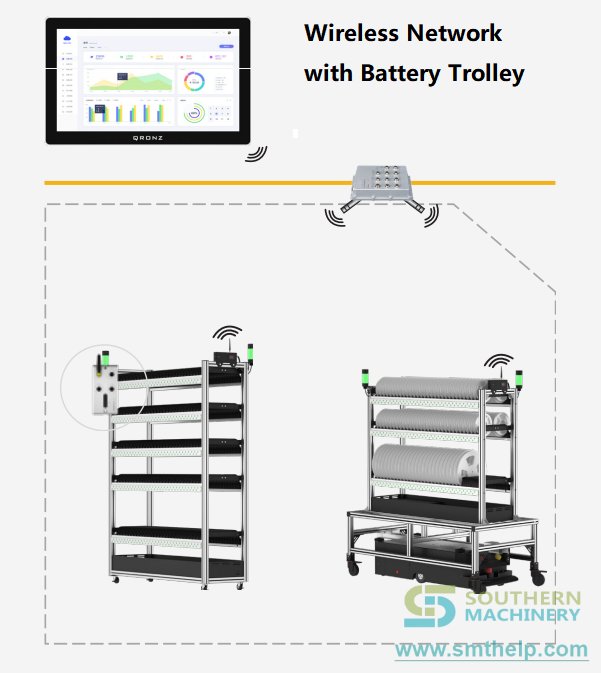
SMT Intelligent Reel Storage Rack for Pick-to-Light Kitting by Southern Machinery
SMT production is often measured by placement speed, but many real line stoppages begin before the reel reaches the feeder cart. When reels are stored manually, operators may spend time searching, checking stock, confirming part numbers, or correcting picking mistakes. Southern Machinery's SMT Intelligent Reel Storage Rack is built to make reel storage visible, guided, and traceable for PCB assembly teams that need more predictable material flow.
Southern Machinery was founded in Shenzhen, China in 2011 and focuses on SMT and THT PCB assembly automation equipment. With service experience across 237+ global customers, the team supports high-efficiency, cost-effective solutions covering SMT lines, THT automation, wave soldering, board handling, inspection, spare parts support, global service, and professional training.
What is this machine used for?
The SMT Intelligent Reel Storage Rack is used to store, identify, locate, and issue SMT component reels for production. In the source page workflow, each reel is scanned, assigned a unique ID, stored in a guided slot, and later picked through LED pick-to-light guidance based on the production job list.
The practical purpose is simple: reduce manual searching and wrong-pick risk while giving production, warehouse, and quality teams better visibility over where every reel is and how it moves.
The production problem it addresses
Manual reel storage creates three common bottlenecks in EMS and high-mix PCB assembly factories:
- Inaccurate stock visibility, especially when reels move between warehouse, line-side carts, and production lines.
- Misplaced reels or wrong parts sent to the SMT line, causing downtime and rework.
- Slow kitting because operators must search shelves, verify labels, and update records manually.
The source document describes this as inventory chaos and costly mispicks. For global EMS, automotive electronics, medical electronics, industrial control, and ODM factories, these errors affect more than warehouse housekeeping. They can delay changeover, interrupt placement, and weaken traceability.
How the intelligent reel storage workflow works
Southern Machinery's page describes a four-step material flow:
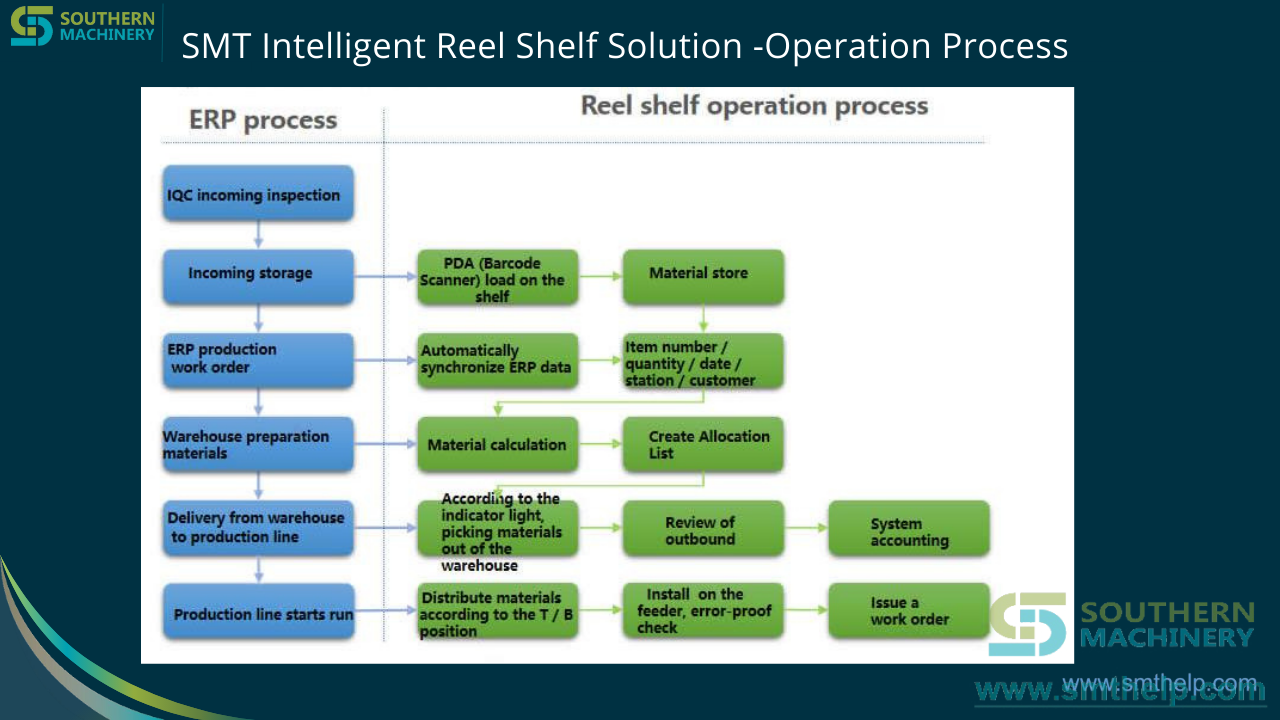
1. Scan and store
The operator scans the reel barcode. The system assigns a unique ID and uses LED guidance to direct the reel to an available slot.
2. Import the job list
The production list can be imported from MES or ERP. The system checks component availability before the operator starts picking.
3. Pick with light
LEDs identify the required reels for the kitting list, helping operators pick the correct part faster and with less dependence on manual shelf searching.
4. Automate and analyze
Inventory movement is updated automatically, and the resulting data can support process analysis, inventory control, and continuous improvement.

Typical application scenarios
This storage rack is most useful where SMT material flow is a recurring bottleneck:
- High-mix, low-to-medium-volume EMS lines with frequent job changeovers.
- Line-side material preparation areas where operators must kit many reels per work order.
- Factories that need stronger reel traceability for quality control and process audits.
- SMT warehouses that want real-time visibility instead of relying on manual location records.
- Production teams connecting storage workflows to MES or ERP-driven job lists.
It is not only a warehouse shelf. It is a controlled material handling station that connects component storage, kitting, traceability, and SMT line replenishment.
How it fits into a complete PCB assembly line
In a complete Southern Machinery PCB assembly solution, the intelligent reel storage rack can sit upstream of the SMT line:
- Incoming component reels are registered and stored.
- The job list is imported from MES or ERP.
- Operators pick reels through LED-guided kitting.
- Reels move to feeders and line-side material carts.
- The SMT line runs through printing, SPI when required, pick-and-place, reflow, AOI, and downstream handling.
- Remaining reels return to controlled storage with updated movement records.
For mixed SMT and THT production, Southern Machinery can also connect the material planning discussion with THT automation, wave soldering, board handling, inspection, and traceability requirements. The exact line configuration should be confirmed against PCB size, component mix, production volume, and factory software environment.
Key selection parameters to confirm
Before selecting the final storage rack configuration, buyers should confirm:
- Reel sizes and storage quantity requirements.
- Whether the system will be used for warehouse storage, line-side kitting, or both.
- Barcode and unique ID rules for reels and internal material labels.
- MES or ERP integration expectations and data fields.
- Pick-to-light workflow requirements for operators.
- Traceability requirements for quality control.
- Available floor space and preferred layout.
- Whether the factory needs future expansion for more racks or connected material stations.
ROI, quality, and capacity value
The source page presents the business value around fewer logistic problems, saved labor hours, and improved inventory accuracy. Those figures should be treated as examples that depend on configuration, operator workflow, software integration, and the factory's current baseline.
A realistic ROI review should compare:
- Current time spent searching and kitting reels.
- Cost of wrong-part picking and line-down incidents.
- Changeover frequency and number of reels per job.
- Labor hours used for warehouse and line-side material handling.
- Value of stronger traceability for quality control and customer audits.
For many EMS factories, the first-principles logic is clear: if material uncertainty causes repeated line interruptions, then improving reel identification, location accuracy, and guided picking can protect placement capacity without changing the pick-and-place machine itself.
Buyer FAQ
Does this rack replace MES or ERP?
No. The source page describes importing production lists from MES or ERP, so the rack should be treated as an execution and storage-control layer that can work with broader factory systems.
Can it help prevent wrong reel picking?
Yes, the key mechanism is LED pick-to-light guidance combined with reel ID tracking. The final result depends on barcode discipline, operator workflow, and integration quality.
Is it only for large EMS factories?
No. It is especially relevant for high-mix production where frequent changeovers make manual material handling inefficient, even if the factory is not a very large site.
What information is needed for a configuration proposal?
Southern Machinery should confirm reel quantity, reel sizes, storage workflow, MES or ERP requirements, available floor space, and whether the rack is for warehouse storage, line-side kitting, or both.
Can this connect with a complete SMT or THT automation project?
Yes. Southern Machinery can discuss the rack as part of a broader PCB assembly automation plan covering SMT line equipment, board handling, inspection, THT automation, wave soldering, and traceability.
Is the payback period guaranteed?
No. Any payback estimate must be checked against the actual factory baseline, labor cost, picking time, changeover frequency, error rate, and final system configuration.
CTA: request a material-flow review
If your SMT line loses time to reel searching, wrong picks, or unclear inventory location, send Southern Machinery your current material handling workflow, reel quantity, production changeover pattern, and MES or ERP requirements. The team can suggest a practical storage and kitting configuration for your PCB assembly line.
Comments