
SMT Intelligent Reel Storage Rack for Material Traceability by Southern Machinery
For EMS and PCB assembly factories, SMT reels are not just inventory items. They control line uptime, material accuracy, moisture-sensitive device handling, and production traceability. Southern Machinery’s SMT Intelligent Reel Storage Rack helps factories replace manual searching and paper-based stock checks with guided picking, real-time database synchronization, FIFO/FEFO logic, and optional MSD control. This buyer-focused guide explains where the system fits in a full SMT line, which parameters should be confirmed before configuration, and how the rack can reduce material-related delays while supporting quality control and future MES/ERP integration.
Jul 26, 2026 · Updated Jul 26, 2026 · Southern Machinery
SMT Intelligent Reel Storage Rack for Material Traceability by Southern Machinery
SMT production efficiency is often limited by small material-handling problems: operators searching for reels, wrong-part picking, unclear reel location, expired floor-life records, and inventory data that does not match the actual warehouse. The SMT Intelligent Reel Storage Rack from Southern Machinery is designed to turn reel storage into a controlled, traceable, and line-connected process.
Southern Machinery was founded in Shenzhen, China in 2011 and focuses on SMT/THT PCB assembly automation equipment. For global EMS, ODM, automotive electronics, medical electronics, industrial control, and power electronics factories, the goal is not only to sell a rack. The rack should fit into the full production flow: SMT placement, THT insertion, wave soldering or selective soldering, board handling, inspection, traceability, spare parts support, and professional training.
What is this machine used for?
The SMT Intelligent Reel Storage Rack is used to store, locate, pick, and manage SMT component reels in a controlled production warehouse or line-side material area. It helps factories guide operators to the correct reel with LED pick-to-light indication, synchronize storage activity with a real-time database, support FIFO/FEFO material rotation, and maintain traceability from receiving to production.
In practical terms, the system is used when a factory wants to reduce manual reel searching, improve picking accuracy, support MES/ERP data flow, protect sensitive components, and reduce the chance that an SMT line waits for missing or incorrect material.
Why SMT material storage becomes a production bottleneck
A pick-and-place line can only run as smoothly as its material preparation process. If reels are stored in open shelves without clear location control, several problems appear:
- Operators spend time searching for the correct reel.
- Similar part numbers or package types can be picked incorrectly.
- Inventory records may not match physical stock.
- Moisture-sensitive components may not have clear floor-life control.
- Urgent changeovers become slower because materials are not staged reliably.
- Quality teams lose confidence in component traceability.
The source landing page positions the system around precision, speed, and control for modern electronics factories. That is the correct buying lens: the rack is not a decorative warehouse upgrade. It is a control point for SMT line continuity.
Core functions from the source system
LED pick-to-light guidance
Multi-color LEDs guide operators to the exact component location. In the source page, this is described as a way to eliminate search time and improve picking accuracy. For public project discussion, Southern Machinery recommends treating any accuracy figure as a configuration-dependent target that must be verified against the customer’s barcode process, operator workflow, reel labeling discipline, and software integration.
Real-time database synchronization
Every storage and retrieval action can be recorded so the factory has better inventory visibility. The system is positioned for MES/ERP integration through database or API connection. This matters for EMS factories that need material status visibility before releasing work orders to the line.
Full traceability
Each reel can be tracked from receiving to production with a unique ID. For regulated or high-reliability electronics, this supports stronger quality records and faster investigation if a material issue appears.
FIFO/FEFO management
Software-driven FIFO/FEFO logic helps rotate material correctly. This is especially important for components with limited shelf life, date-code rules, or moisture-sensitive handling requirements.
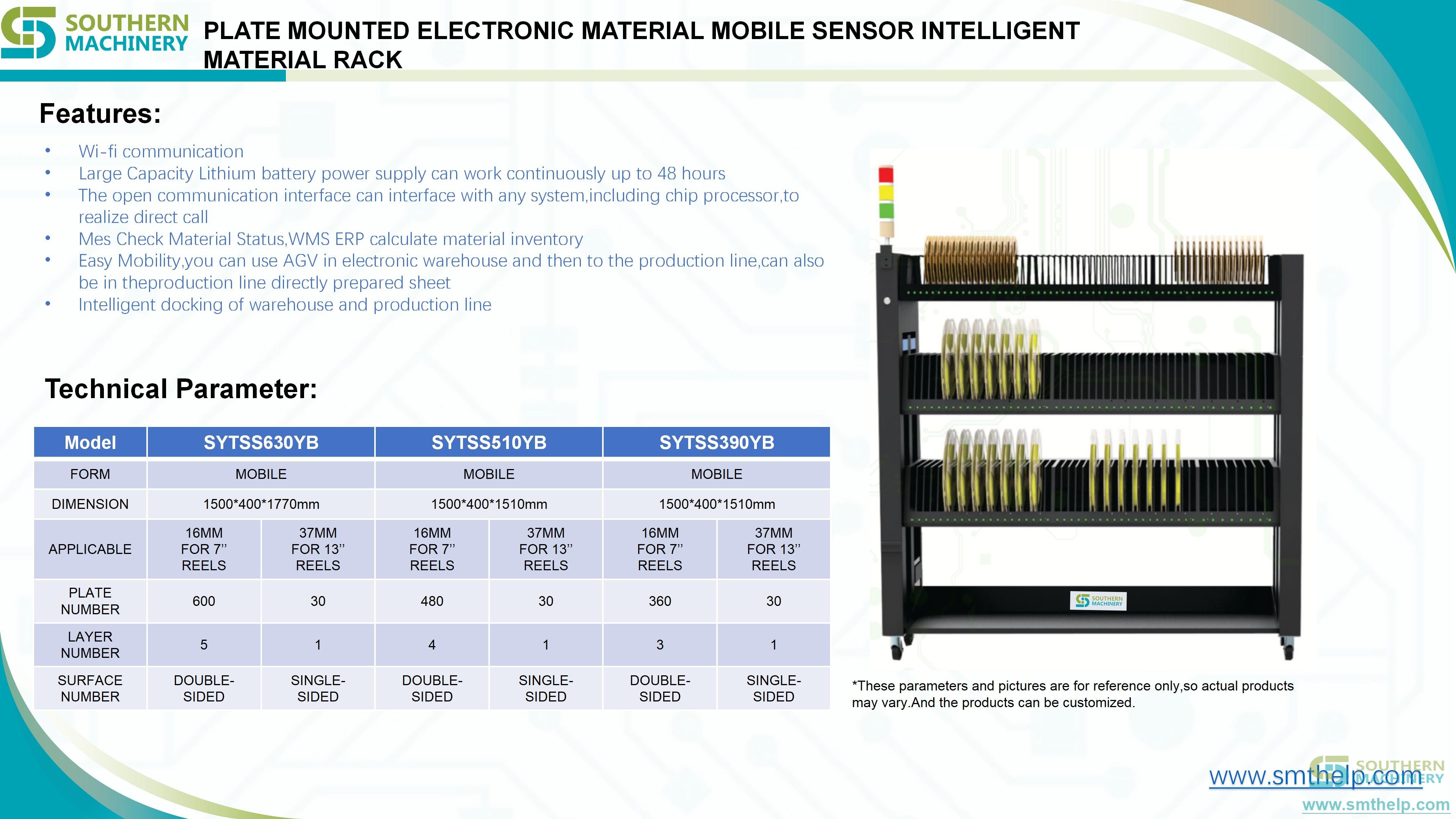
Modular and mobile configuration
The source page describes modular rack configuration and mobile trolley options. This allows the system to be planned for central storage, line-side kitting, or a hybrid setup depending on plant layout.
Optional MSD control
Optional humidity control and floor-life tracking can be configured for moisture-sensitive devices. The source file references optional humidity control below 5% RH; this should be treated as an option subject to final technical confirmation for the exact model and plant conditions.
Typical application scenarios
EMS factories with frequent changeovers
High-mix production needs fast and reliable kitting. Guided storage and picking reduce wasted time during changeovers and help operators stage reels before the line stops.
Automotive and industrial control PCB assembly
Factories building automotive electronics, industrial controllers, power modules, and sensor boards often require stronger material traceability. A rack connected to inventory and production records can support more disciplined part control.
Medical electronics and quality-sensitive production
When batch traceability and correct material usage are critical, manual shelf management is weak. A controlled storage process helps reduce the probability of wrong-part issue and supports audit preparation.
Smart factory upgrades
Factories introducing MES, barcode traceability, AGV material movement, or automated warehouse workflows need physical storage equipment that can connect to the digital process. The intelligent reel storage rack can act as one node in that system.
How it connects to a complete PCB assembly line
A practical SMT line is more than one machine. The reel storage rack should be planned around the full material and production flow:
- Receiving and labeling: reels are received, checked, and assigned unique IDs.
- Storage: reels are placed into controlled rack locations.
- Work order preparation: MES/ERP or production planning sends the required BOM and reel list.
- Guided picking: LED indication helps operators retrieve the right reel.
- Line-side staging: reels move to feeder preparation, splice area, or trolley staging.
- SMT production: materials feed pick-and-place machines through standard SMT feeders.
- Inspection and traceability: SPI, AOI, barcode, and MES records connect material usage with PCB batch history.
- Return storage: remaining reels are returned, scanned, and updated in inventory.
Southern Machinery can configure the broader production solution around this flow, including SMT line equipment, board handling, THT automation, wave soldering, selective soldering, inspection, and traceability modules.
Key selection parameters to confirm before ordering
Before selecting the final rack configuration, the buyer should confirm:
- Reel sizes used in production, such as 7 inch, 10 inch, 13 inch, or 15 inch.
- Number of reels to be stored per rack or per storage area.
- Whether storage is central warehouse, line-side, mobile trolley, or mixed.
- Required barcode, QR code, RFID, MES, or ERP workflow.
- Whether FIFO, FEFO, shelf-life, date-code, or MSD rules must be enforced.
- Need for humidity control, ESD protection, or floor-life tracking.
- Available power, network, Wi-Fi, and plant IT requirements.
- Operator workflow for receiving, picking, returning, and auditing materials.
- Required integration with SMT feeder preparation and production planning.
The source page lists example specifications such as SIS series models, reel size support, API for MES/ERP systems, AC 110V/220V power, mobile trolley, ESD protection, and MSD control. Capacity and retrieval time should be confirmed against the final model and layout; the source examples should not be treated as a universal promise.
ROI, quality, and capacity value
The business case usually comes from three areas.
First, the rack can reduce labor spent on searching, counting, and reconciling reels. Second, it can reduce production interruptions caused by missing or wrong material. Third, it can strengthen quality control through traceability, FIFO/FEFO logic, and optional MSD management.
The source page mentions rapid ROI as a benefit. For a public buying guide, the more reliable statement is that ROI depends on line value, labor cost, changeover frequency, current inventory accuracy, and the cost of material-related downtime. Southern Machinery can help estimate payback after reviewing the customer’s current material process and production volume.
FAQ
Is the SMT Intelligent Reel Storage Rack only for large EMS factories?
No. It is most valuable wherever reel searching, incorrect picking, inventory mismatch, or material traceability creates production risk. The final size and configuration should match the number of reels, production mix, and factory layout.
Can it connect with MES or ERP?
The source page describes API support for MES/ERP systems. The exact integration method should be confirmed with the customer’s IT team, barcode workflow, database requirements, and production planning system.
Does it replace a dry cabinet?
Not automatically. The rack can be configured with optional humidity control and MSD-related functions, but the correct solution depends on component sensitivity, storage policy, and factory process rules. For strict MSD storage, final technical confirmation is required.
What reel sizes can be supported?
The source file references support for common SMT reel sizes including 7 inch, 10 inch, 13 inch, and 15 inch. The final rack design should be checked against the customer’s actual reel mix.
Can it be used beside an SMT line?
Yes. Modular and mobile configurations can support line-side storage or staging. The best layout depends on feeder preparation, changeover frequency, aisle space, and operator movement.
What information is needed for a quotation?
A useful request should include reel size distribution, target storage capacity, plant layout, current ERP/MES status, barcode or RFID requirements, humidity/MSD needs, and whether the rack will be central, mobile, or line-side.
CTA: plan your SMT reel storage workflow
If your SMT line loses time because operators cannot find reels quickly, inventory records are unreliable, or material traceability is still manual, Southern Machinery can help review the workflow and suggest a practical configuration.
Send your reel size mix, target storage capacity, current MES/ERP status, and SMT line layout. Southern Machinery will recommend a cost-effective intelligent reel storage setup that fits your PCB assembly line and future smart factory plan.
Comments