
SMT Intelligent Reel Storage Rack: Cutting Material Handling Costs by Southern Machinery
Manual SMT material handling hides real costs: operators searching for reels, kitting errors that cause rework, and line stoppages when components arrive late. Southern Machinery's SMT Intelligent Reel Storage Rack automates storage, retrieval, and traceability so EMS and ODM factories can keep high-speed lines fed, cut operator hours, and improve OEE. Typical values from the source document include reel retrieval under 4 seconds, up to 99.9% inventory accuracy, and up to 75% less storage floor space, all subject to configuration and final confirmation. This guide explains what the system is used for, typical application scenarios, how it connects into a complete PCB assembly line, key selection parameters, and ROI considerations for factory decision-makers.
Aug 11, 2026 · Updated Aug 11, 2026 · Southern Machinery
SMT Intelligent Reel Storage Rack: Cutting Material Handling Costs by Southern Machinery
Manual SMT material handling hides costs that do not appear in a machine quotation. Operators searching for reels, kitting errors that cause rework, and line stoppages when components arrive late all reduce factory OEE and profitability. Southern Machinery's SMT Intelligent Reel Storage Rack is designed to replace this manual, error-prone flow with automated storage and retrieval, so EMS, ODM, automotive electronics, medical electronics, and industrial control factories can keep high-speed lines fed and turn the warehouse into a production advantage.
What is this machine used for?
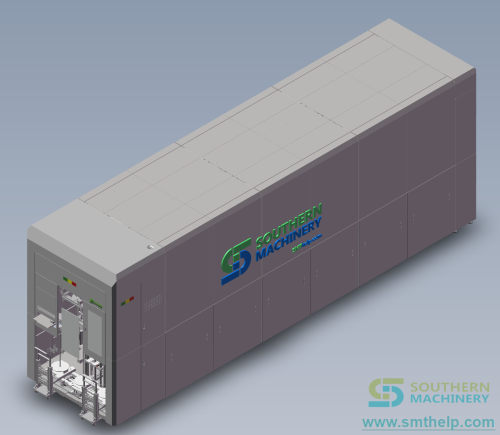
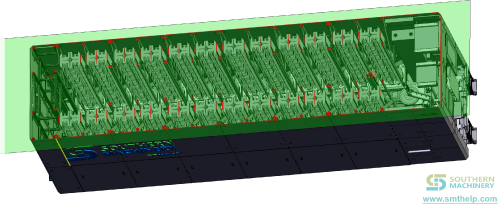
The SMT Intelligent Reel Storage Rack is used to store, locate, and retrieve SMD component reels automatically inside an electronics assembly factory. Instead of walking through shelves to find the right reel, operators request the component and the system delivers it. The source document describes the core purpose in one sentence: the system "automates your material flow, delivering the right component at the right time, every time."
In practical terms, it is a material handling buffer between the warehouse and the production line. It reduces the time spent searching for reels, prevents wrong-part picks, and keeps line-side material ready so placement machines are not starved during changeover or replenishment.
The hidden cost of manual SMT material handling
Material handling is often treated as a fixed overhead, but the source document frames it as a direct efficiency risk. Line stops, time spent searching for reels, and kitting errors directly impact OEE and profitability. Each event looks small in isolation; repeated across shifts, they consume operator hours and create quality risk before a single board reaches the placement machine.
Three cost categories are typical in an EMS factory:
- Search time and kitting time: operators walk, scan, and double-check reel locations before every changeover.
- Picking errors: a wrong or expired reel reaching the line causes rework, scrap, or emergency re-kitting.
- Line starvation: material shortages stop high-speed lines, and the cost of a stopped line is far higher than the cost of the missing reel.
None of these costs require new equipment to appear. They are already in the factory's labor hours, downtime records, and rework reports.
What the intelligent reel storage rack changes
The SMT Intelligent Reel Storage Rack replaces manual shelf searching with automated material flow. The source document lists the following benefits, which should be treated as typical values subject to configuration and final technical confirmation:
- Fast retrieval: reel retrieval under 4 seconds, so operators and kitting teams are not waiting.
- High inventory accuracy: up to 99.9% inventory accuracy, reducing costly picking errors and rework.
- Less floor space: a high-density vertical design can free up to 75% of current storage floor space.
- Faster payback: ROI in under 6 months is cited as a typical result in the source document.
- Operator hour savings: thousands of operator hours per year can be reclaimed by automating kitting, searching, and stock counting.
These figures are examples from the source marketing material, not guarantees. Actual results depend on reel volume, SKU count, line configuration, and the factory's current process.
Typical application scenarios
The system is most valuable in factories where material flow is already a visible bottleneck:
- EMS factories with multiple SMT lines: shared reel inventory must be kitted correctly to several lines at the same time.
- High-mix, low-volume production: frequent changeovers multiply the number of times reels must be located and swapped.
- Factories running out of warehouse space: vertical storage reclaims floor area for production lines or other value-adding activities.
- Companies improving OEE: reducing line starvation and kitting errors directly improves availability and quality metrics.
- Plants preparing for Industry 4.0: a connected storage system becomes the material backbone for automated kitting and traceability.
How to integrate it into a complete PCB assembly line
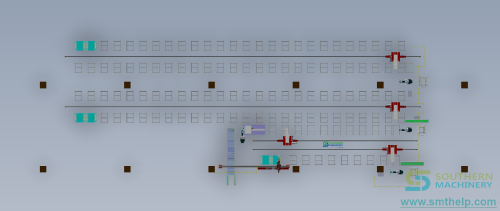
An intelligent reel storage rack is not an isolated warehouse product; it is part of the material flow that feeds a complete PCB assembly line. A typical integration follows this path:
- Receiving: incoming reels are logged into the system with component data.
- Storage: reels are stored in the high-density rack at assigned positions.
- Kitting: when a production order starts, kitting requests are generated and reels are retrieved quickly.
- Line side: kitted reels move to feeder setup stations, then to SMT placement machines.
- Return and control: unused or returned reels go back into the system, keeping inventory data current.
Because the storage rack sits upstream of placement, the rest of the line - printing, placement, reflow, inspection, THT insertion, and soldering - can run without waiting for material. Southern Machinery can configure the storage system together with feeders, feeder carts, and line layout so the complete flow from reel storage to finished board is balanced.
Key selection parameters checklist
Before quoting a system, factories should prepare the following information:
- Inventory volume: number of active SKUs and total reel quantity to be stored.
- Reel types: tape widths and reel diameters used by the product portfolio.
- Retrieval and kitting speed target: required kitting time per order or per line.
- Floor space available: current warehouse footprint and target footprint after automation.
- Accuracy and traceability requirements: whether wrong-part prevention and stock visibility are required by customer audits.
- Integration scope: how kitting requests should be triggered and how stock data is shared with production planning.
- Expansion plan: expected SKU growth over the next 12 to 24 months.
Providing this information lets Southern Machinery propose the right rack size, position count, and operating flow for the factory.
ROI, quality, and capacity value
The ROI story is about recovered time and avoided errors rather than a single machine's throughput. The source document cites a typical payback of under 6 months and thousands of recovered operator hours, with up to 99.9% inventory accuracy and up to 75% less storage floor space. These are typical planning values and should be validated against the factory's own data before approval.
Quality improves in a less obvious way: when the right component reaches the line every time, defect rates from wrong-part placement and expired material drop, and audit readiness improves because inventory records are reliable.
FAQ
1. What is this machine used for?
It is used to store, track, and retrieve SMD component reels automatically, delivering the right component at the right time so production lines are not delayed by manual searching or kitting.
2. How fast can the system retrieve a reel?
The source document cites retrieval in under 4 seconds as a typical value. Actual time depends on rack configuration, position layout, and software integration.
3. How accurate is the inventory?
The source document cites up to 99.9% inventory accuracy. This is a typical planning figure and should be confirmed against the selected configuration and data-entry process.
4. How quickly does it pay back?
The source document cites ROI in under 6 months as a typical result. Payback depends on current labor hours, error rates, line downtime, and floor-space costs.
5. Does it replace warehouse staff?
It automates search, kitting, and stock-counting work, which reduces operator hours, but staffing decisions depend on the factory's overall workflow and other manual tasks.
6. How do we start?
Send Southern Machinery your SKU list, reel types, floor plan, and kitting process. We can analyze the material flow and propose a storage configuration that matches your line layout.
Talk to Southern Machinery
Southern Machinery was founded in Shenzhen, China in 2011 and serves 237+ global customers with SMT/THT PCB assembly automation equipment. Beyond storage and material handling, we provide complete line solutions covering SMT, THT, wave soldering, board handling, and inspection, supported by high-efficiency, cost-effective equipment, global service, spare parts support, and professional training.
If material handling is becoming your bottleneck, contact us for a free material flow analysis:
- Email: info@SMThelp.com
- Phone/WhatsApp: +86 136 0256 2576
- Website: https://www.smthelp.com
Comments