
SMT Intelligent Reel Storage Rack Buyer’s Guide by Southern Machinery
For EMS and PCB assembly factories, manual SMT reel storage often causes hidden losses: slow kitting, wrong part picks, inventory gaps, and weak traceability. Southern Machinery’s SMT Intelligent Reel Storage Rack brings
Jul 7, 2026 · Updated Jul 7, 2026 · Southern Machinery
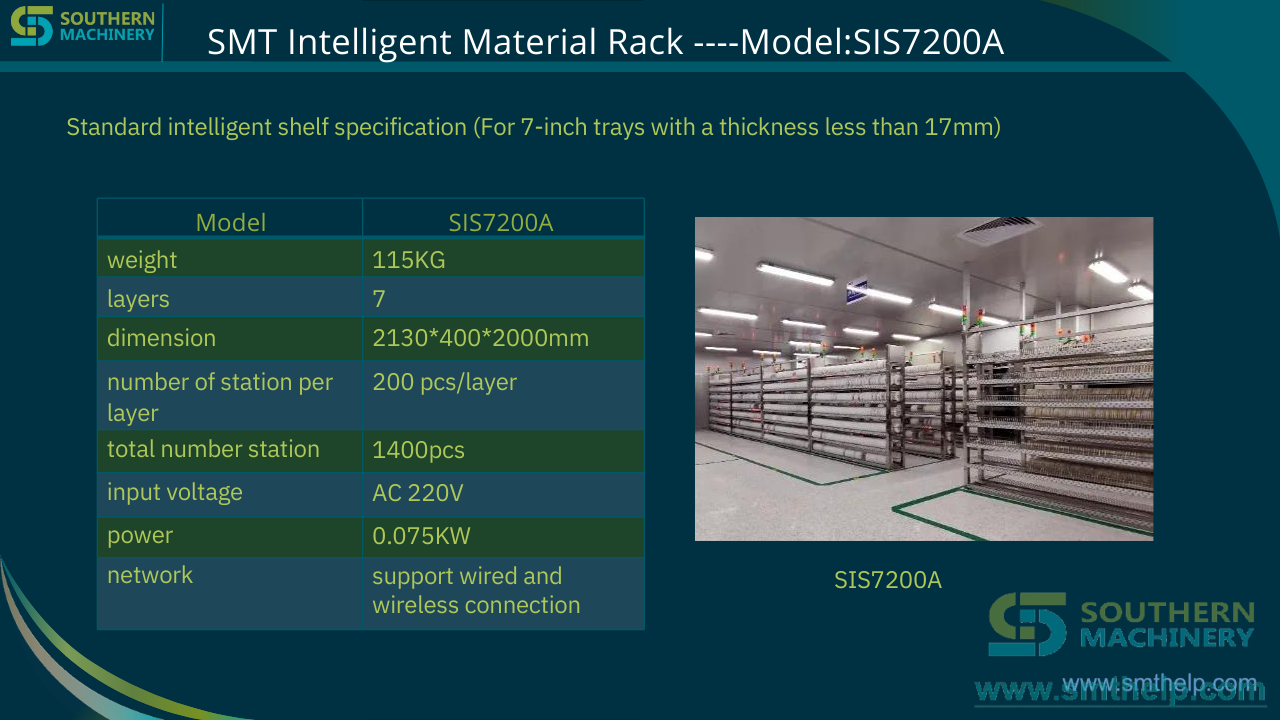
SMT Intelligent Reel Storage Rack Buyer’s Guide by Southern Machinery
Manual reel storage looks simple until it starts slowing down the SMT line. Operators hunt for reels, inventory records drift from reality, changeovers take longer, and the wrong component can reach the line before anyone notices.
Southern Machinery’s SMT Intelligent Reel Storage Rack is built for factories that want better control over SMD reel storage, picking, kitting, and traceability without jumping straight to a fully automated warehouse. It combines rack-based storage, LED-guided operation, real-time inventory updates, and software visibility for EMS, ODM, automotive electronics, industrial control, medical electronics, and other PCB assembly environments.
Southern Machinery was founded in Shenzhen, China in 2011. We focus on high-efficiency, cost-effective SMT/THT PCB assembly automation equipment, with support for SMT lines, THT insertion, wave soldering, board handling, inspection options, global service, spare parts, and professional training.
What is this machine used for?
The SMT Intelligent Reel Storage Rack stores, locates, picks, and traces SMT component reels more accurately than a traditional manual shelf.
In practical factory terms, it helps the material team answer four questions quickly:
- Where is the reel now?
- Is the correct reel being picked for this job?
- Has inventory been updated after each movement?
- Can the factory trace material movement from receiving to production?
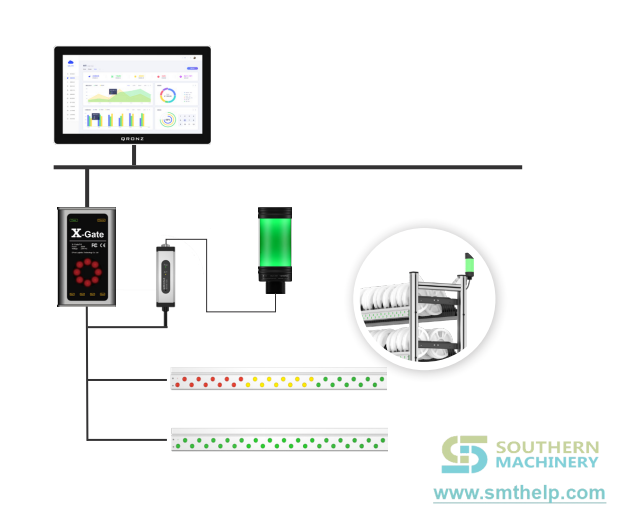
The source page highlights LED-guided operation, real-time data sync, and complete traceability as the main functions. Multi-color LEDs point operators to the correct storage or picking position, while scanning and software updates keep inventory data aligned with actual material movement.
Why manual SMT reel storage becomes a production bottleneck
For a small workshop, manual shelves and spreadsheets may work fine. For a growing EMS factory, the same workflow can quietly reduce output.
Typical problems include:
- Inaccurate inventory records leading to unexpected shortages.
- Slow kitting before production changeovers.
- Human picking errors that cause rework, scrap, or line stoppages.
- Weak traceability when quality teams need to investigate a batch issue.
- No real-time visibility for planners, warehouse staff, and production supervisors.
These problems don't always show up as one big failure. Instead, they appear as repeated small delays: ten minutes looking for one reel, another delay because a reel was returned to the wrong location, and another because the system says material is available but the operator cannot find it.
How the intelligent reel rack works in daily production
The rack is designed around a simple material workflow.
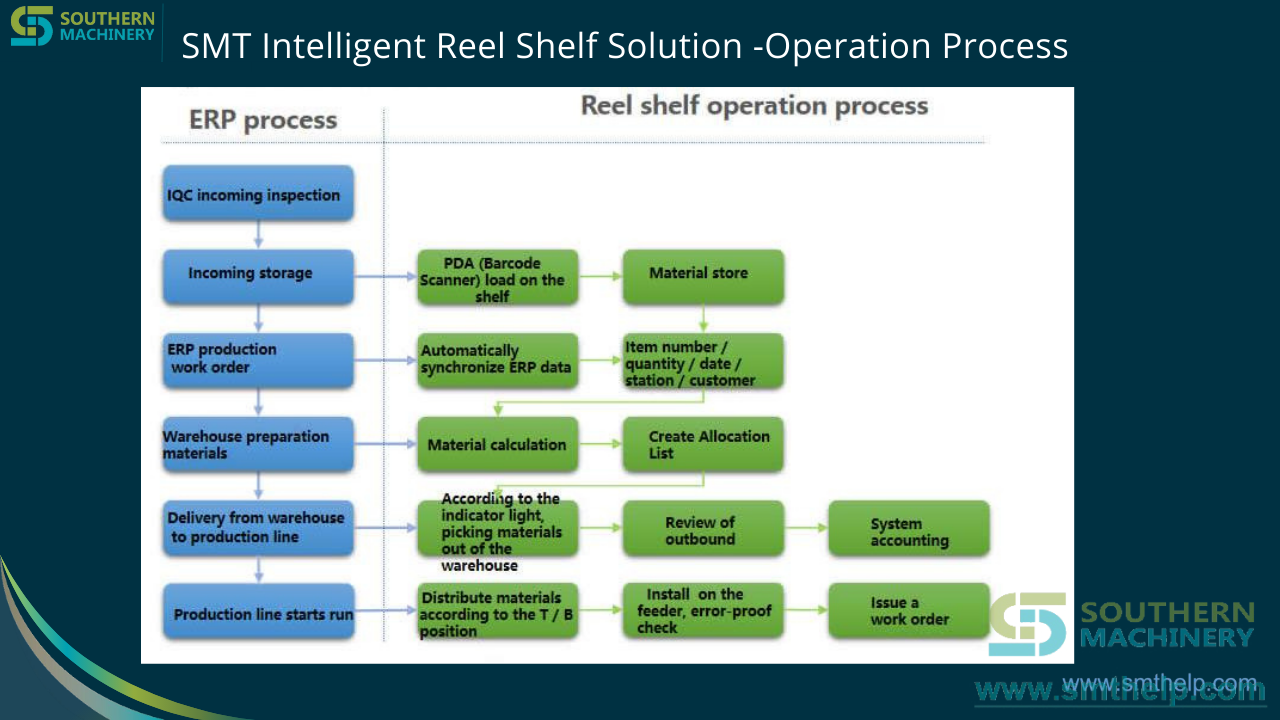
1. Store reels with an identified location
Each reel is associated with a unique ID or barcode. When material is stored, the system records where it belongs. This gives the warehouse team a structured location map instead of relying on memory or handwritten labels.
2. Pick reels with LED guidance
When a job requires material preparation, LED indicators guide the operator to the correct reel location. This is especially useful for high-mix EMS work, where material handlers may prepare many small jobs every day.
3. Update inventory data after movement
The source page describes real-time data sync: each scan and material movement updates inventory data and can connect with MES/ERP systems depending on the final configuration.
4. Keep a traceable history
Every reel can have a movement history from receiving, storage, picking, production use, and return. This supports quality control and root cause analysis when a component batch, lot, or job needs review.
How it fits into a complete PCB assembly line
An intelligent reel rack is not a standalone "nice to have" accessory. It should support the full SMT production workflow.
A typical integration path is:
- Incoming SMD reels are received, labeled, and scanned.
- Reels are stored in the intelligent rack with defined locations.
- Production planning or kitting lists are generated from job requirements.
- Operators pick reels with LED guidance.
- Reels move to the SMT line: loader, printer, SPI (if needed), pick-and-place, reflow, AOI, and unloading.
- Unused reels are returned and scanned back into storage.
- Inventory and traceability records are updated for the next job.
For factories that also run THT assembly, wave soldering, selective soldering, or final test, the same material discipline helps the whole production floor. Southern Machinery can support a broader line plan covering SMT, THT insertion, wave soldering, board handling, inspection, and related automation around the material flow.
Key selection parameters to confirm before buying
Before choosing the final rack configuration, a factory should confirm these points:
- Reel size range and storage quantity required.
- Current daily or shift-level kitting volume.
- Number of SMT lines supported by the material area.
- Barcode, reel ID, and label workflow already used in the factory.
- Whether MES/ERP connection is required.
- Whether FIFO or lot-level traceability is mandatory.
- Available floor space and line-side material flow.
- Operator workflow for receiving, picking, returning, and auditing reels.
- Future expansion needs if more SMT lines will be added.
If these details are unclear, the rack can still be discussed at concept level, but the final configuration should be confirmed after reviewing the factory’s reel volume, software workflow, and production mix.
ROI, quality, and capacity value
The source page presents example benefits such as shorter kitting time, fewer picking errors, and a possible payback window. Treat these as examples, not fixed guarantees, because actual results depend on the factory’s current labor cost, material volume, number of changeovers, operator discipline, and software integration depth.
In general, the value comes from five areas:
- Less time spent searching for reels.
- Fewer wrong-part picking events.
- Faster preparation for high-mix SMT jobs.
- More accurate real-time inventory.
- Better traceability for quality and customer audits.
For a high-mix EMS factory, even a small reduction in kitting delay can matter because changeovers happen repeatedly. For a larger factory, the bigger value may be inventory control and process discipline across multiple lines.
Typical application scenarios
High-mix EMS production
Frequent model changes create heavy material preparation work. LED-guided storage and picking can help reduce operator search time and wrong-location mistakes.
Automotive and industrial electronics
These products often require stronger traceability. A reel movement record helps the factory connect material history with production batches and quality checks.
Growing factories moving toward Industry 4.0
Factories may not be ready for a full automated warehouse. An intelligent rack can be a practical first step toward data-driven material management.
SMT lines with repeated material shortages
If the line often stops because material is "in the system but not on the shelf," the real issue may be warehouse visibility. Smart storage can help close that gap.
FAQ
Does the SMT Intelligent Reel Storage Rack replace an automatic warehouse?
Not always. It is better understood as a practical smart storage layer for SMD reels. For many factories, it provides enough control and traceability without the cost and complexity of a fully automated warehouse.
Can it connect with MES or ERP?
The source page describes real-time data sync and MES/ERP connection. The final interface and data fields should be confirmed based on the customer’s software system and integration requirements.
Is it only for large EMS factories?
No. It is useful for any factory where reel searching, wrong picking, inventory mismatch, or changeover preparation is already affecting production. The configuration should match the factory’s reel quantity and SMT line count.
What information is needed for a quotation?
The key inputs are reel size range, storage quantity, number of SMT lines, current kitting workflow, MES/ERP needs, floor space, and whether traceability is required at reel, lot, or job level.
Can Southern Machinery provide a full line solution around this rack?
Yes. Southern Machinery supports SMT and THT PCB assembly automation, including SMT line equipment, THT insertion, wave soldering, board handling, inspection options, spare parts, training, and service support.
CTA: build a smarter SMT material flow
If your SMT line is losing time through manual reel search, inaccurate inventory, or weak traceability, the storage area is worth reviewing before buying more placement capacity.
Share your reel quantity, SMT line count, current kitting process, and MES/ERP requirements. Southern Machinery can help match an intelligent reel storage configuration and connect it with a practical SMT/THT production line plan.
Comments