
SMT Intelligent Reel Storage Rack Buyer Guide by Southern Machinery
For EMS and PCB assembly factories, SMT reel storage is no longer just a warehouse issue. Wrong reel picking, slow kitting, unmanaged MSD exposure, and poor material traceability can stop production even when the pick-and-place line itself is capable. This guide explains how the SMT Intelligent Reel Storage Rack by Southern Machinery helps manufacturers automate reel retrieval, improve inventory accuracy, support MES/ERP data flow, and connect material preparation with the wider SMT line. Final performance and ROI depend on reel volume, software integration, factory layout, and operating discipline, so each project should be confirmed with real production data before purchase.
Jul 25, 2026 · Updated Jul 25, 2026 · Southern Machinery
SMT Intelligent Reel Storage Rack Buyer Guide by Southern Machinery
SMT material storage is one of the easiest factory problems to underestimate. A pick-and-place machine may be fast, the reflow oven may be stable, and the SMT line may look well equipped, but if reels are stored manually, searched by memory, or kitted with weak traceability, the production line still loses time before the PCB reaches the printer.
The SMT Intelligent Reel Storage Rack by Southern Machinery is designed for EMS, ODM, automotive electronics, medical electronics, industrial control, and high-mix PCB assembly teams that need faster reel retrieval, cleaner inventory control, and a more reliable bridge between material storage and production execution.
Southern Machinery was established in Shenzhen, China in 2011. The company focuses on SMT and THT PCB assembly automation equipment and has served 237+ global customers with cost-effective solutions covering SMT lines, THT automation, wave soldering, board handling, inspection, traceability, spare parts support, and professional training.
What is this machine used for?
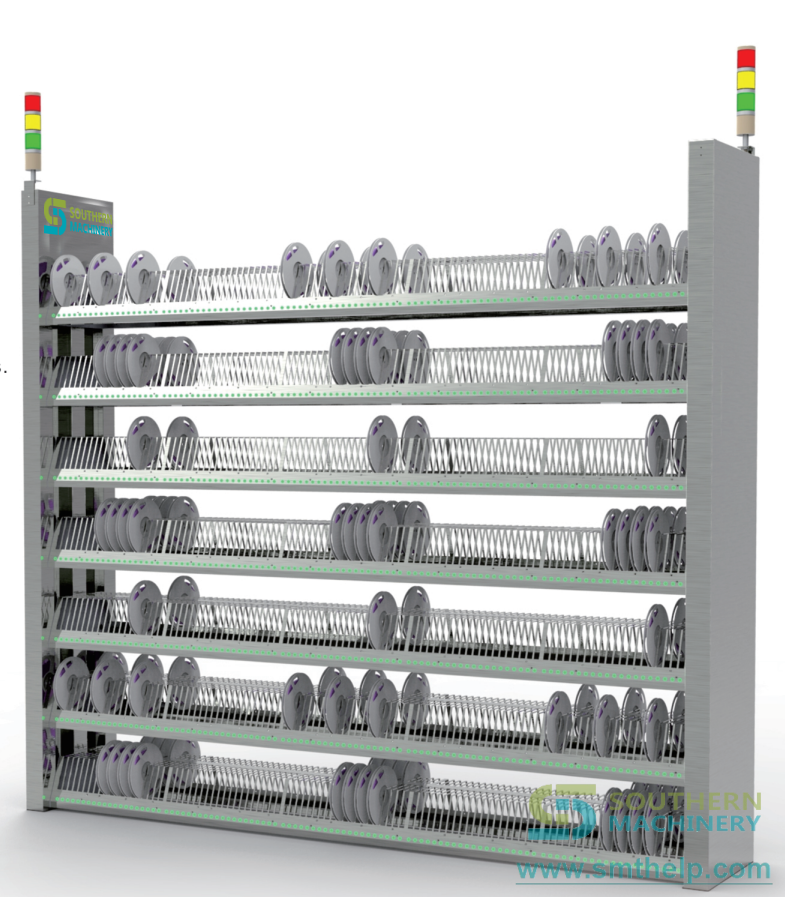
The SMT Intelligent Reel Storage Rack is used to store, locate, retrieve, and manage SMD component reels for PCB assembly production. In practical factory terms, it helps operators find the correct reel faster, prepare kits for upcoming work orders, reduce picking errors, track reel movement, and support data connection with systems such as MES or ERP.
The source product page describes core functions including automated location assignment, pick-to-light guidance, reel retrieval support, inventory data synchronization, MSD management, ESD-protected construction, and modular expansion. Exact software functions and retrieval workflow should be confirmed against the factory's reel labeling method, barcode rules, MES interface, and production process.
Why SMT reel storage becomes a production bottleneck
In many SMT factories, the visible bottleneck is assumed to be the placement machine. The first-principles view is different: placement speed only matters when the correct components arrive at the right feeder, at the right time, with reliable identity and condition records.
Manual reel storage creates several structural risks:
- Operators spend time searching shelves instead of preparing production.
- Wrong reel picking can create rework, scrap, or line stoppage.
- High-mix production increases the number of changeovers and material movements.
- Moisture-sensitive devices require disciplined floor-life tracking.
- ERP stock data may not match the physical storage location.
- Engineering teams cannot easily audit reel movement by work order.
The SMT Intelligent Reel Storage Rack addresses these problems by making reel storage more structured, searchable, and traceable.
Core functions for EMS and PCB assembly factories
Automated reel location and retrieval support
The system is positioned as an intelligent storage rack for SMD reels. Instead of relying only on paper labels or operator memory, reels can be assigned to storage locations and retrieved through a guided process. The source page highlights rapid reel retrieval as a key value, but final retrieval time depends on storage density, reel size, operator workflow, labeling discipline, and system configuration.
Pick-to-light guidance for kitting
Pick-to-light guidance helps direct operators to the correct reel position. For high-mix assembly, this is especially valuable because every changeover may involve many component reels. The practical value is not just speed; it is reducing the probability of human picking error before materials reach the line.
Inventory accuracy and traceability
The source page emphasizes real-time data and transaction logging. For automotive, medical, and industrial electronics, this matters because production teams often need to connect reel identity, lot information, storage movement, and work order consumption. The rack can support a more reliable material trail when integrated with the factory's barcode, MES, or ERP process.
MSD and ESD control support
Moisture-sensitive devices and ESD-sensitive components require more than clean shelves. The product page identifies MSD management and ESD protection as important features. For purchase decisions, buyers should confirm how floor-life timing, warning logic, dry storage requirements, and ESD material construction are implemented in the final configuration.
Typical application scenarios
High-volume SMT production
For high-volume factories, the main target is uptime. If the material room cannot replenish reels quickly, a capable SMT line can still wait for parts. Intelligent reel storage helps material teams prepare and retrieve reels more consistently, reducing avoidable stoppages during feeder replenishment and line changeover.
High-mix, low-volume assembly
High-mix EMS production is where manual storage pain becomes most visible. More part numbers, smaller lots, and frequent changeovers increase the chance of wrong picks and lost reels. A structured smart storage rack can help operators kit jobs faster and maintain clearer location control.
Automotive, medical, and industrial electronics
These applications often require stronger traceability. A storage rack connected to barcode and production data can help support component movement records. This does not replace a full MES quality system, but it can become an important upstream data point before placement and reflow.
Smart EMS factory upgrades
For factories moving toward digital manufacturing, the SMT Intelligent Reel Storage Rack can be part of a broader material management upgrade. It can work alongside SMT loaders, printers, SPI, pick-and-place machines, reflow ovens, AOI, board handling equipment, and traceability systems.
How to connect it with a complete PCB assembly line
The storage rack should not be evaluated as an isolated warehouse device. Its value increases when it is connected to the complete PCB assembly workflow.
A typical SMT-side flow can be planned as:
- Incoming reels are labeled and registered.
- Reels are assigned to intelligent storage locations.
- Production orders trigger kitting requirements.
- Operators use guided picking to prepare reels for feeders.
- Reels move to the SMT line for printing, SPI, placement, reflow, AOI, and downstream handling.
- Reel usage and return movement are recorded for inventory and traceability.
Southern Machinery can support broader line discussions that include SMT equipment, THT automation, wave soldering, board handling, inspection, and material traceability, so the storage rack can be specified according to the actual production flow instead of as a standalone shelf.
Key selection parameters to confirm before buying
Before selecting an SMT Intelligent Reel Storage Rack, buyers should confirm the following details:
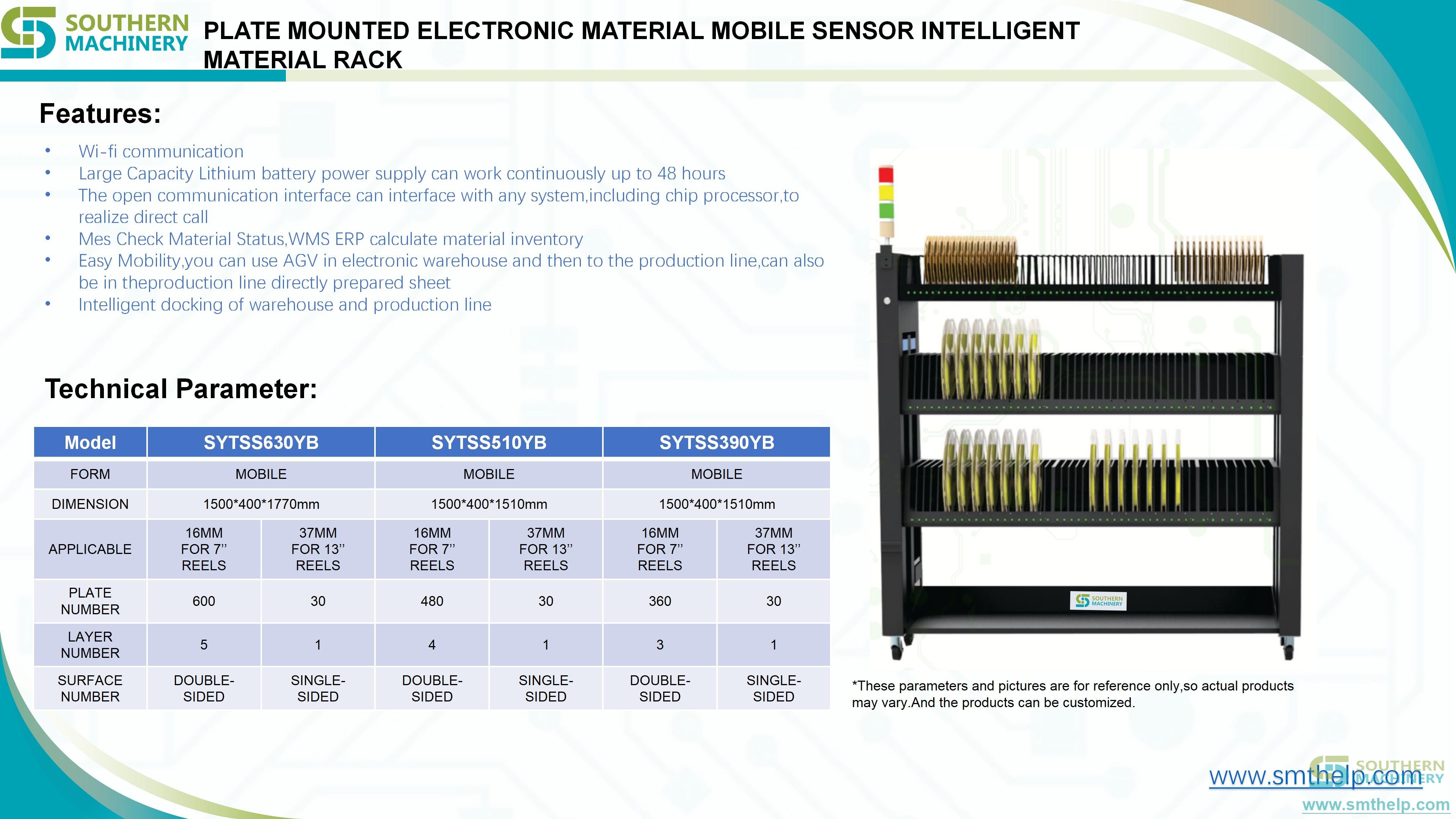
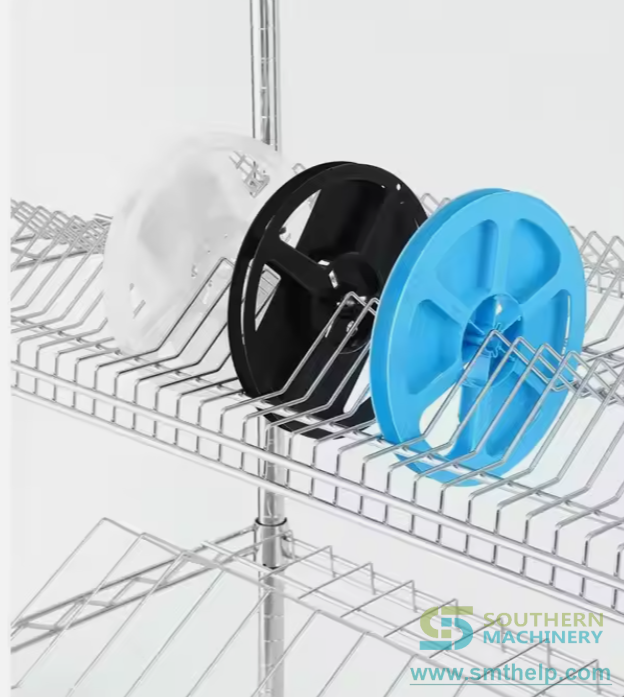
- Reel sizes used in production, such as 7 inch, 13 inch, 15 inch, or mixed storage needs.
- Number of active part numbers and expected reel storage quantity.
- High-volume versus high-mix production profile.
- Barcode, QR code, or reel ID labeling method.
- Whether MES, ERP, WMS, or custom software integration is required.
- MSD control requirements and floor-life tracking rules.
- ESD requirements for the storage area and component handling.
- Kitting workflow, feeder preparation area, and line-side replenishment process.
- Available floor space and whether modular expansion is needed.
- Reporting requirements for inventory, movement history, work orders, and audit records.
These inputs determine the final system configuration and whether the buyer should start with one rack, multiple racks, a connected trolley workflow, or a wider smart material management project.
ROI, quality, and capacity value
The source page presents example value points around faster retrieval, inventory accuracy, space saving, and ROI. For a real project, these should be treated as configuration-dependent evaluation targets, not universal guarantees.
A more defensible ROI analysis should calculate:
- Current operator time spent searching and kitting reels.
- Average line stoppage time caused by material delays.
- Cost of wrong reel picking, rework, and scrap.
- Inventory mismatch cost and emergency material purchasing.
- Space occupied by current shelving and carts.
- Quality risk tied to weak MSD or traceability control.
If those losses are measurable, the business case becomes practical. The rack is valuable when it reduces repeated material handling waste and gives production teams better control over what is stored, what is picked, and what is consumed.
FAQ
Is this only for large factories?
No. High-volume factories may use it to protect uptime, while high-mix EMS factories may use it to reduce changeover chaos and picking errors. The correct configuration depends on reel quantity, job frequency, and traceability requirements.
Can it connect with MES or ERP?
The source page highlights MES/ERP integration as a feature direction. Buyers should confirm the required interface, data fields, barcode rules, and integration scope before final specification.
Does it manage moisture-sensitive devices?
The product page identifies MSD management as a supported function. The final workflow should be checked against your component categories, floor-life rules, warning logic, and storage environment requirements.
Can it replace all manual material handling?
No storage rack removes every manual step by itself. It can reduce searching, improve guided picking, and strengthen inventory control, but the full result depends on process discipline, software integration, labeling, and operator training.
How should I choose the right rack size?
Start with active reel quantity, reel size mix, daily kitting volume, changeover frequency, and available floor space. Southern Machinery can help map the storage rack to your SMT line layout and material preparation process.
What information should I prepare for a quotation?
Prepare your reel size mix, approximate number of reels, production model type, current kitting workflow, MES/ERP requirement, MSD control needs, factory layout, and expected expansion plan.
CTA: plan your smart SMT material storage upgrade
If your SMT line still depends on manual reel searching, paper-based location control, or weak material traceability, the storage area may be limiting your production more than the placement machine itself.
Share your reel quantity, reel size mix, current kitting workflow, and MES/ERP requirements with Southern Machinery. Our team can help you evaluate an SMT Intelligent Reel Storage Rack configuration and connect it with a wider PCB assembly automation plan covering SMT, THT, wave soldering, board handling, inspection, traceability, spare parts support, and professional training.
Comments