
SMT Intelligent Reel Storage Rack for Line-Side Kitting by Southern Machinery
Southern Machinery’s SMT Intelligent Reel Storage Rack helps EMS and ODM factories move from manual reel searching to scan-based, LED-guided material control. For high-mix SMT production, it can support faster kitting, fewer wrong-part risks, cleaner inventory records, and better traceability for MES or ERP workflows. This guide explains how the rack is used, where it fits in a complete PCB assembly line, what buyers should confirm before configuration, and how to evaluate ROI without overpromising results.
Jul 10, 2026 · Updated Jul 10, 2026 · Southern Machinery
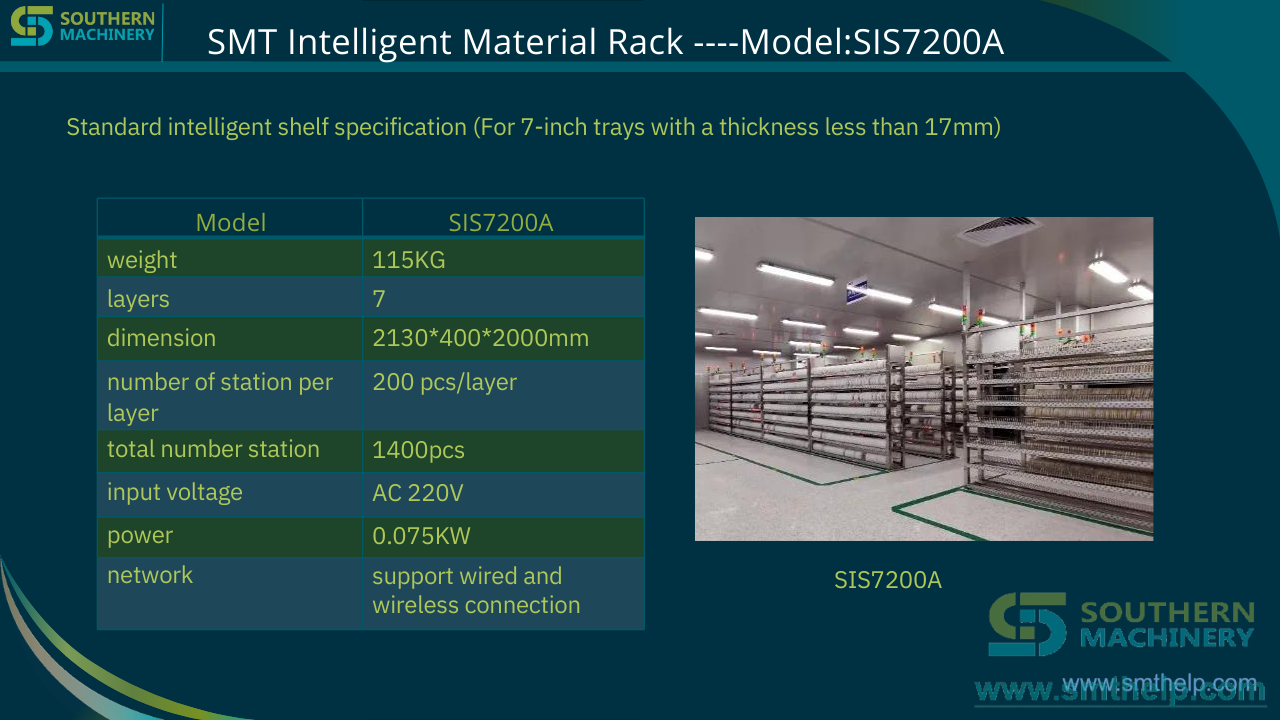
SMT Intelligent Reel Storage Rack for Line-Side Kitting by Southern Machinery
For EMS factories, SMT reels are not just warehouse items. They decide whether the SMT line starts on time, whether the right component reaches the right feeder, and whether production data can be traced when quality questions appear later. Southern Machinery's SMT Intelligent Reel Storage Rack is designed to move reel management from manual searching and paper records to scan-based, LED-guided, real-time material control.
Southern Machinery was founded in Shenzhen, China in 2011. We focus on high-efficiency, cost-effective SMT and THT PCB assembly automation equipment, serving 237+ global customers with complete line solutions covering SMT lines, THT insertion, wave soldering, board handling, inspection options, spare parts support, global service, and professional training.
What is this machine used for?
The SMT Intelligent Reel Storage Rack is used to store, locate, pick, return, and trace SMT component reels more accurately. In a typical PCB assembly factory, it helps operators find the correct reel by barcode and LED indication instead of walking through shelves, checking labels manually, or relying on memory.
In simple terms, it is a smart storage and kitting station for SMD reels. It supports faster production preparation, cleaner inventory records, fewer wrong-part risks, and better material visibility for MES or ERP workflows, depending on the final software integration.
The production problem it solves
Manual SMT reel management often looks acceptable until the factory changes products frequently. Then the hidden losses become obvious:
- Operators spend too much time finding the right reels for the next job.
- Inventory records do not match the physical shelf.
- Wrong reels can be picked for a work order, creating rework or quality risk.
- Engineers lack a clear reel movement history when investigating defects.
- Changeovers become slower because material preparation is not synchronized with the SMT line.
For high-mix EMS, automotive electronics, medical electronics, industrial control boards, and ODM production, these problems directly affect OEE, line utilization, and delivery reliability.
How the intelligent reel rack workflow works
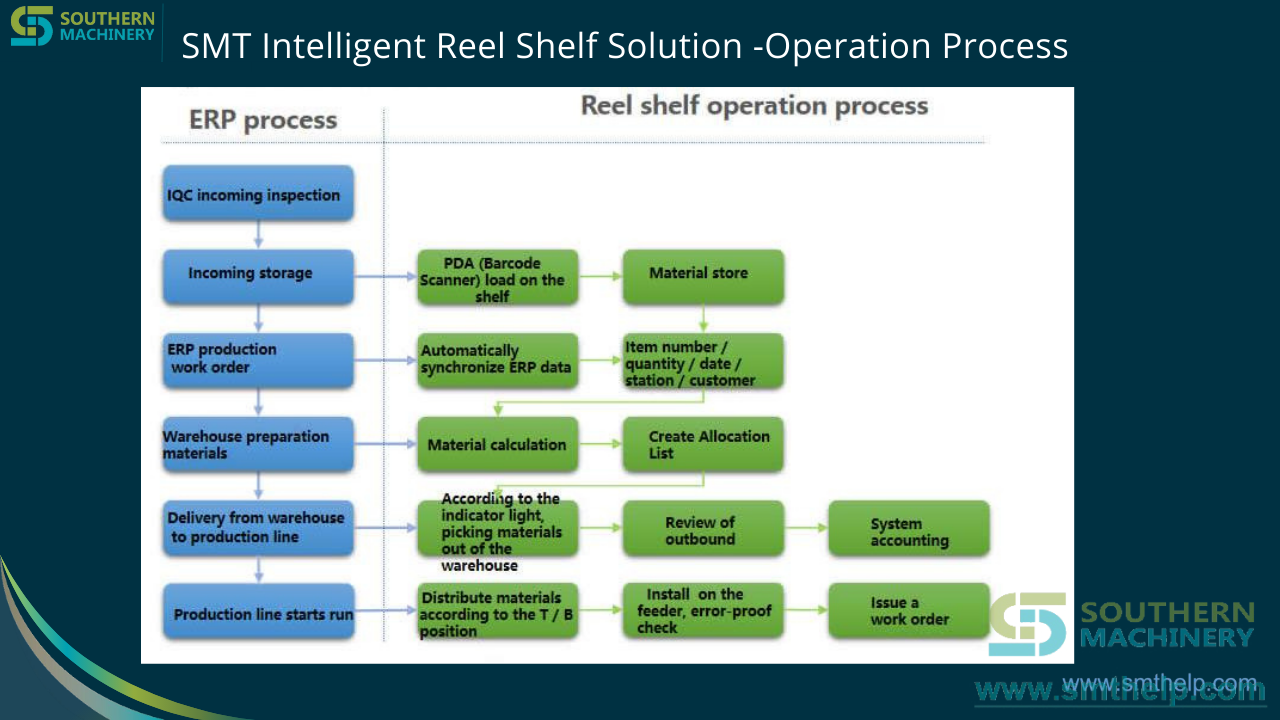
A practical workflow normally includes four steps:
- Receiving and barcode registration
Each reel is scanned into the system with its material ID, batch information, quantity, and location rules.
- Guided storage
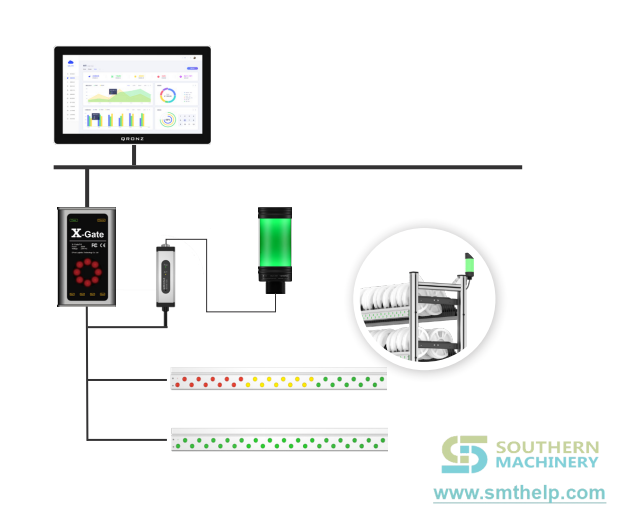
The rack indicates the target storage location with LED guidance, reducing operator judgment and placement errors.
- Work order picking and kitting
When a job is prepared, the system guides the operator to the correct reel locations. This can reduce searching time and help prevent wrong-part picking.
- Return and traceability
After production, remaining reels can be scanned back into storage, keeping inventory and movement records updated.
How it connects to a complete PCB assembly line
The intelligent reel rack is most valuable when it is treated as part of the full production flow, not as a standalone shelf.
In a Southern Machinery SMT line, it can support the material side of this process:
- SMT material receiving and reel storage before production.
- Stencil printing and SPI where correct paste and component preparation affect first-pass yield.
- Pick-and-place preparation where the feeder setup must match the BOM and work order.
- Reflow and AOI where traceability helps connect production results back to material batches.
- MES / ERP integration where scan records and reel movement can support digital factory management, depending on your system interface.
For factories that also run THT automation, wave soldering, selective soldering, board handling, or inspection stations, Southern Machinery can help design the full SMT + THT flow so material management, board movement, and process control work together.
Key selection parameters for buyers
Before choosing the final rack configuration, confirm these points:
- Reel size range: 7-inch, 13-inch, 15-inch, and any special reel formats used in your factory.
- Storage capacity target: number of reels required for line-side storage, central warehouse storage, or both.
- Barcode and label rules: existing material labels, customer labels, supplier labels, and internal traceability format.
- MES / ERP integration needs: whether you need simple local records or two-way data exchange with factory systems.
- Kitting workflow: whether operators prepare material by line, by work order, by product family, or by shift.
- MSD and FIFO control requirements: especially important for moisture-sensitive components and quality-sensitive production.
- Factory layout: distance between warehouse, feeder preparation area, and SMT lines.
- Future expansion: expected increase in product mix, reel count, SMT lines, and automation level.
ROI, quality, and capacity value
The source product page highlights example improvement targets such as 3-12 months ROI, more than 95% reduction in picking errors, and more than 75% faster kitting. These should be treated as example values, because real results depend on your current manual process, number of SMT lines, operator cost, product mix, software connection, and factory discipline.
The practical value is clear even without overpromising:
- Faster kitting helps reduce waiting time before line changeover.
- LED guidance helps reduce wrong reel selection.
- Real-time records help purchasing and warehouse teams see actual material status.
- Traceability helps quality teams investigate batch-related issues.
- A structured material workflow makes future MES and smart factory upgrades easier.
Typical application scenarios
This system is especially suitable for:
- EMS factories with frequent product changeovers.
- ODM manufacturers managing many customer BOMs.
- Automotive electronics plants that require stronger material traceability.
- Medical electronics and industrial control PCB assembly where wrong components create high risk.
- SMT lines where operators still spend too much time searching shelves before production.
- Factories preparing for MES, barcode traceability, or smart warehouse upgrades.
Why choose Southern Machinery?
Southern Machinery builds practical PCB assembly automation equipment for real production environments. We can support not only intelligent SMT reel storage, but also the complete automation chain around it: SMT line configuration, THT insertion, wave soldering, board handling, inspection, customized feeders, nozzles, training, spare parts, and remote technical support.
Our approach is straightforward: match the equipment to your product mix, capacity target, factory layout, quality requirements, and budget. If an intelligent rack is enough, we will say that. If your bottleneck is actually feeder preparation, placement capacity, THT insertion, or soldering, we will help you identify that before you invest.
FAQ
1. Can the rack work without MES?
Yes. It can be used as a local smart storage and picking system. MES or ERP integration is useful when you need stronger traceability and factory-wide inventory synchronization.
2. Is it only for large EMS factories?
No. Large factories usually gain the most from scale, but high-mix medium-size factories can also benefit if manual reel searching, wrong picking, or inventory mismatch is already hurting production.
3. Does it replace all warehouse operators?
No. It reduces manual searching and improves accuracy. Operators still manage receiving, scanning, kitting, returns, and exception handling, but the workflow becomes faster and more controlled.
4. Can Southern Machinery match the rack to our current SMT lines?
Yes. We can review your line count, reel quantity, label format, feeder preparation area, and software needs, then recommend a suitable rack layout and integration plan.
5. Are ROI numbers guaranteed?
No. ROI depends on your current labor cost, line downtime, error rate, changeover frequency, and software usage. The figures above are example targets from the product material and should be confirmed during project evaluation.
6. What information is needed for a configuration proposal?
Please share your number of SMT lines, monthly production volume, reel quantity, reel sizes, current kitting process, MES/ERP requirement, and available warehouse or line-side space.
CTA: build a cleaner SMT material flow
If your SMT line is losing time because reels are hard to find, inventory is inaccurate, or changeovers are slow, the SMT Intelligent Reel Storage Rack is a practical place to start. Southern Machinery can review your current material flow and recommend a cost-effective configuration that fits your factory today while leaving room for future SMT, THT, wave soldering, board handling, and inspection upgrades.
Comments