
SME800 Electric Stencil Cleaner: Fixed Spray Rods, 1 µm Filtration and Fast Drying by Southern Machinery
Manual stencil cleaning leaves paste balls in apertures, inconsistent results between shifts and long dry times between jobs. The SME800 electric stencil cleaner from Southern Machinery automates clean-rinse-dry with four fixed spray rods, real-time 1 µm dual filtration on cleaning liquid and DI water, and a 5.5 HP hot-air blower for fast drying of stencils up to 750×750×40 mm. This guide covers how it works, typical applications, integration into a complete SMT/THT PCB assembly line, key selection parameters and the labor, quality and payback impact for EMS, ODM, automotive, medical and industrial electronics manufacturers.
Aug 27, 2026 · Updated Aug 27, 2026 · Southern Machinery
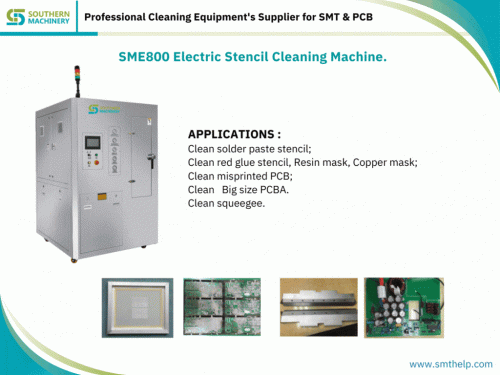
SME800 Electric Stencil Cleaner: Fixed Spray Rods, 1 µm Filtration and Fast Drying by Southern Machinery
Stencil cleaning is easy to overlook on an SMT line — until blocked apertures cause paste misprints, solder paste balls wash back onto the stencil, or a weak drying step stretches changeover time. The SME800 electric stencil cleaner from Southern Machinery replaces operator-dependent hand scrubbing with a repeatable clean-rinse-dry cycle: four fixed spray rods clean while the stencil moves by motor, DI water rinses through real-time 1 µm filtration, and four hot-air blades dry the stencil quickly with a 5.5 HP blower.
This guide explains the working principle, the hidden costs it removes, how it fits into a complete PCB assembly line, and the parameters to prepare when you request a configuration.
What is this machine used for?
The SME800 is an electric stencil cleaning machine used to remove solder paste, red glue and resin or copper mask residue from SMT stencils between print jobs — and to clean misprinted PCBs. The stencil is placed in the chamber (up to 750 × 750 × 40 mm), cleaning parameters are set, and the machine runs an automatic sequence: four fixed spray rods spray aqueous cleaning liquid while the stencil moves forwards and backwards by motor, four fixed spray bars rinse with DI water, and four hot-air blades dry the stencil with a 5.5 HP hot-air blower.
In short: it keeps stencil apertures clear and print quality consistent, so paste misprint and rework stop being a daily variable.
The hidden cost of manual stencil cleaning
Every stencil with residue and every drop of wasted cleaning liquid costs money. An electric stencil cleaner changes that math:
- Solder paste balls return. Without real-time filtration, paste balls wash back onto the stencil and re-contaminate boards.
- Blocked apertures. Residue in stencil apertures causes paste misprint and rework.
- Soft hoses wear out. Bending liquid and air hoses on moving spray heads fail and leak frequently.
- Long dry times. Weak drying slows the stencil changeover between jobs.
- Plastic pipes contaminate. Plastic liquid pipes risk contamination and corrosion in cleaning chemistry.
- Manual results vary. Hand-cleaning quality depends on the operator, batch and shift.
How the SME800 cleans a stencil
The machine runs a four-step cycle:
- Load the stencil. Place the stencil (up to 750 × 750 × 40 mm) in the chamber and set the cleaning parameters.
- Spray clean. Four fixed spray rods spray aqueous cleaning liquid while the stencil moves forwards and backwards by motor.
- DI rinse. Four fixed spray bars rinse with DI water; real-time 1 µm filtration keeps solder paste balls out.
- Hot-air dry. Four hot-air blades dry the stencil; a 5.5 HP blower shortens dry time.
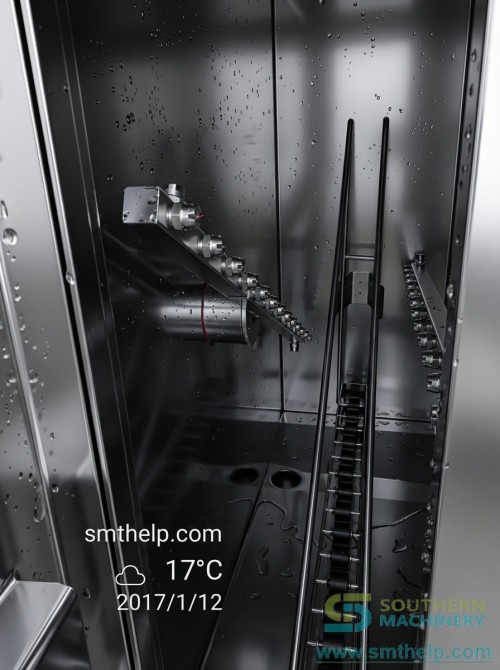
Stencil moves, rods stay fixed
The SME800 design keeps the spray rods and air blades fixed while the stencil moves by motor (reference SME800 design). There are no soft liquid or air hoses that bend, rub and wear down — which means less downtime and fewer leaks compared with cleaning heads that travel on flexible hoses.
Real-time 1 µm dual filtration
Filtration grade is 1 µm on both the cleaning liquid and the DI water circuit, in real time. This keeps solder paste balls from returning to the stencil and re-contaminating boards after rinsing — a common failure point in machines without real-time filtering.
Key specifications for project evaluation
Values come from the SME800 electric stencil cleaning machine brochure (2021) and support initial evaluation. Final configuration is confirmed against your stencils and cleaning liquid.
| Parameter | SME800 value |
| --- | --- |
| Stencil size | 750 mm (L) × 750 mm (W) × 40 mm (H) maximum |
| Cleaning agent | Aqueous cleaning liquid for cleaning; DI or DM water for rinsing |
| Tank capacity | 60 L maximum (liquid tank and water tank) |
| Way of cleaning | 4 fixed spraying rods spray liquid; the stencil moves forwards and backwards by motor |
| Way of rinsing | 4 fixed spraying bars spray DI water; stencil moves forwards and backwards |
| Way of drying | 4 hot-air blades blow hot air; 5.5 HP hot-air blower for frequent start and stop |
| Filter grade | 1 µm for cleaning, 1 µm for DI water (real-time filtering) |
| DI water supply | Open-loop 30–60 L/min (≤ 0.4 MPa); closed-loop cyclic with conductivity-based discharge |
| Electric pump | 4 HP stainless steel pump |
| Fluid path | Total SUS304 liquid pipes with angle valves, no plastic hose |
| Electrics | Mitsui PLC, touch panel, inverter and breakers; Schneider relays and contactors; Omron switching power supply |
| Applications | Solder paste stencils, red glue stencils, resin / copper masks, misprint PCB cleaning |
Cleaning results: reference before/after samples show effective solder paste removal, and effective cleaning of red glue and copper mask residue. All specifications remain subject to final technical confirmation for your stencils and cleaning liquid.
Typical applications
The SME800 handles solder paste stencils, red glue stencils, resin and copper masks, and misprint PCBs, using aqueous cleaning liquid followed by a DI water rinse. It suits EMS, ODM, automotive electronics, medical electronics and industrial control manufacturers running stencil-based SMT printing with high-mix changeovers.
How the SME800 fits into a complete PCB assembly line
Stencil cleaning sits at the front of the SMT process: between print jobs, the SME800 restores stencil aperture definition so the printer keeps depositing consistent paste volume. Faster, repeatable cleaning shortens stencil changeover between product runs, and misprint PCB cleaning supports the rework loop before boards continue through placement and reflow. Downstream, THT processes such as wave soldering or selective soldering receive boards with cleaner, more predictable SMT printing — one more way Southern Machinery ties SMT, THT, wave soldering, board handling and inspection into one accountable line.
ROI, quality and capacity value
Southern Machinery shares a worked example for an EMS line cleaning stencils by hand today (reference estimate):
- 1 operator per shift freed from manual stencil scrubbing.
- ~50% less dry time with the 5.5 HP hot-air blower (reference estimate).
- <12 months typical payback for a stencil cleaner on a mid-size line (reference estimate).
- Quality stability from real-time 1 µm dual filtration and a documented, repeatable cycle.
ROI figures are planning estimates based on reference EMS lines; actual payback depends on stencil volume, liquid cost and quality targets. Southern Machinery calculates a line-specific payback with your numbers during the consultation.
Choosing the right stencil cleaner
Southern Machinery offers electric and pneumatic stencil cleaners:
- SME800 electric cleaner — electric drive with a 4 HP pump and 5.5 HP blower. Use when faster drying, DI rinsing and higher throughput matter.
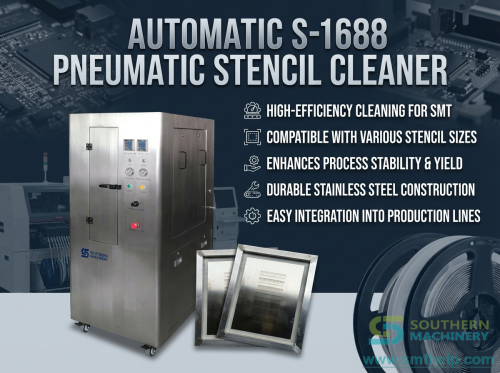
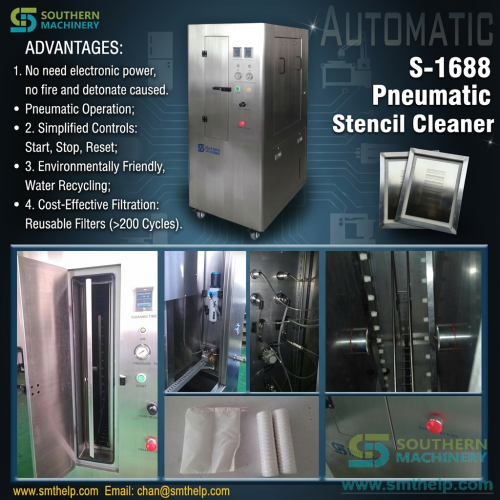
- S-1688 pneumatic cleaner — full pneumatic, no electric power. Use when flammable solvents are involved or power is limited.
- SME-750II dual-stencil cleaner — pneumatic cleaner for two stencils at once. Use for higher stencil volume.
Configuration checklist to send with your inquiry: stencil details (size up to 750 × 750 × 40 mm reference, solder paste / red glue / resin mask type), cleaning liquid (aqueous cleaner; DI water availability for rinsing), volume (stencils per day and cleaning intervals), and facility (power, DI water supply, drainage and floor space).
Installation and commissioning
Reference procedure for an electric stencil cleaner (full documentation ships with the machine):
- Site preparation. Place the machine on a solid, flat, clean floor with enough space for installation, spare parts and maintenance.
- Utilities. Connect power per the nameplate, DI water supply (30–60 L/min open loop reference) and drainage; connect the exhaust vent.
- Liquid and filters. Fill the cleaning liquid and water tanks; check the 1 µm filters for cleaning and DI water.
- Pre-run check. Check spray rods, air blades, pumps and valves; confirm the stencil transport moves freely.
- Clean test. Load a stencil, set the cleaning parameters, press start and verify the clean-rinse-dry result.
Engineering support around your cleaning deployment
Southern Machinery confirms the machine and cycle before you commit — the installation guide is included:
- Stencil and liquid review. Share your stencil types, cleaning liquid and volumes.
- Technical consultation. Model and cycle confirmed within 24 hours.
- Configuration. SME800 electric, S-1688 pneumatic or SME-750II dual matched to your line.
- Installation and training. Installation per the reference guide; operators trained on parameters.
- After-sales support. Warranty, spares and rapid technical follow-up.
FAQ
What does the SME800 clean?
Solder paste stencils, red glue stencils, resin and copper masks, and misprint PCBs, using aqueous cleaning liquid followed by a DI water rinse.
How does the cleaning process work?
The stencil moves forwards and backwards by motor while four fixed spray rods spray aqueous liquid, then four fixed bars rinse with DI water, then four hot-air blades dry it.
What size stencils fit?
Stencils up to 750 mm (L) × 750 mm (W) × 40 mm (H) are supported.
How is contamination prevented?
Real-time 1 µm filtration on both the cleaning liquid and DI water keeps solder paste balls from returning to the stencil and re-contaminating boards.
Why is drying fast?
A 5.5 HP hot-air blower with four air blades delivers a high air rate, greatly reducing dry time between jobs.
What utilities does the SME800 need?
Per the reference installation guide: power connected per the nameplate, a DI water supply (30–60 L/min open loop reference), drainage and an exhaust vent.
Next step: send your stencil and liquid details
Tell Southern Machinery your stencil types, cleaning liquid, volume and quality target. They reply with a machine recommendation, quotation and delivery schedule — quotation and delivery schedule are provided after technical confirmation, typically the same working day. Email info@smthelp.com or WhatsApp +86 136 0256 2576.
About Southern Machinery: founded in Shenzhen, China in 2011, serving 237+ global customers with high-efficiency, cost-effective SMT/THT PCB assembly automation equipment. Beyond stencil cleaning, Southern Machinery provides SMT, THT, wave soldering, board handling and inspection solutions for complete PCB assembly lines, backed by global service, spare parts support and professional training. Visit www.smthelp.com to browse the machine catalog.
Comments