
SME6200 Inline PCBA Cleaning Machine: Reliable Flux Residue Removal for PCB Assembly
The SME6200 inline PCBA cleaning machine washes, rinses, and dries circuit boards after reflow or wave soldering, removing flux residue for high-reliability PCB assembly.
Aug 19, 2026 · Updated Aug 19, 2026 · Southern Machinery
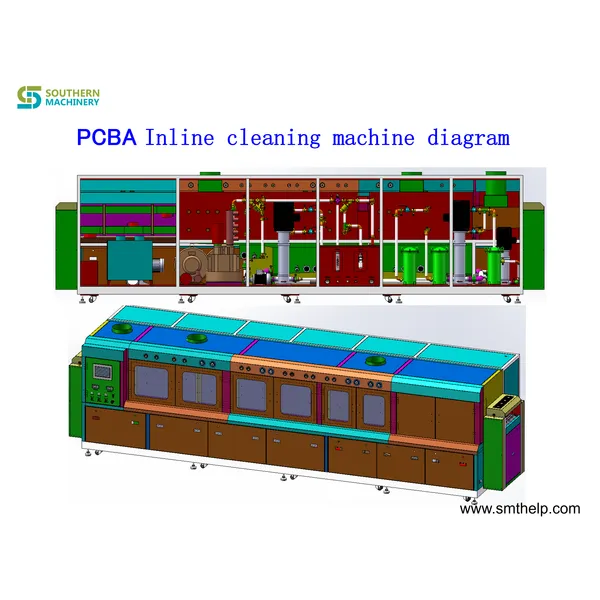
SME6200 Inline PCBA Cleaning Machine: Reliable Flux Residue Removal for PCB Assembly
Southern Machinery's SME6200 is an inline/online PCBA cleaning machine that washes, rinses, and dries assembled circuit boards continuously as part of the SMT line. It removes flux residue, solder balls, and ionic contamination after reflow or wave soldering — without taking boards out of production for batch cleaning.
What Is This Machine Used For?
The SME6200 is an in-line cleaning machine for assembled PCBs (PCBA). After a board exits the reflow oven or wave soldering machine, flux residue and other contaminants remain on the surface, under components, and around through-hole joints. The SME6200 carries boards through wash, rinse, and drying sections on a mesh conveyor, so cleaning happens automatically and continuously as part of the line — no operator handling, no batch queuing, and no separate cleaning cell.
Cleaning after soldering is essential for boards that must meet high reliability and ionic cleanliness standards: automotive electronics, medical devices, industrial control, telecom infrastructure, and other applications where residual flux can cause leakage current, electrochemical migration, dendrite growth, or coating adhesion failure.
Primary Functions:
- Post-reflow flux residue cleaning
- Post-wave soldering flux and contaminant removal
- Removal of solder paste balls and solder spatter
- Reduction of surface ionic contamination before conformal coating or final inspection
Typical Application Scenarios
| Industry | Why Inline Cleaning Is Used |
|---|---|
| Automotive electronics | High-reliability boards, IPC Class 3 requirements, conformal coating prep |
| Medical devices | Cleanliness and biocompatibility requirements; no-clean flux is often not acceptable |
| Industrial control | Long service life, harsh environments, coating adhesion |
| Telecom & networking | High-frequency performance affected by residue; ionic contamination control |
| LED lighting / power | Removal of flux residues that can affect optical components and reliability |
| EMS / ODM production | Mixed SMT+THT lines, high volume, consistent process quality |
In practice: an EMS factory running a mixed SMT + THT line uses the SME6200 between wave soldering and final assembly/inspection, or after reflow for boards destined for conformal coating. Automotive tier suppliers use it as a defined process step to meet ionic cleanliness targets before coating or potting.
How It Integrates into a Complete PCB Assembly Line
The SME6200 is designed for inline integration:
- After reflow oven — for boards that require post-reflow cleaning (e.g., before coating)
- After wave soldering — for THT/mixed boards where flux residue is heaviest
- Before conformal coating / dispensing — cleaning is a prerequisite for coating adhesion
- Before AOI / final inspection — clean boards inspect more reliably and consistently
It connects to your existing conveyor system at the standard SMEMA-style line height, so boards flow through automatically. Boards enter on the line conveyor, get washed with a water-based cleaning solution, rinsed (typically with DI water for ionic removal), dried with air knives and hot air, and exit onto the next station — all without operator intervention.
For a complete line, Southern Machinery supplies the full ecosystem around the cleaner: PCB handling (loaders, unloaders, conveyors, turn conveyors), wave soldering, stencil printing and cleaning, insertion machines, inspection, and material management — so the SME6200 slots into a line supplied by one accountable partner.
Key Selection Parameters
Confirm these with Southern Machinery for your specific boards, as no two lines are identical:
- Board size range — maximum and minimum PCB dimensions the conveyor and wash sections must handle
- Board thickness & component height — clearance in wash and dry modules for tall components
- Conveyor width & line height — must match your existing line's SMEMA interface
- Cleaning chemistry — water-based wash compatible with your flux types (rosin, no-clean, water-soluble)
- Rinse quality — DI water supply and resistivity requirements for ionic cleanliness targets
- Drying capacity — air knife + hot air dry performance for your board density and throughput
- Throughput / conveyor speed — match to the cycle time of your SMT line
- Facility requirements — power supply, exhaust, water supply, and drain connections
- Options — DI water system, filtration upgrades, specific nozzle configurations
Southern Machinery can recommend the right configuration based on your board profile, flux chemistry, and cleanliness requirements.
ROI, Quality & Throughput Perspective
Quality: consistent, repeatable cleaning replaces manual brushing or "clean enough" judgment. Every board gets the same wash, rinse, and dry cycle — exactly what ionic cleanliness and coating adhesion specifications demand.
Throughput: because the SME6200 is inline, there is no batch delay. Boards move at line speed instead of accumulating for an offline cleaning shift, removing a bottleneck and reducing work-in-progress.
Labor: no operator is needed to load/unload a separate cleaner, brush boards by hand, or inspect whether boards were cleaned properly. One inline station replaces manual effort on every board.
Rework & yield: removing residue before coating/inspection cuts coating defects, false AOI calls, and field failures caused by ionic contamination. On high-reliability products, avoiding a single field failure can pay for the machine many times over.
Line balance: with a dedicated inline cleaning step, downstream stations (coating, potting, final assembly, test) stop waiting on manual cleaning.
FAQ
Q: What does a PCBA online cleaning machine do?
A: It washes, rinses, and dries assembled PCBs inline — removing flux residue, solder balls, and ionic contamination after reflow or wave soldering, automatically and continuously as part of the SMT line.
Q: Is the SME6200 an inline or offline cleaning machine?
A: The SME6200 is an inline/online cleaning machine — boards enter on the line conveyor and exit cleaned, rinsed, and dried, with no batch handling.
Q: Which flux types can it clean?
A: Water-based cleaning systems handle rosin flux, no-clean flux, and water-soluble flux residues, plus solder paste balls and other organic/inorganic contaminants. Confirm your flux chemistry with Southern Machinery to get the right wash configuration.
Q: Can it integrate with my existing SMT/THT line?
A: Yes. It connects at the standard SMEMA-style conveyor height and works after reflow, after wave soldering, or before conformal coating. Confirm board size, conveyor width, and line height during configuration.
Q: Which industries need PCBA cleaning machines?
A: Automotive electronics, medical devices, industrial control, telecom, aerospace, LED lighting, and power electronics — anywhere residual flux poses a risk to reliability, ionic contamination, coating adhesion, or field failure.
Q: What support does Southern Machinery provide?
A: Southern Machinery, founded in 2011 in Shenzhen, China, serves 237+ global customers with SMT/THT PCB assembly automation. Support includes configuration advice, spare parts, training, and global service for the full line — SMT, THT, wave soldering, board handling, and inspection.
Contact Southern Machinery for Configuration Advice
Get a cleaning configuration matched to your board profile, flux chemistry, and cleanliness targets. Contact Jason Wu at jasonwu@smthelp.com or visit www.smthelp.com. Browse machine catalogs at file.autoinsertion.com and machine photos at ph.smthelp.com.
Watch the SME6200 in operation: How to operate PCBA inline cleaning machine for Smart EMS factory PCB assembly | What is online PCBA cleaning machine | PCB cleaning machine for high end SMT line | Automatic PCBA cleaning after wave soldering | PCBA cleaning for automotive electronics
Comments