
SME-6300 Inline PCBA Cleaning Machine: Wash, Rinse and Dry in One Pass by Southern Machinery
Flux residue, ionic contamination and off-line cleaning detours quietly raise rework, field-failure risk and throughput loss in PCBA production. The SME-6300 inline cleaning machine from Southern Machinery solves this at line speed: water-based wash, DI water rinse and hot-air dry in one continuous pass, without boards leaving the line. It processes PCBA from 50×50 mm to 500×400 mm at 0.1–1.5 m/min with 1 µm filtration and up to 100 °C drying. Built for EMS, ODM, automotive, medical and industrial electronics, the SME-6300 reduces operator-dependent cleaning, stabilizes ionic cleanliness and protects yields. Request a configuration review for your line.
Aug 27, 2026 · Updated Aug 27, 2026 · Southern Machinery
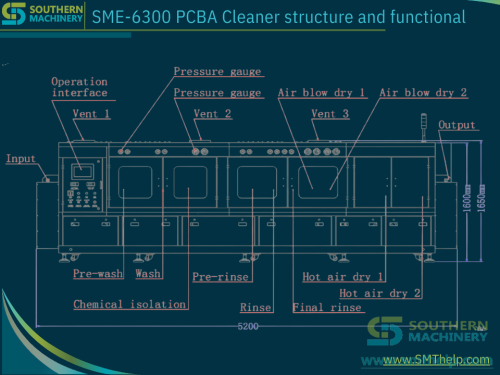
Flux residue does not usually fail on the first board. It fails later, in the field, on the warranty line. The SME-6300 inline PCBA cleaning machine removes rosin, water-soluble and no-clean flux residues, plus organic and inorganic contaminants, with a water-based wash, DI water rinse and hot-air dry — all in one continuous pass, without the board ever leaving the production line.
Southern Machinery designed the SME-6300 for mass-production EMS, ODM, automotive, medical and industrial electronics lines that need documented, repeatable cleanliness instead of operator-dependent hand washing or throughput-breaking batch detours.
What is this machine used for?
The SME-6300 is a water-based inline PCBA cleaning system used to clean assembled printed circuit boards between soldering and downstream processes. It washes, rinses and dries boards in one pass, removing rosin, water-soluble and no-clean flux residues as well as organic and inorganic contaminants. Because cleaning happens inline, boards never leave the line to queue for an off-line batch cleaner — the clean, dry board simply continues automatically to the next process.
Why inline PCBA cleaning changes the cost picture
Every residue-related failure and every board that leaves the line for cleaning costs money. The source brochure for the SME-6300 lists the classic problems:
- Residue left on the board — incomplete flux removal causes leakage, corrosion and reliability failures in the field.
- Batch cleaning breaks the flow — off-line cleaning means boards leave the line, queue and come back, killing throughput.
- High-end products demand cleanliness — automotive, medical and industrial electronics require ionic cleanliness that hand or simple washing cannot guarantee.
- Manual washing is inconsistent — results vary by operator and residues remain in hard-to-reach areas.
- Water and chemistry waste — uncontrolled washing consumes DI water and detergent without predictable results.
An inline system turns cleaning from a detour into a process step: wash, rinse and dry are completed in sequence at line speed, with controlled temperatures, filtration and resistivity.
How the SME-6300 works: three inline units
Boards travel left to right through three inline units, exactly as described in the SME-6300 brochure:
- Water-based wash — removes rosin, water-soluble and no-clean flux residues plus organic and inorganic contaminants. Liquid temperature ranges from room temperature to 80 °C.
- DI water rinse — clears ionic residue from the board surface with DI water at 0–18 MΩ resistivity, supplied at 6–15 L/min.
- Hot-air dry — dries the board completely at up to 100 °C before it exits the line.
- Back to the line — the clean, dry board continues automatically to the next process, inline and ready for mass production.
The system uses a 1 µm liquid filter for consistent cleaning quality, with clean, pre-rinse and rinse tanks of 280 L, 60 L and 40 L.
Typical application scenarios
The SME-6300 fits lines where ionic cleanliness and continuous flow are both non-negotiable:
- Automotive electronics — ECUs, sensors and power modules where ionic residue is a field-reliability risk.
- Medical devices — assemblies that must meet documented cleanliness expectations.
- Industrial control — boards exposed to humidity, vibration and long service life.
- High-volume consumer and ODM production — where batch cleaning queues would otherwise cap throughput.
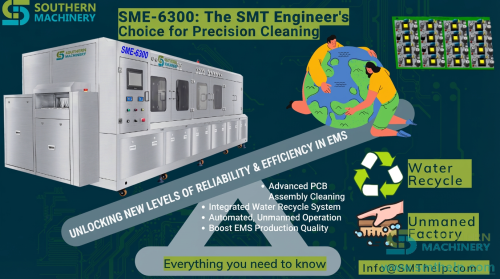
Integrating the SME-6300 into a full PCB assembly line
The SME-6300 is positioned in the inline flow after soldering and before downstream inspection, test or coating processes (exact placement depends on your line configuration). Three things make integration straightforward:
- Matching net height — 900 ± 25 mm reference, aligned with adjacent line equipment.
- One-pass layout — a reference footprint of about L5200 × W1650 × H1650 mm with left-to-right board flow at 0.1–1.5 m/min.
- Documented installation procedure — site preparation, line alignment, utility connection, pre-run check and test run are covered in the machine documentation.
For utilities, plan for AC 380 V 3-phase 50/60 Hz power (110 kW reference), DI water at 6–15 L/min, compressed air at 0.5–0.7 MPa (200–400 L/min) and exhaust of about 40 m³/min.
Key specifications for project evaluation
| Parameter | SME-6300 (from brochure) |
|---|---|
| PCBA max size | 500 × 400 mm (W × L) |
| PCBA min size | 50 × 50 mm |
| PCBA thickness | 100 mm (with components) |
| Net width / speed | 500 mm · 0.1–1.5 m/min · left to right |
| Net height | 900 ± 25 mm |
| Wash liquid temp | Room temperature to 80 °C |
| DI water temp | Room temperature to 60 °C |
| Dry temp | Room temperature to 100 °C |
| DI water supply | 6–15 L/min · 0–18 MΩ |
| Filtration | 1 µm liquid filter |
| Tanks | Clean 280 L · pre-rinse 60 L · rinse 40 L |
| Air supply | 0.5–0.7 MPa · 200–400 L/min |
| Power | AC 380 V, 3-phase, 50/60 Hz, 110 kW |
| Exhaust / noise | About 40 m³/min · about 70 dB |
| Machine size / weight | L5200 × W1650 × H1650 mm · 2,800 kg |
Values support initial evaluation and remain subject to final technical confirmation against your boards, flux types and line layout.
Key selection checklist
When you send an inquiry for inline cleaning, include:
- Board details — size, thickness, component heights and daily volume.
- Flux types — rosin, water-soluble or no-clean; contamination level.
- Line integration — inline position, net height matching and available footprint.
- Facility — power, DI water supply, compressed air and exhaust.
- Quality target — required ionic cleanliness level, for example DI resistivity 0–18 MΩ.
Southern Machinery also offers a full cleaning family for different tasks: SME-6200 / SME-7600 inline cleaners for other line capacities, SC810 / SC820 / SC860 semi-inline machines, SME-5200 / SME-5300 pallet and fixture cleaners, S-6200 / SME-24 nozzle cleaners, and the CTM-500S ionic tester to verify cleaned boards.
ROI and quality value
The brochure presents a worked example for a mid-size EMS line moving from batch or manual cleaning to inline cleaning:
- 0 boards leaving the line for cleaning — inline keeps the flow moving.
- 100% inline completion — chemical wash, rinse and dry in sequence.
- ~30% lower field-failure / rework risk from uncontrolled residues (reference estimate).
- <24 months typical payback on a high-volume line (reference estimate).
These ROI figures are planning estimates based on reference EMS lines; actual payback depends on board volume, flux types and quality targets. Southern Machinery calculates a line-specific payback with your numbers during the consultation.
FAQ
What does the SME-6300 clean?
It cleans rosin, water-soluble and no-clean flux residues, plus organic and inorganic contaminants, from assembled PCBA using a water-based process.
How does the inline process work?
Boards travel left to right through three inline units: water-based chemical wash, DI water rinse (0–18 MΩ) and hot-air drying up to 100 °C — all in one pass, without leaving the line.
What board sizes can it handle?
PCBA from 50 × 50 mm to 500 × 400 mm, up to 100 mm thick with components, at 0.1–1.5 m/min.
Is it suitable for automotive and medical boards?
Yes — the DI rinse with controlled resistivity (0–18 MΩ) delivers the ionic cleanliness that automotive, medical and industrial electronics require.
What are the facility requirements?
AC 380 V 3-phase 110 kW power, DI water supply 6–15 L/min, air 0.5–0.7 MPa, exhaust about 40 m³/min, and a footprint of about L5200 × W1650 × H1650 mm.
How do I get a price and delivery time?
Email info@smthelp.com or WhatsApp +86 136 0256 2576 with your board details, flux types and volume. Quotation and delivery schedule are provided after technical confirmation.
Next step: get a cleaning proposal for your line
Southern Machinery was founded in 2011 in Shenzhen, China, and serves 237+ customers worldwide with SMT and THT PCB assembly automation equipment — from placement support and THT insertion to wave soldering, board handling and inspection. Beyond the SME-6300, we provide complete line solutions with high-efficiency, cost-effective machines, global service, spare parts support and professional training.
Send your board size, flux types, cleanliness target and daily volume to info@smthelp.com or WhatsApp +86 136 0256 2576 for a machine recommendation, configuration, quotation and delivery schedule — typically the same working day.
Comments