
SMD Reel Taping Machine for Re-Reeling by Southern Machinery
SMD reel taping machine guide: repack tray, tube and bulk parts into 8-200 mm carrier tape at up to 400 m/h, with empty-pocket detection and dual-stage sealing.
Oct 7, 2026 · Updated Oct 7, 2026 · Southern Machinery
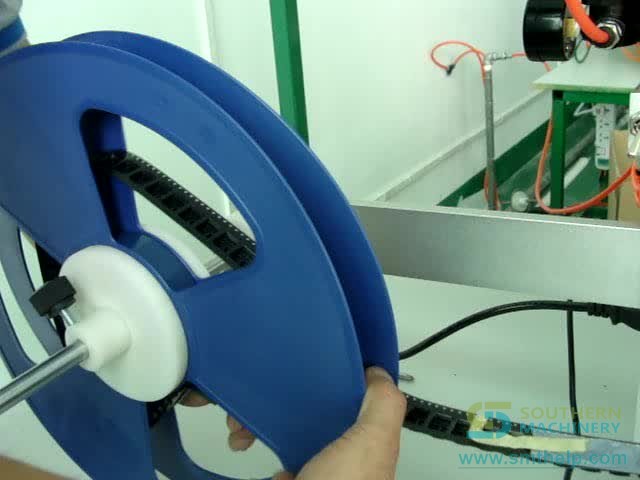
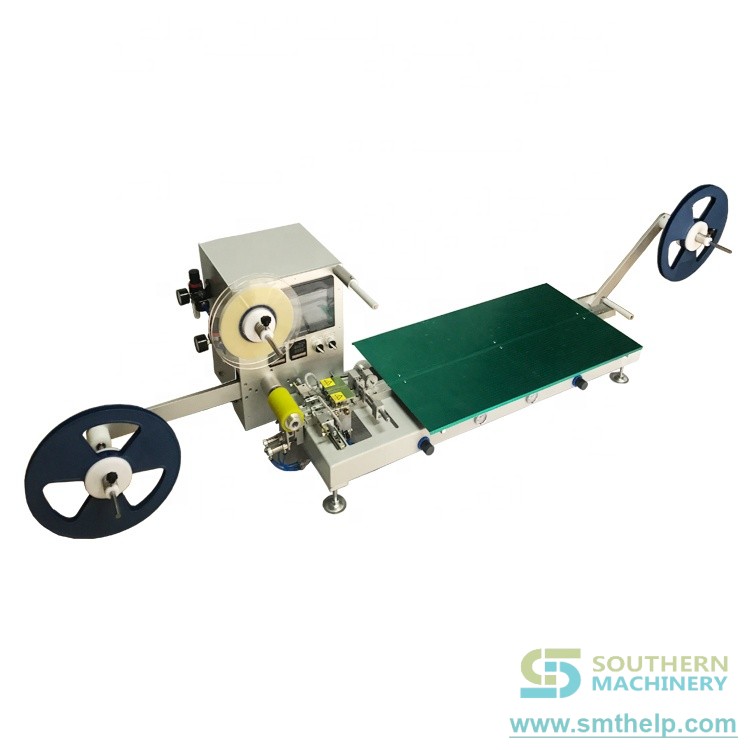
An SMD reel taping machine repacks loose parts — from trays, tubes, bulk bags or a rejected reel — back into embossed carrier tape sealed with cover tape, so a pick-and-place feeder takes them exactly like a factory reel. The SJL80A Semi-Auto SMD Reel Taping Machine from Southern Machinery seals at an adjustable speed of up to 400 metres per hour across 8–200 mm carrier tape, runs a dual-stage heat or PSA sealer with independent temperature per cover-tape side, and alarms on every empty pocket. Loose parts in, mounter-ready reels out.
What is an SMD reel taping machine used for?
It exists because of one packaging mismatch: components that arrive in trays, tubes or bulk cannot be fed to a mounter, and components on a damaged or part-used reel often cannot be re-fed either. Someone has to convert them into taped, sealed, counted reels before the line can run — and usually that person works at a bench with a hand sealer.
What goes in and what comes out
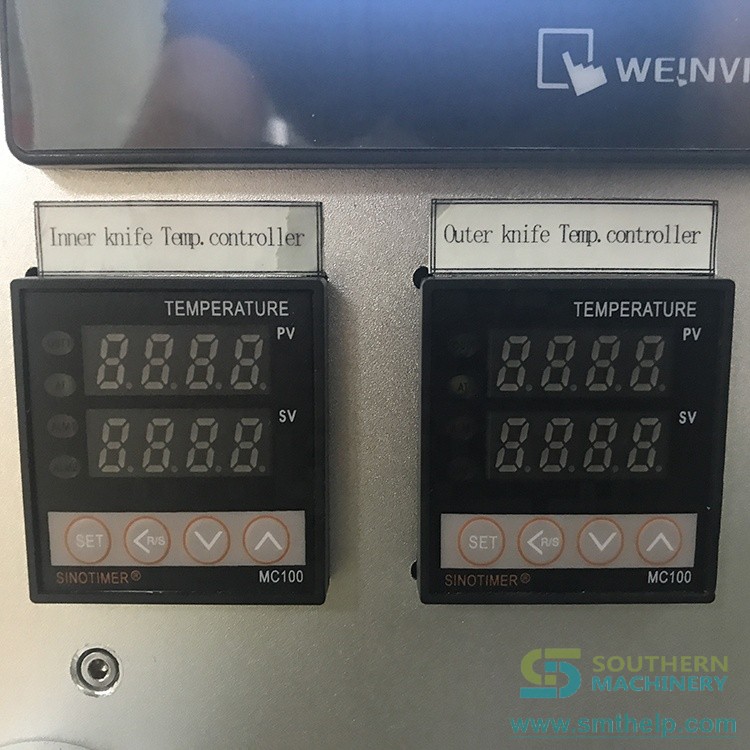
The input side is deliberately wide: radial parts, semiconductors, passives and mechanical parts arrive as trays, tubes or bulk. The output is a sealed reel — automatic sealing and furling onto a plastic spool, wound from carrier tape sized 8 to 72 mm or 8 to 200 mm on a screw-driven adjustable track. Empty-pocket detection (EPD) and a low-cover-tape sensor watch the run, so a pocket that passes without a component raises an alarm instead of a silent gap in the reel. In high-mix plants one adjustable track replaces a collection of jigs, and one finished spool joins kitting as a countable, mounter-feedable unit.
SMD reel taping machine or manual repack bench — which costs less per reel?
Hand repacking looks cheap because its cost hides in salaries and in the failures it sends downstream. The machine looks expensive because the investment appears on one invoice. Compared item by item, the picture changes.
- Packing speed — manual: operator pace, one part at a time. SJL80A: adjustable, up to 400 m/h of carrier tape.
- Empty pockets — manual: found later at the mounter. SJL80A: EPD detects and alarms, with a low-cover-tape warning.
- Seal quality — manual: hand or semi-manual peel that drifts between operators. SJL80A: dual-stage sealer, independent temperature per cover-tape side.
- Tape coverage — manual: a jig or setup per format. SJL80A: 8–72 mm and 8–200 mm on one adjustable track.
- Labour and ESD — manual: paid per hour at the bench, loose parts through bare hands and open trays. SJL80A: runs beside other work inside a taped, sealed format.
Where the manual bench hides its cost
The direct cost per reel is small and easy to see; the indirect cost is not. One missed pocket becomes one skipped placement and one failed board, discovered only after the board has absorbed printing, placement and reflow. Kitting waits on repacked reels, so the mounter — your most expensive asset — idles for a packaging step. The source document lists the same failures plainly: bench labour, undetected empty pockets, drifting seal quality, kitting delays, ESD exposure and no lot traceability. Against that, the machine makes packing schedulable — an adjustable automatic sealing and furling rate is a number you can plan a kit list around — and it moves the empty-pocket alarm to the machine instead of the mounter.
How do you work out repack cost per reel?
Price the two hidden terms — bench labour and downstream rework — and compare them with the amortised machine cost.
Annual repack labour cost = repack operator hours per year × loaded labour rate
Annual rework cost        = empty-pocket + seal-failure events per year × cost per reworked board
Annual repack cost today  = labour + rework + consumable waste
Machine payback (years)   = SJL80A investment ÷ (labour released + rework avoided)
A worked example
Example only — depends on configuration; subject to final technical confirmation. A bench running two operators four hours a day, 250 days a year, consumes 2,000 repack hours; at a loaded rate of USD 6 per hour for illustration, that is USD 12,000 a year before any rework. Add 40 empty-pocket or seal-failure events a year at USD 120 each and the pool grows by USD 4,800 — roughly USD 16,800 the machine can attack in this example. Divide the SJL80A investment you are quoted by the share of that pool the machine actually releases, and you have payback in years. Southern Machinery publishes no guaranteed ROI figure, because the answer depends on your component mix, package formats, volume and loaded labour rate; send those four inputs and the quotation arrives configured to your numbers.
How does the SJL80A fit into a complete PCB assembly line?
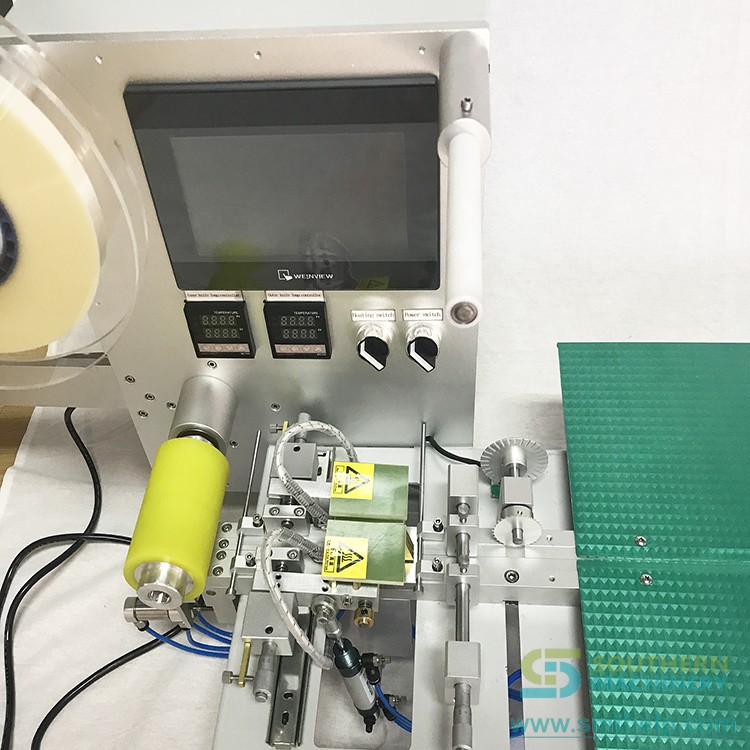
It sits upstream of placement, beside material preparation. Components arrive in trays, tubes or bulk from receiving or a returned kit; the SJL80A repacks them; the finished spools join kitting and go to the feeder bank. A SMEMA-compatible interface is available for plants that want the taping step inside inline material handling instead of run as an island.
Upstream sources and the feeder bank
Three streams feed the machine: components bought without reel packaging, parts de-kitted from a finished or cancelled build, and part-used or damaged reels needing new spools, carrier tape and cover tape. Downstream, a properly sealed reel with consistent pocket attitude is what the feeder expects, and EPD is what stops an incomplete reel reaching it. For the wider picture, see Southern Machinery's SMT machine category, the THT machine category and the one-stop PCB assembly total solution.
Which SJL80A specifications decide your configuration?
Values below are from the official Southern Machinery SJL80A datasheet and support initial evaluation; they remain subject to final technical confirmation against your component mix, tape widths and line layout.
- Packing mode — automatic sealing, furling and manual empty; touch-screen operation.
- Packing speed — adjustable, as high as 400 metres per hour.
- Applicable scope — 8–72 mm and 8–200 mm carrier tapes.
- Function — empty-pocket (starvation) detection and alarm; low cover-tape sensor.
- Sealing — dual-stage heat and PSA sealer; independent temperature per cover-tape side.
- Temperature range — room temperature to 300 °C.
- Power and air — AC220 V, 400 W; 0.4–0.6 MPa compressed air.
- Footprint and weight — L170 × W60 × H60 cm; 35 kg benchtop.
- Extras — footswitch control; screw-adjustable track; retractable-motor sealing; SMEMA interface; different machine lengths available.
The three decisions that matter
Carrier tape width comes first: 8–72 mm and 8–200 mm cover most formats, and the adjustable track makes a width change a setup rather than a machine change. Seal method comes second: heat seal or PSA, with the working setpoint for your own cover tape validated during the trial run rather than assumed — the machine reaches 300 °C, so the setpoint is a process decision. Placement comes third: AC220 V, 400 W and 0.4–0.6 MPa air are the only utilities, and at 35 kg it can sit beside kitting or at the end of material preparation.
What does it take to run the SJL80A from installation to spare parts?
Installation and operator training are included free, and the ramp is five steps: site the unit on a stable workbench with room for supply reels and the take-up spool; connect AC220 V (400 W) and 0.4–0.6 MPa air; load empty carrier tape, set track width and seal temperature, and verify the EPD sensor; run a trial with your own components to check pocket seating, seal quality and speed; then ramp with training. Operator training to full mastery is given as one day.
Running cost and uptime
Running cost sits in three consumables — plastic spools, carrier tape and cover tape, all supplied to match your components. Lot control is the quieter benefit: because repacking becomes a machine step, a reel belongs to a build rather than to whoever filled it, which is the first requirement of any traceability conversation with an EMS customer. Afterwards, Southern Machinery provides 24/7 worldwide support and a one-day spare-part lead time; on a bench-class machine that lead time decides whether a repack queue delays a build, so confirm the wear-parts list at handover.
Frequently asked questions about the SJL80A SMD reel taping machine
What can the SJL80A repack?
Trays, tubes and bulk components — radial parts, semiconductors, passives and mechanical parts — into embossed carrier tape sealed with heat or pressure-seal cover tape, ready for your pick-and-place.
How fast is the packing speed?
Adjustable up to 400 metres per hour with automatic sealing and furling; actual speed depends on component size and pocket pitch, and Southern Machinery confirms the number for your components.
Which carrier tape widths does it handle?
8 to 72 mm and 8 to 200 mm, with a screw-driven adjustable track for quick width changeover.
How does empty-pocket detection work?
EPD detects pockets with no component and raises an alarm; a low-cover-tape sensor warns before the cover tape runs out. Complete reels only.
What utilities does it need?
AC220 V (400 W) and compressed air at 0.4–0.6 MPa. It is a 35 kg benchtop unit and no special foundation is required.
How do I get a quote and packaging recommendation?
Email info@smthelp.com or WhatsApp +86 136 0256 2576 with your component samples, package format and monthly volume; the configuration, quotation and process recommendation come back within 24 hours.
Send your components for a packaging recommendation
Tell Southern Machinery which components you repack today, their package format and monthly volume. You get a configuration, a quotation and a process recommendation within 24 hours, plus the documents behind this page: the SJL80A SMD Reel Taping Machine catalog, the S-300B molding and taping machine for high-volume work, and the taped components lead cutting and forming machine.
Southern Machinery has built SMT and THT PCB assembly automation equipment in Shenzhen, China since 2011 and serves 237+ customers worldwide, with high-efficiency, cost-effective machines, global service, spare-parts support and professional training.
Comments