
Smart SMT Stencil Storage System for Printing Workflow Control by Southern Machinery
A smart SMT stencil storage system helps EMS factories cut hidden losses in stencil searching, wrong-stencil risk, and weak rotation control. Based on materials from Southern Machinery, this guide explains how intelligen
Jul 7, 2026 · Updated Jul 7, 2026 · Southern Machinery
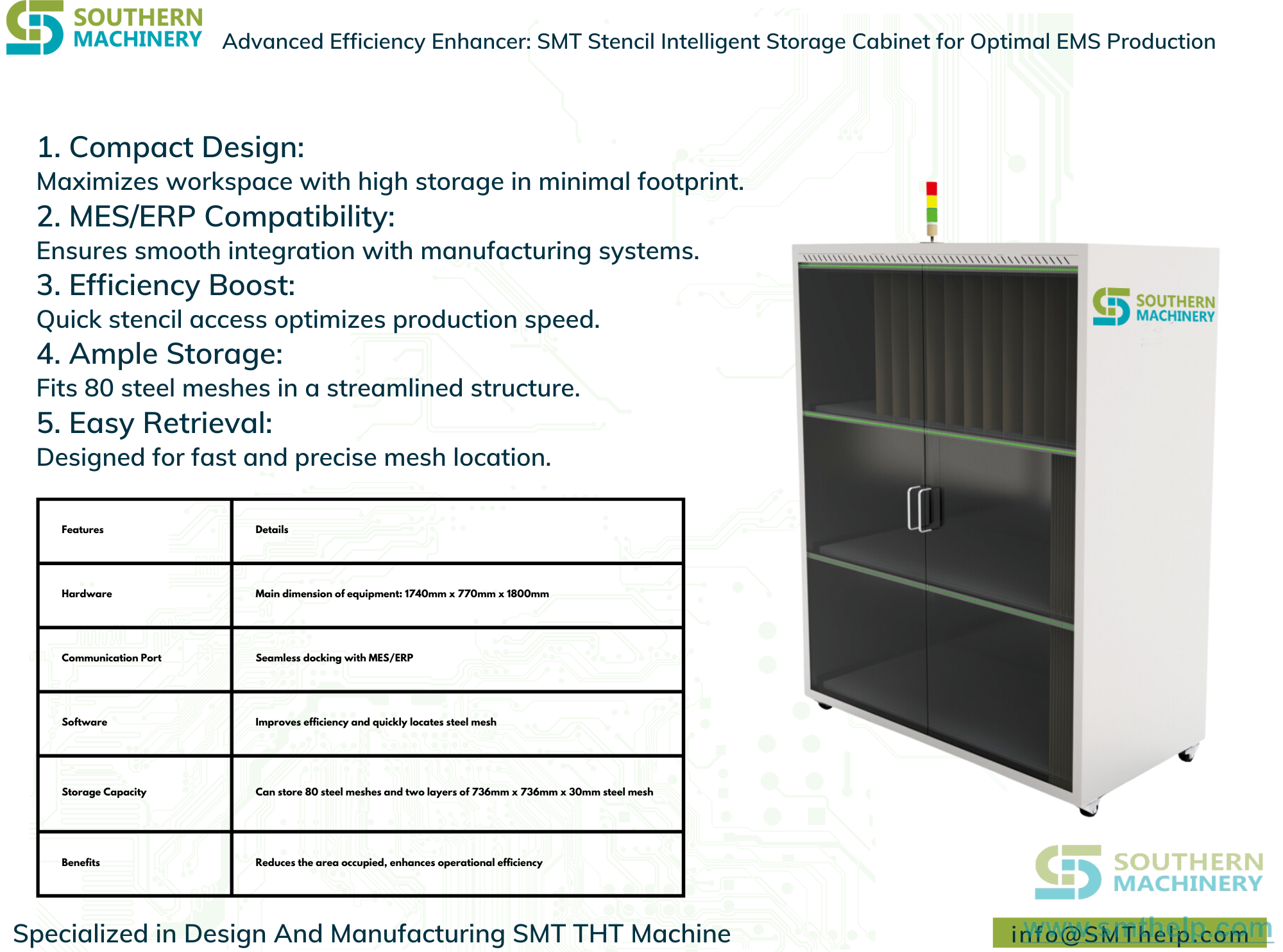
Smart SMT Stencil Storage System for Printing Workflow Control by Southern Machinery
Manual stencil storage looks simple until production changes models several times per shift. Operators search cabinets, manually confirm stencil identity, and rely on memory or paper records to track usage. In a busy EMS factory, those small delays can become real SMT line losses.
Southern Machinery's Smart SMT Stencil Storage System is designed for factories that want a cleaner, more traceable stencil workflow before solder paste printing. It's not just a cabinet; it's a controlled storage point for stencil search, retrieval, rotation, and production preparation.
What is this machine used for?
The Smart SMT Stencil Storage System stores, identifies, and manages SMT solder paste stencils before they enter the printing process. Its main job is to help operators find the correct stencil faster, reduce manual search errors, and enable better control over stencil usage in a modern SMT line.
In practical terms, it helps answer three daily production questions:
- Where is the correct stencil for this PCB model?
- Has this stencil been used, rotated, or maintained correctly?
- Can the operator prepare the next job without slowing the printer and placement line?
Why stencil management matters in SMT production
Stencil printing is one of the first process steps in SMT assembly, and mistakes here can propagate downstream into placement, reflow, AOI, and rework. If the wrong stencil is pulled, if the stencil can't be found quickly, or if usage tracking is weak, the line can lose time before production even starts.
The source document highlights three typical pain points:
- Manual searches and inefficient stencil workflows create hidden cost.
- Automated tracking and rotation can support more stable printing quality.
- A smarter process can improve line efficiency when stencil changeover is frequent.
The source email gives example improvement figures including reduced search time, higher overall efficiency, and fewer printing defects. These numbers should be treated as examples from the source document, not a universal guarantee. Actual results depend on stencil quantity, product mix, operator workflow, software integration, and the current factory baseline.
Typical application scenarios
This system is most relevant for EMS, ODM, automotive electronics, medical electronics, industrial control, LED driver, and consumer electronics factories with multiple PCB models and frequent stencil changes.
It's especially useful when:
- The factory stores many stencils across racks, rooms, or production areas.
- Operators spend too much time searching before changeover.
- Wrong-stencil risk is a concern during high-mix production.
- The SMT team wants better usage history and rotation control.
- Management wants a more digital material and tooling workflow.
- The factory is preparing for MES or ERP-connected traceability.
For a low-mix factory with only a few stencils, a simpler storage method may be enough. For a high-mix SMT line, manual stencil control can become a bottleneck that is easy to overlook.
How it connects into a complete PCB assembly line
A stencil storage system doesn't replace the printer, SPI, pick-and-place machine, reflow oven, or AOI. It supports the line by improving the preparation step before printing.
A typical SMT workflow can look like this:
- Production order or model change is confirmed.
- Operator retrieves the correct stencil from the smart storage system.
- Stencil is loaded into the automatic or semi-automatic stencil printer.
- Solder paste printing is completed.
- SPI can inspect paste volume and position if the factory demands tighter process control.
- Pick-and-place machines mount components.
- Reflow oven completes soldering.
- AOI checks post-reflow quality.
For a complete Southern Machinery line, the stencil storage system can be combined with SMT printers, conveyors, placement equipment, reflow, AOI, THT automation, wave soldering, board handling, inspection options, and traceability support. This is where Southern Machinery's full-line experience matters: the storage equipment should support the production flow, not sit as a disconnected cabinet.
Key selection parameters
Before selecting the final configuration, confirm these points:
- Stencil quantity: current number of stencils and expected growth.
- Stencil size range: frame dimensions and any non-standard sizes.
- Product mix: number of PCB models and frequency of changeover.
- Storage workflow: centralized tool room or line-side storage.
- Retrieval method: how operators currently search, confirm, and return stencils.
- Traceability need: barcode, software records, MES or ERP connection requirements.
- Space limits: available floor area, aisle access, and operator movement.
- Quality target: whether stencil rotation, cleaning, and maintenance records must be controlled.
Southern Machinery can match the final storage configuration after confirming these details. Exact capacity, software interface, and mechanical layout should be confirmed against the real stencil inventory and factory workflow.
ROI, quality, and capacity value
The ROI is usually not from one single dramatic saving. It comes from removing repeated small losses.
The main value areas are:
- Faster changeover: less time spent searching for the correct stencil.
- Fewer process mistakes: reduced chance of using the wrong stencil.
- Better printing discipline: clearer usage and rotation control.
- Cleaner traceability: easier connection between stencil, job, PCB model, and production record.
- More predictable output: the printer and downstream machines wait less during model changes.
The source document includes example claims such as cutting search time by 83%, increasing overall efficiency by 300%, and reducing printing defects by 42%. Treat these as source-document examples only. For a real project, Southern Machinery would first review your stencil count, model-change frequency, and current search time, then estimate a more realistic payback range.
Why work with Southern Machinery
Southern Machinery was founded in Shenzhen, China in 2011 and focuses on high-efficiency, cost-effective SMT and THT PCB assembly automation equipment. The company serves more than 237 global customers and can provide complete solutions across SMT, THT insertion, wave soldering, board handling, inspection, and factory automation.
For stencil storage, the advantage is not only the cabinet itself. It is the ability to connect tooling control with the wider SMT production process, including operator training, spare parts support, remote service, and line-level engineering guidance.
FAQ
Is this only for large factories?
No. It is most valuable when stencil count and product mix are high enough that manual searching creates delay or mistakes. A medium-size EMS factory with frequent changeovers may benefit more than a large factory with very stable products.
Can it connect with MES or ERP?
The source document points to automated tracking and a smarter workflow. Final MES or ERP connection needs technical confirmation based on your software environment, barcode rules, and data fields.
Does it guarantee lower defect rates?
No equipment should be sold with a guaranteed universal defect reduction. Better stencil identification and rotation control can support more stable printing, but final quality depends on stencil condition, paste, printer setup, PCB design, operator discipline, SPI/AOI strategy, and process control.
Can it replace SPI?
No. SPI checks solder paste after printing. Smart stencil storage helps control the stencil before printing. For higher quality requirements, both can work together.
What information is needed for a quote?
Share your stencil quantity, stencil frame size, storage layout, model-change frequency, traceability requirements, and whether you need software integration. With that, Southern Machinery can recommend a suitable configuration.
Is the system part of a complete SMT line proposal?
Yes. It can be proposed as a standalone process improvement or as part of a complete SMT line with printer, SPI, pick-and-place, reflow, AOI, conveyors, loaders, unloaders, and optional THT or wave soldering sections.
CTA: build a cleaner stencil workflow
If your SMT team still searches stencils manually or relies on paper records, it's worth checking the real cost of that workflow. Send Southern Machinery your stencil quantity, frame size range, and average model changes per day. We can help you review whether a Smart SMT Stencil Storage System is justified, or whether a simpler storage setup is enough for your production stage.
Southern Machinery can also provide a broader line review covering SMT, THT, wave soldering, board handling, inspection, spare parts support, and operator training.
Comments