
Smart SMT Stencil Storage System for MES Traceability from Southern Machinery
For EMS factories, stencil storage goes beyond a simple warehouse task—it directly impacts printer changeover speed, solder paste quality control, audit readiness, and operator efficiency. Southern Machinery’s Smart SMT
Jul 5, 2026 · Updated Jul 5, 2026 · Southern Machinery
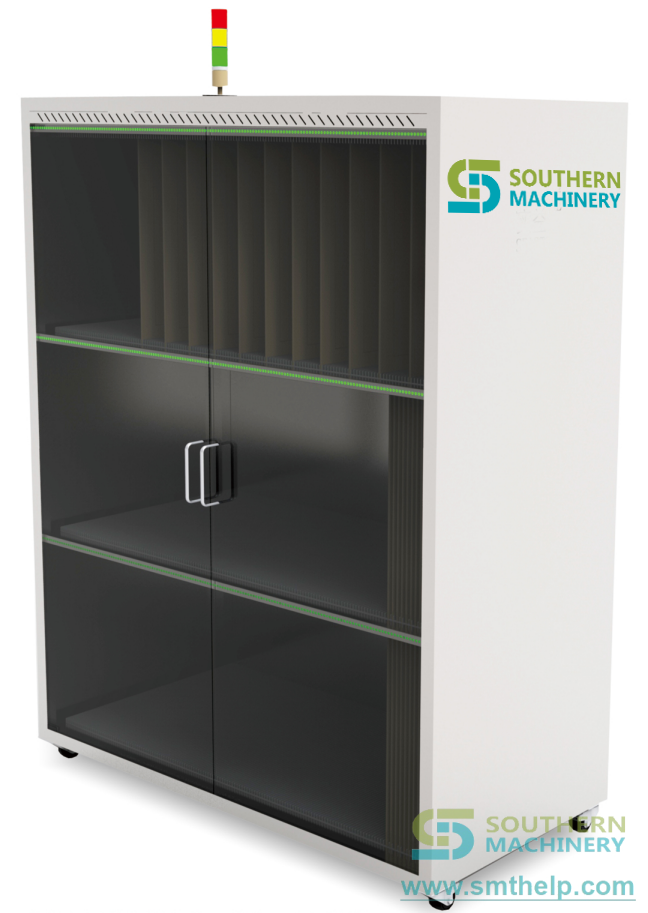
Smart SMT Stencil Storage System for MES Traceability from Southern Machinery
In a high-mix SMT factory, stencil management can quietly become a real production bottleneck. Operators waste time hunting for the right stencil, engineers struggle to verify usage history, and printing defects become harder to trace when storage relies on manual records.
Southern Machinery’s Smart SMT Stencil Storage System is designed for factories that want their stencil storage to integrate into the controlled PCB assembly workflow—not remain an isolated cabinet in the corner. The system combines organized storage, smart LED guidance, usage tracking, FIFO/LIFO logic, and MES/ERP-ready data flow to support faster changeovers and more reliable stencil control.
Southern Machinery, founded in 2011 and based in Shenzhen, specializes in high-efficiency, cost-effective SMT and THT PCB assembly automation equipment. Our portfolio includes SMT lines, THT insertion, wave soldering, board handling, inspection options, smart storage, training, spare parts, and global service support for EMS and OEM factories.
What is this machine used for?
The Smart SMT Stencil Storage System is used to store, locate, manage, and trace SMT solder paste stencils before the printing process.
Rather than relying solely on manual labels, paper logs, or operator memory, the system helps production teams retrieve the correct stencil with LED guidance, track usage, and connect storage activity to the broader factory workflow. For factories that handle many product models, frequent changeovers, or strict audit requirements, this system improves control before the PCB even reaches the stencil printer.
Why stencil storage matters in SMT production
Stencil printing is one of the most critical process steps in SMT assembly. If the wrong stencil is selected, a worn stencil is reused without control, or usage history can’t be confirmed, the downstream effects include solder paste defects, rework, lost line time, and quality disputes.
Manual stencil storage may suffice for a small product mix. But as the number of PCB models grows, the hidden costs become more apparent:
- Operators spend time searching instead of preparing production.
- Changeovers depend too heavily on experienced staff.
- FIFO/LIFO or usage rules are difficult to enforce consistently.
- Stencil life and cleaning history become harder to verify.
- Audit preparation requires manual record checking.
- MES or ERP data may not match real shop-floor activity.
A smart stencil storage system makes this process visible, repeatable, and easier to manage.
Core functions from the source system
The source product page highlights several practical functions for smart factory stencil management.
LED-guided retrieval
The system speeds up retrieval with smart LED guidance. Instead of searching through racks one by one, operators are directed to the correct storage position.
The source page mentions 5-second retrieval and significant search-time reduction as performance examples. These should be treated as target figures; actual performance depends on cabinet layout, stencil quantity, software configuration, and operator workflow.
FIFO/LIFO and usage tracking
The system supports automated FIFO/LIFO logic and stencil usage tracking. This is important for factories that want better control over stencil use, cleaning cycles, and process history.
For example, a medical or automotive electronics EMS plant may need to know which stencil was used for a specific job and whether usage rules were followed. Smart tracking makes that easier than relying on manual logs.
Quality control support
The source page links smart stencil management with reduced printing defects. The logic is straightforward: when the right stencil is selected faster, usage history is visible, and process rules are easier to enforce, the risk of human error in stencil handling decreases.
Any defect reduction percentage should be confirmed using the customer’s own baseline data, product mix, stencil condition, cleaning process, and printer setup.
MES/ERP workflow integration
The source page states that the system can integrate with MES/ERP platforms. For factories building a smart EMS workflow, this is key. Stencil storage should not be isolated from work orders, line changeovers, material preparation, or traceability records.
The final integration scope requires technical confirmation because every factory’s MES, ERP, barcode rules, network environment, and data fields are different.

Typical application scenarios
This system is most useful when stencil management has become too complex for a simple manual rack.
High-mix EMS production
EMS factories often handle many customer projects, PCB revisions, and small-to-medium batch runs. A smart stencil cabinet helps reduce confusion during product changeovers and supports more controlled preparation before printing.
Automotive and medical electronics
Factories serving automotive, medical, and industrial control customers typically care about process traceability. Stencil usage history, retrieval records, and controlled storage can strengthen internal quality management.
Multi-line SMT workshops
When several SMT lines share stencil inventory, the risk of search delays and record mismatch increases. A smart storage system helps standardize how stencils are stored, retrieved, and returned.
Factories moving toward MES-based management
If your factory already uses barcode scanning, work orders, MES dashboards, or digital material control, stencil storage is a logical next process to digitize.
How it connects to a complete PCB assembly line
The stencil storage system is not just a standalone “nice-to-have” when configured correctly. It supports the first major process step in the SMT line: solder paste printing.
A typical Southern Machinery integrated workflow can look like this:
- Stencil preparation and storage: Smart SMT Stencil Storage System manages location, retrieval, and usage history.
- PCB loading: Magazine loader or board handling conveyor feeds PCBs into the line.
- Stencil printing: Automatic stencil printer applies solder paste using the selected stencil.
- SPI inspection: Optional solder paste inspection checks volume, offset, and bridging risk.
- Pick-and-place: SMT mounter places chips, ICs, connectors, and other components.
- Reflow soldering: Reflow oven completes solder joints under a controlled profile.
- AOI and traceability: Inline AOI and barcode/MES data help verify quality and production history.
- THT and wave/selective soldering: For mixed-technology boards, Southern Machinery can also configure THT insertion, wave soldering, selective soldering, and board handling.
This is where Southern Machinery adds the most value: we view stencil storage as part of the entire PCB assembly process, not just a cabinet purchase.
Key selection parameters before buying
Before deciding on the final configuration, confirm these points:
- Stencil quantity: current number of stencils and expected growth.
- Stencil size range: maximum and minimum frame size, thickness, and special storage requirements.
- Line count: how many SMT lines will use the system.
- Changeover frequency: number of product changes per shift or per day.
- Traceability level: whether you need barcode, user login, usage records, MES connection, or ERP sync.
- Storage logic: FIFO, LIFO, usage count, cleaning status, maintenance status, or customer-specific rules.
- Factory layout: where the cabinet sits relative to the stencil printer, material room, and SMT lines.
- Software interface: MES/ERP protocol, data fields, network policy, and user permission rules.
- Training needs: operator workflow, supervisor access, maintenance responsibility, and reporting requirements.
These details determine whether the best solution is a simple smart cabinet, a larger storage system, or a more integrated stencil management workflow.
ROI, quality, and capacity value
The source page presents strong efficiency and ROI examples, including reduced search time, improved efficiency, fewer printing defects, reduced training time, lower staffing needs, and a 12–18 month ROI example.
For external communication, these should be treated as example calculations, not universal guarantees. The real payback depends on:
- labor cost in your region,
- number of stencil searches per shift,
- current search and changeover time,
- defect and rework baseline,
- number of SMT lines,
- operator training model,
- MES integration scope,
- and how disciplined the return-to-storage process is.
A practical ROI review starts with one simple question: how many minutes per shift are lost because operators cannot immediately find, verify, or return the correct stencil? In a high-mix factory, that number can be surprisingly large.
Why work with Southern Machinery?
Southern Machinery provides more than isolated equipment. Since 2011, our Shenzhen team has focused on cost-effective automation for global PCB assembly factories. We support SMT, THT, wave soldering, board handling, inspection options, feeder and nozzle customization, smart storage, training, spare parts, and line integration.
For smart stencil storage projects, we can help you review your current stencil count, production mix, line changeover process, and software connection needs before recommending a configuration. That approach is more reliable than buying a cabinet first and solving workflow issues later.
FAQ
Is this only for large EMS factories?
No. It is most valuable when stencil quantity, changeover frequency, or traceability requirements are already creating pressure. A medium-size high-mix factory can benefit if operators lose time searching for stencils or if audit records are difficult to maintain.
Can it connect with MES or ERP?
The source page states MES/ERP integration capability. Final connection needs confirmation based on your system interface, barcode rules, data fields, and IT policy.
Does it guarantee fewer solder paste defects?
No machine should promise that alone. Better stencil control can reduce human error and support stable printing, but solder paste defects also depend on stencil design, paste condition, printer setup, PCB support, cleaning process, and operator discipline.
What data should we prepare before requesting a quote?
Prepare stencil size range, total stencil quantity, expected future capacity, SMT line count, changeover frequency, current pain points, and whether MES/ERP connection is required.
Can Southern Machinery provide a complete SMT line with this system?
Yes. Southern Machinery can configure SMT line equipment, board handling, stencil printer, SPI, pick-and-place, reflow, AOI, THT insertion, wave/selective soldering, and traceability-related options depending on your product and volume.
Are the ROI numbers fixed?
No. Any ROI or labor-saving number should be calculated from your own production data. Southern Machinery can help build an example calculation after you share current search time, staffing, shifts, stencil count, and defect/rework baseline.
Next step
If stencil search time, manual records, or audit pressure are slowing your SMT operation, send Southern Machinery your stencil size range, stencil quantity, SMT line count, and MES/ERP requirement. We will help match a smart stencil storage configuration that fits your real production workflow and future expansion plan.
Comments