
Smart Home PCB Assembly: Taped Terminal and Through-Hole Auto Insertion
Smart home boards still need through-hole terminals, relays and connectors. See how taped terminal auto insertion cuts cost and defects in smart home PCBA.
Sep 15, 2026 · Updated Sep 15, 2026 · Southern Machinery
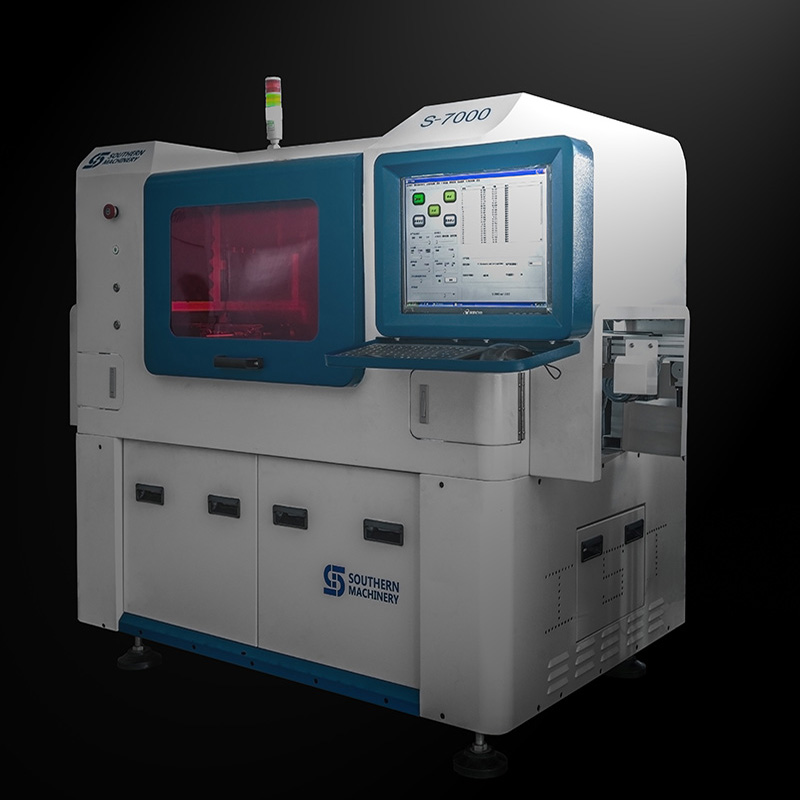
Smart Home PCB Assembly: Taped Terminal and Through-Hole Auto Insertion
Smart home products are built in high volume and sold at consumer prices, yet their circuit boards are still full of through-hole parts. Smart plugs, wall switches, dimmers, gateways and sensor modules all need mains-rated FASTON tabs, relays, transformers, electrolytic capacitors and connectors pressed into plated through-holes and clinched before wave soldering.
That is where the cost hides. SMT sections are already automated, but the terminal and odd-form work at the end of the line is often still done by hand, one part at a time, with inconsistent insertion depth and a steady flow of rework.
This article explains how taped terminal auto insertion works, which smart home boards benefit most, and how to integrate it into a complete SMT/THT PCB assembly line. The video below shows taped terminal auto insertion running for smart home PCB assembly on Southern Machinery equipment: https://www.youtube.com/watch?v=fLfA9bLXAPY
What is a taped terminal insertion machine used for?
A taped terminal insertion machine feeds terminals carried on a reel or carrier tape, cuts each terminal from the tape, inserts it into the plated through-hole and clinches the tail on the solder side of the board. It replaces the manual step of pushing terminals into the board by hand.
For smart home electronics the operation matters more than for many product categories, because mains connections are mechanical as well as electrical: a loose or tilted FASTON tab is both a quality escape and a safety issue. Automated insertion gives a repeatable depth, angle and clinch on every terminal, every board.
Southern Machinery's S-7000T terminal insertion machine is built for this work. Verified from the product page:
- Insertion rate of 5,000 – 6,000 CPH
- Handles any manufacturer's reeled through-hole terminal, plus bulk terminals through a bowl feeder with a feeding guide
- Insertion verification on every cycle, with inward clinching, outward clinching or "N" clinching (optional)
- Industrial high-definition camera with automatic visual correction software
- Passes the IPC-9704 stress-test standard, holding insertion stress within ±400 µe
- Motion accuracy of 0.001 mm/pulse
- Works a 380 mm × 280 mm board area (enlarged sizes customizable) on a 1700 × 1300 × 1600 mm, 1200 kg frame (2 heads)
- Single 220 V AC, 50/60 Hz, 2 kVA
For higher volumes, the S7020 series runs two insertion heads at up to 12,000 CPH for PIN and eyelet terminals in bulk or reel packaging, with a 360° insertion angle (1° increments).
Verified terminal types
The S-7000T terminal handling list published by Southern Machinery covers:
- Zierick terminals, P/N 1021 / 6021 / 1198 / 6198
- TE Connectivity TAB and FASTON, 6.35 mm (.250 in) or 4.75 mm (.187 in)
- Tab fit 6.35 (±0.07 mm) × 0.81 (±0.03 mm)
- Terminal pitch 0.2 in (5.08 mm), with insertion rates up to 2 terminals per second at that pitch
- Terminal thickness ≥ 0.5 mm and ≤ 1.2 mm
Typical application scenarios
Taped and bulk terminal insertion is most valuable where a board carries several mains or high-current terminations and is produced in runs that justify automation:
Smart home and IoT devices — smart plugs and socket adapters, wall switches, dimmers, smart lighting controllers, gateways and hubs, doorbell and sensor modules, and IoT retrofit control modules for existing appliances.
EMS and ODM factories — contract manufacturers who run many smart home programs on one line need one machine that can switch terminal families by changing the tape and the feeder, not a dedicated fixture per product.
Power supply and adapter boards — FASTON tabs and terminal blocks on the mains side of vehicle power supplies, energy-saving power supplies and ballasts.
Consumer and appliance electronics — air conditioner, TV, microwave, electric kettle and induction cooker control boards, where relays and terminals sit alongside radial and odd-form parts.
Automotive and industrial control — terminals and eyelets on boards that must survive vibration and thermal cycling, where clinch quality is measurable rather than estimated.
How terminal insertion fits into a complete SMT/THT PCB assembly line
A smart home board normally runs SMT first and through-hole second, so the terminal inserter sits in the THT section, upstream of wave soldering:
- SMT section — solder paste printer, SPI, pick-and-place, reflow oven, AOI.
- THT insertion section — axial auto insertion (S4000), radial auto insertion (S-3000 / S-3010B), then terminal, PIN and eyelet insertion (S-7000T / S7020 series) as an inline SMEMA station.
- Manual residue and inspection — the few odd-form parts and connectors that stay manual.
- Wave soldering — S-WS450 standard wave, or the S-WS350B lead-free dual-wave machine with PC control.
- Lead cutting and cleaning — S-320AT inline auto lead cutter, then PCBA cleaning (SME6200 / SQC250A).
- Depaneling, inspection and board handling — separators, AOI, and magazine loaders, unloaders, buffers and turn conveyors between stations.
Because the terminal inserter is an inline station, the same machine can feed several product families in sequence: change the terminal tape, load the program, and the line keeps running.
Key selection parameters to confirm before you buy
There is no universal terminal inserter — the machine has to match the terminal, the board and the line. When you specify a system with us, we confirm:
- Terminal family and packaging — TE / Zierick / other, and whether the terminal arrives on reel tape or in bulk
- Tab width and thickness and the corresponding insertion head
- Hole size — the plated hole should be 0.5 ± 0.1 mm larger than the component lead
- Component spacing on the board — a minimum of 2 mm between parts
- Clinch type required — inward, outward or "N", and whether insertion verification is needed
- Board size and panelization — the standard working area is 380 × 280 mm, with enlarged sizes customizable
- Standalone or inline — SMEMA interfacing, conveyor height and line direction
- Utilities — 220 V AC single phase, 50/60 Hz, 2 kVA
Quality, yield and ROI perspective
Manual terminal insertion is slow, and its failures are expensive: a terminal pushed at the wrong angle, inserted to the wrong depth, or missed entirely is usually not caught until after wave soldering, when the fix means rework on a finished board.
Automating the operation changes the failure mode from "found at final test" to "prevented at insertion":
- Vision-based correction and insertion verification catch a bad terminal in the same cycle
- Clinching is repeatable, so pull-out strength is consistent rather than operator-dependent
- Verified IPC-9704 stress control (±400 µe) keeps board stress inside the acceptable band
- Throughput is fixed at 5,000 – 6,000 CPH on the S-7000T and up to 12,000 CPH on the dual-head S7020 series, independent of shift, fatigue or operator skill
- One machine serves many programs, so the payback is spread across the whole smart home product mix
Southern Machinery has published field comparisons on this operation, including a 1-year ROI review of terminal insertion automation and a labour comparison for the S-7000T. If you are running terminal insertion by hand, the labour line is usually the fastest part of the business case to build.
Frequently asked questions
What is a taped terminal insertion machine used for?
It cuts terminals from a reel or carrier tape, inserts them into plated through-holes and clinches them on the solder side, replacing manual terminal insertion before wave soldering. Smart home and appliance boards with FASTON tabs, terminal blocks and relays are typical applications.
Which terminals can an S-7000T handle?
Southern Machinery publishes a handling list that includes Zierick terminals (P/N 1021 / 6021 / 1198 / 6198) and TE Connectivity TAB and FASTON terminals at 6.35 mm (.250 in) and 4.75 mm (.187 in), and states the machine can process any manufacturer's reeled through-hole terminal, with bulk terminals handled by a bowl feeder.
Can terminal insertion run inline with my existing SMT line?
Yes. The terminal inserter is used as an inline SMEMA station in the THT section, between radial or axial insertion and wave soldering, and can be fed by the same board handling equipment.
Does the machine handle both reeled and bulk terminals?
Yes. The feeding system accepts tape feeder or bowl feeder with a feeding guide, and the S7020 series handles terminals in bulk or reel packaging.
What should I check on my PCB before specifying a machine?
Terminal family, tab width and thickness, hole size (0.5 ± 0.1 mm larger than the lead), minimum 2 mm spacing between components, required clinch type, and the largest board or panel size you plan to run.
How does automation improve quality compared with manual insertion?
Automation inserts and clinches every terminal the same way, verifies each insertion in cycle with vision correction, and holds board stress within the IPC-9704-based ±400 µe limit — removing the angle, depth and missed-insertion defects that manual work produces.
Contact Southern Machinery for configuration advice
Southern Machinery (Shenzhen Southern Machinery Sales and Service Co., Ltd) has supplied SMT and THT PCB assembly equipment from Shenzhen, China since 2011 and serves more than 237 customers worldwide. We build complete SMT / THT / wave soldering / board handling / inspection line solutions, and we support them with spare parts, sub-assemblies, retrofit kits, repair, operator training and overhaul.
Tell us your terminal family, board size and target throughput and we will recommend the right insertion configuration.
- Email: jasonwu@smthelp.com | Phone/WhatsApp: +86 13602562576
- Machine catalogs and files: https://file.autoinsertion.com
- Machine photos: https://ph.smthelp.com
- Website: https://www.smthelp.com
Watch the operation: https://www.youtube.com/watch?v=fLfA9bLXAPY
Comments