
SM-650 BGA Rework Station by Southern Machinery
Vision-guided BGA rework for 550 x 500 mm boards: SM-650 optical alignment, 3-zone heat and anti-warpage support, with full specs and PCB assembly line fit.
Oct 7, 2026 · Updated Oct 7, 2026 · Southern Machinery

The SM-650 is a vision-guided BGA rework station: it desolders and re-solders ball-grid-array and chip packages on assembled boards, so a bad joint stops being a scrapped board. A 27× colour optical vision system overlays the package image on the pad image before placement, three independent heating zones reflow the joint from above and below, and an 8-stage profile is stored per chip type. Southern Machinery publishes a verified placement accuracy of ±0.05 mm and a temperature balance of ≤2 °C across a 550 × 500 mm envelope.
What is a BGA rework station actually for?
A BGA rework station removes a ball-grid-array or large chip package from a finished assembly, re-dresses the pads and solders a replacement package back on. It is the repair path for boards that fail after SMT reflow, where the rest of the assembly is good and only one package is in question.
Typical work for an SM-650 in an EMS or ODM factory:
- BGA and large chip packages that fail inspection after reflow
- Prototype and NPI builds where one package must be swapped and the rest of the board kept
- Boards whose value makes scrapping the wrong decision
- Laptop motherboards, which combine a large board area with fine-pitch packages
- Returned units, where the customer expects the same board back with a documented rework record
Why do large boards fail at the rework bench?
These are the failure modes the SM-650 datasheet is written against. On a small board they are annoying; on a 550 mm motherboard they decide whether the unit is repaired or scrapped.
Alignment by eye fails on fine-pitch balls
Fine-pitch BGA balls cannot be centred by eye. An off-centre placement bridges neighbouring balls or leaves a row off its pad, and both defects hide under the package.
One-sided heat warps a 550 mm board
Heating a large board from one side lifts pads and warps the laminate. The board may survive the first rework and fail later, which is the expensive version of the same failure.
Profiles get forgotten between chip types
Without stored profiles, every package type is re-flowed by guesswork: hot spots burn the laminate and cold spots create joints that look soldered and are not.
Rework doubles the cost of the same board
A failed rework goes back to the bench: the same labour a second time, on a board that is now weaker than it started.
Uncontrolled rework cannot be audited
Customers audit rework with documentation: a curve, a profile, a pass record. An uncontrolled bench has nothing to show.
How does the SM-650 control alignment, heat and warpage?
Vision-class alignment before placement
The standard configuration is a 27× colour optical vision system with dichroic lighting and auto focus. The IC image is overlaid on the PCB image on screen, so the operator aligns balls to pads before the head comes down. Verified placement accuracy is ±0.05 mm, with a 40 × 40 mm maximum viewing area.
Three heating zones instead of one heat source
Three independent zones — upper hot air 1200 W, lower hot air 800 W and a 3600 W bottom infrared heater — hold the board and package within a verified ≤2 °C balance. Hot air is programmable to 350 °C and the infrared stage to 400 °C, and a built-in cross-flow fan cools the joint after reflow.
Laptop-motherboard clamps and anti-warpage supports
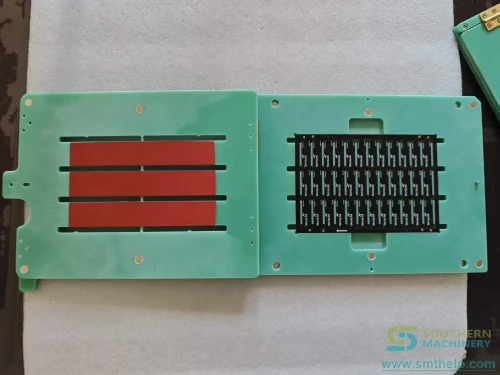
Large boards are the case the accessory set is built for: clamps for laptop motherboards plus adjustable anti-warpage support posts keep a 550 × 500 mm, 4 mm-thick board flat while it is heated from above and below. Standard nozzles of 45 × 45, 38 × 38 and 31 × 31 mm are supplied, with custom sizes for unusual packages.
Profiles that are stored, not remembered
The 8-stage programmable profile covers multi-segment rising and activity temperatures. Curves are stored on the embedded industrial PC, shown on the touch screen and LCD monitor, and compared against saved curves, so the same package is re-flowed the same way next month and the record can be exported for audit.
Which SM-650 specifications decide whether it fits your boards?
These values come from the official Southern Machinery SM-650 datasheet. They support initial evaluation and remain subject to final technical confirmation against your board size, package mix and line layout.
- Model — SM-650 BGA rework station
- Maximum PCB size — 550 × 500 mm, up to 4 mm thick
- Maximum process area — 120 × 120 mm
- Component size — maximum 70 × 70 mm, minimum 1 × 1 mm
- Maximum component weight — 80 g
- Minimum component spacing — 0.30 mm
- Fine adjustment range — front/rear ±10 mm, left/right ±10 mm
- Rotation angle — 60°
- Maximum hot-air temperature — 350 °C; infrared maximum 400 °C
- Heater power — upper hot air 1200 W, lower hot air 800 W, bottom infrared 3600 W
- Verified performance — placement accuracy ±0.05 mm, temperature balance ≤2 °C
- Machine size and weight — 850 × 750 × 630 mm, approximately 80 kg
- Power — single phase 220 VAC, 50/60 Hz, approximately 5.6 kW (the installation guide quotes 5 to 8 kW depending on model)
- Certification and service — CE certified, free installation and operator training, 24/7 worldwide support, 1-day spare-part lead time
- Production reference — the separate automatic optical platform sheet (ZM-R7220A) quotes ±0.02 mm and 5650 W for PCBA motherboard rework; those figures vary by configuration and are not the SM-650 verified values
Anything not on this list is not specified in the source document. Contact Southern Machinery to confirm it for your application.
Where does the SM-650 sit in a complete PCB assembly line?
Rework is a station that inherits whatever the upstream process did to the board.
Upstream: SMT printing, placement and reflow
Boards are printed, populated and reflowed first; the rework bench receives the ones that fail afterwards. That process is catalogued at smta.smthelp.eu/products/smt-line-placement/reflow-oven.
Hand-off: board handling
Rework sits beside board handling rather than inside the conveyor. Conveyors, buffers, loaders and unloaders keep the line flowing while the rework station handles exceptions — see smta.smthelp.eu/products/board-handling/pcb-conveyor-500-800.
Downstream: a repair decision instead of a scrap decision
Every package the SM-650 recovers is a board that no longer needs a second full pass through the line, and each carries a curve and profile record the customer audit can read.
What does vision-controlled BGA rework return?
The arithmetic is board-value driven rather than machine-speed driven, so it has to run on your own numbers. The formula is:
Annual rework value = (boards recovered per year × board value) + (rework labour hours avoided per year × loaded labour rate) − (rework station cost + consumables + training time)
Worked example (illustrative only; every figure below is an example, depends on configuration, and is subject to final technical confirmation):
- Board value that would otherwise be scrapped: example 120 USD
- Boards recovered per month: example 40 units
- Loaded rework labour rate: example 22 USD per hour
- Labour hours avoided per recovered board: example 0.5 hours
That gives an example recovery of about 4,800 USD per month in board value plus about 440 USD in labour, assuming vision alignment and profile control push first-pass rework success toward one. Southern Machinery prepares a board-specific estimate within 24 hours, using the machine's verified figures as inputs rather than as the outcome.
FAQ: questions buyers ask before ordering
What makes the SM-650 a vision-class rework station?
The 27× colour optical zoom vision system with dichroic lighting and auto-focus overlays the IC image on the PCB image before placement, so the operator aligns BGA balls to pads on screen. Placement accuracy is verified within ±0.05 mm.
What board and package sizes can it handle?
PCBs up to 550 × 500 mm and 4 mm thick, with BGA packages up to 70 × 70 mm, a maximum component weight of 80 g and minimum spacing of 0.30 mm. Maximum process area is 120 × 120 mm.
How is the temperature controlled?
Three independent zones — top hot air 1200 W, lower hot air 800 W and bottom infrared 3600 W — with 8-stage programmable settings and real-time curve display. Balance across the board is verified within ≤2 °C, and the profile is checked with a K-type thermocouple after installation.
Can it store and compare reflow profiles?
Yes. Profiles are stored on the embedded industrial PC, displayed on the touch screen and monitor, and compared with saved curves, which makes the process repeatable and auditable.
What about large laptop motherboards?
The SM-650 includes clamps for laptop motherboards plus adjustable anti-warpage support posts, so large boards heat evenly without sagging.
What utilities does the installation need?
Single-phase 220 VAC (±10%), roughly 5 to 8 kW depending on model, on a stable workbench with clearance around the moving head and fume extraction above it. Vacuum pump and cooling fans are built in; no compressed air is required.
Next step: send board samples for a vision-rework demo
Tell us which boards and BGA packages you rework today, and your monthly volume. You get a configuration, quotation and profile recommendation within 24 hours — email info@smthelp.com or message WhatsApp +86 136 0256 2576. Southern Machinery has built SMT and THT PCB assembly automation from Shenzhen since 2011 and serves more than 237 customers worldwide. Machine photos are at ph.smthelp.com, the SM-650 introduction PDF is at file.autoinsertion.com, and the wider catalogue is at smta.smthelp.eu/products.
Comments