
SM-VL-800D AOI Placement Guide by Southern Machinery
The SM-VL-800D AOI machine from Southern Machinery inspects solder paste printing, component placement and solder joints on SMT boards, in in-line (S-L680) and off-line (S-H680) versions. This guide explains the three common AOI positions (after printing, before reflow, after reflow), lists source specifications such as 01005 chip and 0.4 mm pitch IC capability, and shows how to connect the in-line model to a complete PCB assembly line. It adds a buyer checklist, an example-only ROI formula, and FAQs, so quality and process engineers can decide where inspection earns its place and cut rework by finding defects earlier.
Oct 23, 2026 · Updated Oct 23, 2026 · Southern Machinery
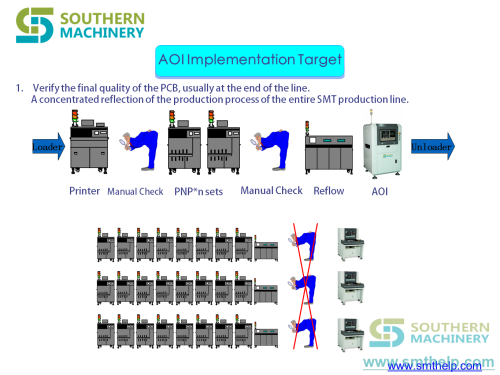
SM-VL-800D AOI Machine: Where to Place It by Southern Machinery
What is the SM-VL-800D AOI machine used for? It is an automatic optical inspection (AOI) machine that checks solder paste printing, component placement and solder joints on SMT boards. Per the source manual, it comes as an in-line model (S-L680) and an off-line model (S-H680), and it inspects 01005 chips and 0.4 mm pitch ICs.
Why does one inspection station at the end of the line leave you guessing?
Most defects are cheap to find and expensive to explain. A board that fails at final test tells you something went wrong. It rarely tells you where. Teams then adjust the printer, the placer and the oven all at once, and hope.
The hidden problem is not missing inspection. It is inspection in a single place. The source manual says in-line AOI serves two purposes: final quality and process tracking. Most plants buy for the first and forget the second.
What is the three-position placement model for AOI?
The manual describes three common positions. Use them as a decision framework, not a rule.
After solder paste printing
Many defects start with poor printing. The manual notes that insufficient paste can lead to missing components or open circuits. Catching it here keeps a bad print from becoming a bad assembly.
Before reflow
After placement and insertion, AOI detects defects caused by poor mounting or insertion, while boards can still be corrected.
After reflow
The manual calls this the most common position. It detects defects from all previous processes so defective products do not reach the customer.
A simple way to choose: list your last three escapes, mark which process caused each, and put the first AOI where the earliest cause lives. Add a second station only when the data justifies it.
What does the SM-VL-800D actually inspect?
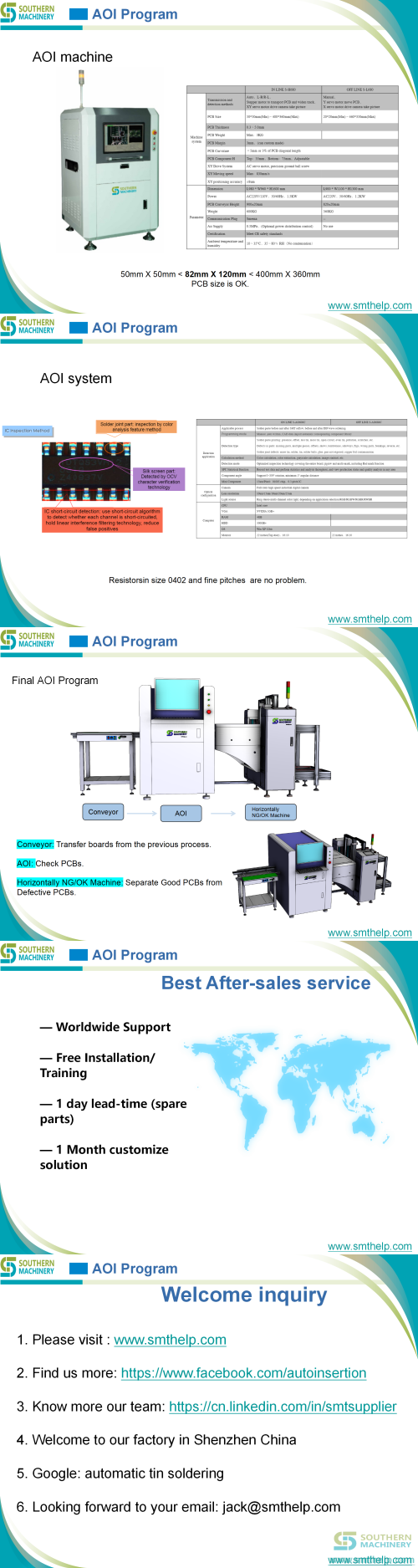
The source lists these defect families:
- Solder paste printing: offset, insufficient solder, excess solder, open, contamination.
- Placement: missing, offset, skew, tombstone, on-edge, flipped, wrong part, damaged, reversed.
- Solder joints: excess solder, insufficient solder, cold solder, bridging.
- PCB defects: copper contamination, black pad, blister, missing copper, oxidation.
It works optically. A three-channel RGB LED light source makes SMD solder visible through specular, diffuse and oblique reflection. The software then applies colour operation, colour extraction, grey-scale operation and image comparison against stored standards. When a result exceeds the error threshold, the defect position is shown so the operator can confirm it, or the board goes to a repair station.
Which specifications matter when you compare AOI machines?
| Item | Source specification |
|---|---|
| Models | S-L680 (in-line), S-H680 (off-line) |
| Smallest inspectable part | 01005 chip and 0.4 mm pitch IC |
| PCB size | 50 × 50 mm (min.) to 400 × 360 mm (max.) |
| Component height | Top side < 30 mm, bottom side < 50 mm |
| PCB warpage | < 5 mm or 3 % of PCB diagonal |
| Positioning accuracy | < 16 µm |
| Travel speed | 800 mm/s |
| Image processing speed | 0402 chip < 12 ms |
| Lens resolution | 8 µm to 25 µm (optional) |
| Light source | Three-channel RGB |
| Display | 22-inch, 1680 × 1050 |
| Output signals | OK/NG, machine status, alarm |
| Programming | Automatic, manual, CAD import, component library matching |
| Compressed air | Plant air, ≥ 0.49 MPa |
| Environment | 10 °C to 35 °C, 35 % to 80 % RH |
Price, lead time and certifications: not specified in source — contact Southern Machinery to confirm.
How do you connect it to a complete PCB assembly line?
The in-line model connects automatically with upstream and downstream equipment and sends an OK/NG signal downstream. Its conveyor has automatic width adjustment. On site, the manual says to align the AOI front rail with the upstream machine's rail, then level and calibrate.
Place it alongside your board handling system, and review the 3D SPI and AOI category for related inspection equipment. For mixed lines, see our THT machine range and wave soldering machines.
How should you think about the return on inspection?
Use a simple formula and your own numbers:
Annual value = (defects caught earlier per year × cost avoided per defect) − (annual inspection operating cost)
Example only, depending on configuration and subject to final technical confirmation: if 200 boards a year are caught before reflow and each avoids 10 USD of rework, that is 2,000 USD, before subtracting operating cost. These figures are invented for illustration, not source data. No ROI is guaranteed.
How do you get a repeatable inspection routine?
- Pick positions using your escape history.
- Program with CAD data imported from your placement machines. The source notes coordinate import and one-click framing.
- Use the SPC records to review production status and quality by area.
- Follow the maintenance schedule, including ball screw and linear guide lubrication.
- Shut down in order: exit the AOI application, shut down Windows, then switch off power. Wait at least 20 seconds before switching on again.
Keep this checklist on the line. The next article in this series covers how to read AOI results as process feedback.
FAQ
Is the SM-VL-800D in-line or off-line? Both. The source names S-L680 (in-line) and S-H680 (off-line). Confirm the model on the nameplate.
What is the smallest part it can inspect? The source states 01005 chip and 0.4 mm pitch IC. It also says 0201 inspection is available with upgrade capacity for 01005.
Can it import placement data? Yes. It imports coordinate data from placement machines and supports CAD, Excel and TXT formats.
Who can operate it? Rights are controlled by Administrator, Programmer and Operator levels. Only trained personnel should operate or service it.
Does Southern Machinery provide support? Yes: technical support, spare parts, training and warranty service. Founded in Shenzhen in 2011, Southern Machinery serves 237+ global customers with SMT and THT automation.
Next step
Tell us your line layout and your last three defect escapes. Request a quote or contact the team to discuss AOI placement for your line.
Comments