
SMT PCB Magazine Loader SLD250: Automating the Front End of Your PCB Assembly Line
Every SMT or THT line starts with a stack of bare PCBs in a magazine. The SLD250 SMT PCB Magazine Loader from Southern Machinery turns that stack into a controlled, SMEMA-linked input: PLC control, four selectable pitch
Sep 13, 2026 · Updated Sep 13, 2026 · Southern Machinery
SMT PCB Magazine Loader SLD250: Automating the Front End of Your PCB Assembly Line
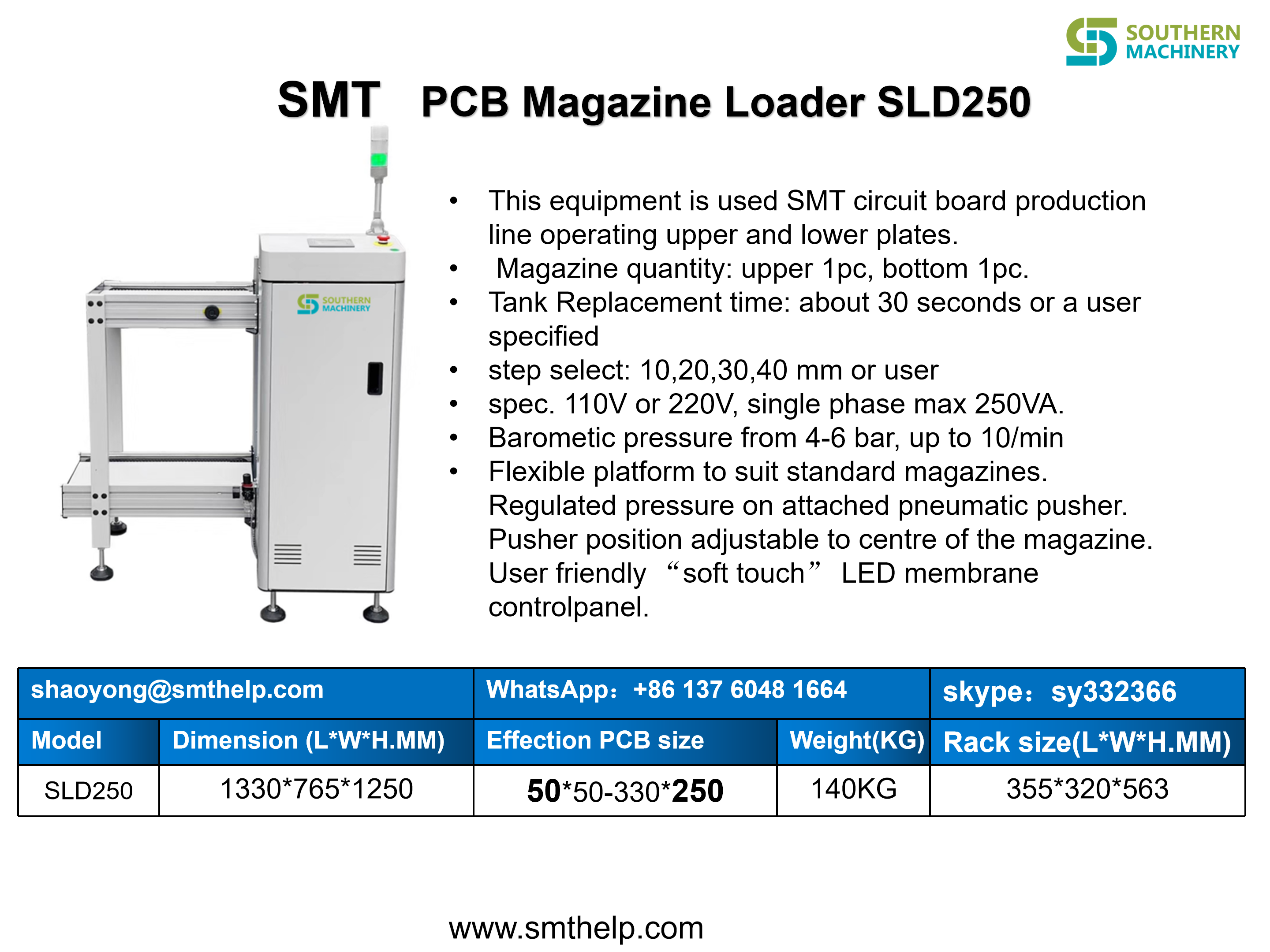
Every SMT or THT line starts with a stack of bare PCBs in a magazine. The SLD250 SMT PCB Magazine Loader from Southern Machinery turns that stack into a controlled, SMEMA-linked input: PLC control, four selectable pitch steps (10, 20, 30, and 40 mm), support for effective PCB sizes from 50×50 to 330×250 mm, and magazine swaps in about 30 seconds. This guide explains what the SLD250 does, where it fits in a complete PCB assembly line, which parameters procurement and process engineering must confirm before ordering, and how consistent automatic loading protects yield from the very first station of the line.
What is the SLD250 SMT PCB Magazine Loader used for?
The SLD250 is a magazine loader. It sits at the front of a PCB assembly line, or mid-line after a buffer or depaneling station, and does one job with great precision: it pushes PCBs out of a magazine and onto the conveyor of the downstream machine, one board at a time, at whatever pitch the process requires.
Feeding boards by hand looks simple, but it is a controlled operation in disguise. An operator lifts a magazine, indexes through the slots, lifts each board out, and places it on the conveyor. Every one of those movements is a chance to bend a lead, touch a pad, drop a board edge onto a rail, or feed the line at an uneven rhythm. The SLD250 replaces that motion with a PLC-controlled pusher and a magazine platform.
In practical terms, the SLD250 answers four questions for a line planner:
- Where do bare boards enter the line? From a standard magazine, automatically.
- At what spacing? Pitch steps of 10, 20, 30, or 40 mm, selectable by the user.
- How does it communicate with the line? Through a SMEMA-compliant interface with the downstream machine.
- How long does a refill stop the line? The magazine/rack replacement time is specified at about 30 seconds, or as the user specifies.
Why the loader decides your line's real throughput
A common mistake when upgrading a line is to size the middle of it — the pick-and-place machine, the inserter, the reflow oven — and treat the loading and unloading ends as accessories. The result is a fast line that starves at the entrance.
A loader that cannot keep up with the line's takt time becomes the real bottleneck, because everything downstream sits idle waiting for it. That idle time is expensive: reflow oven zones keep drawing power, inserters sit between cycles, and operators wait. Automatic magazine loading with a defined pitch and a SMEMA handshake is what turns a collection of machines into a line with a predictable cadence.
The second reason is board integrity. At the front of the line, a board is usually still bare. Handling damage here — chipped edges, contamination from gloves, ESD exposure, bent leads on already-inserted parts — is avoidable damage. A machine that indexes the magazine and pushes at a fixed position is simply more repeatable than a wrist.
SLD250 verified specifications
The following values are taken from the official SLD250 product page published by Southern Machinery.
Machine specification (published values):
- Machine type: SMT PCB magazine loader (line-front board feeding)
- Control system: PLC control system
- Magazine capacity: upper 1 pc, bottom 1 pc
- Pitch / step selection: 10, 20, 30, 40 mm, or user selectable
- Effective PCB size: 50 × 50 – 330 × 250 mm
- Machine dimensions (L × W × H): 1330 × 765 × 1250 mm
- Magazine rack size (L × W × H): 355 × 320 × 563 mm
- Machine weight: 140 kg
- Magazine replacement time: about 30 seconds, or user specified
- Line interface: SMEMA compliant
- Operator interface: user-friendly soft-touch LED membrane control panel
- Magazine platform: flexible platform to suit standard magazines
- Pusher setting: pusher position adjustable to the centre of the magazine
- Compliance stated on the product page: Southern Machinery states that its PCB handling equipment is CE compliant
Two engineering notes matter more than the specification list itself.
First, the pusher is adjustable to the centre of the magazine. That adjustment is what keeps the push force centred and repeatable across different magazine builds, instead of relying on the magazine sitting perfectly every time.
Second, the magazine platform is described as a flexible platform to suit standard magazines. Magazine dimensions are the most common source of retrofit surprises in board handling, because magazine racks are not all built to the same tolerance. Confirming rack size (L × W × H) against your existing racks before ordering is a step that saves a line reconfiguration later.
Typical application scenarios
The SLD250 is a general-purpose board feeder. It suits lines where boards arrive in magazines and must be presented to a downstream machine at a controlled rate:
- EMS and ODM production lines running mixed work orders, where the same line must accept different board sizes across the shift.
- LED lighting and LED display assembly, where board panels are handled in magazine batches and edge protection matters.
- Power supply and ballast manufacturing, including boards that will later pass through axial and radial insertion and wave soldering.
- Home appliance electronics — air conditioner, TV, microwave, and small appliance control boards.
- Automotive electronics and industrial control boards, where incoming feed consistency affects downstream AOI and MES traceability.
- THT-heavy lines, where boards enter a radial or axial insertion machine and later exit to wave soldering.
- Lines with manual feeding today, where the loader is the first automation step before additional machines are added.
Because the effective PCB range is 50 × 50 to 330 × 250 mm, very large panels and very small boards both need to be checked against the specification before a configuration is confirmed.
How the SLD250 integrates into a complete PCB assembly line
A loader is rarely bought on its own. It is the upstream boundary of a line that typically looks like this:
- SLD250 magazine loader — boards leave the magazine and enter the conveyor.
- Stencil printing / solder paste printing — for SMT-side boards, paste is deposited and inspected by SPI.
- SMT placement (pick and place) — components are placed, then reflowed in a reflow oven.
- THT auto insertion — axial and radial insertion machines, or odd-form inserters for connectors, transformers, and relays.
- Wave soldering — through-hole joints are soldered, with controlled preheat and cooling.
- Inspection — AOI for placement and solder joint verification, and X-ray where hidden joints require it.
- Depaneling — routing, V-cut, or multi-cutter separation according to board design.
- Cleaning and coating — flux removal, stencil cleaning, and selective conformal coating where the application requires it.
- Magazine unloader and buffer — finished PCBs return to magazines for test and packing, often using the SUL250 PCB unloader as the matched downstream unit.
Southern Machinery supplies the loader, the unloader, conveyors, buffers, and the process machines in between, which means the board-handling interface between stations can be planned as one system instead of assembled from uncoordinated suppliers. That is the practical meaning of the company's position as an SMT and THT PCB assembly automation partner: the loader is not a standalone product but the entry point of a connected line.
Southern Machinery has been building PCB assembly automation equipment in Shenzhen since 2011 and serves more than 237 global customers across SMT, THT, wave soldering, board handling, and inspection applications.
Key selection parameters checklist
Before requesting a configuration, confirm these items. They determine whether a standard SLD250 fits or whether the platform, pitch, or interface needs adjustment:
- PCB size — confirm that your board or panel falls inside the effective range of 50 × 50 to 330 × 250 mm.
- PCB thickness and weight — thin boards deflect differently from thick panels; state both.
- Magazine / rack dimensions — compare your racks against the stated rack size of 355 × 320 × 563 mm (L × W × H).
- Pitch required — which of the 10, 20, 30, or 40 mm steps matches your board spacing, and whether a custom step is needed.
- Line direction and transport height — confirm the direction of flow and the transport height of the downstream machine.
- Downstream interface — confirm SMEMA compatibility and the connector convention of the neighbouring machine.
- Required takt time — state boards per hour and the target line cycle, so loader performance can be matched to the line rather than estimated.
- Cleanroom, ESD, or coating environment — flag any special environment requirements before configuration.
- Power supply available at the installation point — confirm the plant supply so the machine configuration can be matched.
- Floor space and footprint — the SLD250 occupies 1330 × 765 × 1250 mm (L × W × H); verify aisle and access clearance for magazine refills.
ROI, quality, and throughput angle
Loading is the least glamorous station on the line and one of the easiest to justify financially.
Labour. A manual loading position exists for every shift the line runs. Replacing continuous manual board handling at the line entrance removes that position from the staffing plan and returns the operator to higher-value work such as inspection, changeover preparation, or kitting.
Yield protection at the first station. A board damaged at the entrance is scrap or rework before any value has been added — and if the damage is not caught, it becomes a field failure later. Machine loading removes the variable hand movement that causes most of this damage.
Cadence and line stability. With a defined pitch and a SMEMA handshake, downstream machines receive boards in a predictable rhythm. That stability is what makes MES-level production tracking meaningful, because the line start is no longer a manual event.
Changeover speed. A magazine replacement time of about 30 seconds, combined with four selectable pitch steps and a flexible magazine platform, keeps line-front changeover short during high-mix production.
Retrofit path. The loader can be the first automation investment on a line that is still partly manual. It is the least disruptive place to start, because it changes how boards enter the line rather than how the product is built.
Southern Machinery publishes a full product catalogue, including PCB handling equipment, at file.autoinsertion.com, and product photographs at ph.smthelp.com.
Frequently asked questions
What PCB size can the SLD250 handle?
The published effective PCB size is 50 × 50 to 330 × 250 mm. Boards or panels outside that range need to be reviewed against the machine platform before ordering.
How many magazines can the SLD250 hold at once?
The specification lists a magazine capacity of upper 1 pc and bottom 1 pc, with a magazine replacement time of about 30 seconds or as the user specifies. Continuous production therefore depends on an operator or AGV bringing the next loaded magazine to the station.
Is the SLD250 compatible with other manufacturers' SMT equipment?
The unit is SMEMA compliant, which is the standard board-handling interface between SMT machines. Compatibility with a specific neighbouring machine should still be confirmed at the configuration stage, including connector convention and transport height.
What is the difference between a magazine loader and a vacuum loader or destacker?
A magazine loader feeds boards that are already stacked in a standard magazine and pushes them onto the line. A vacuum loader handles bare boards using vacuum contact, and a destacker separates boards from a stack. The right choice depends on how boards arrive at the line: in magazines, in stacks, or loose.
Can the SLD250 be added to an existing line?
Yes, in most cases. Because it is SMEMA compliant and feeds a downstream conveyor, it is commonly added as a retrofit at the line entrance. The main checks are PCB size, magazine rack dimensions, pitch, line direction, and transport height.
What information does Southern Machinery need to configure an SLD250?
Board size, thickness, and weight; magazine/rack dimensions; required pitch; line direction and transport height; downstream machine interface; target boards per hour; available power supply; and installation footprint. With those inputs, the standard configuration can be confirmed or the necessary adjustments identified.
Talk to Southern Machinery about your line front end
Board handling problems are usually interface problems, and interface problems are best solved with the machine supplier that also knows the process stations on either side.
Southern Machinery builds SMT and THT PCB assembly automation equipment in Shenzhen and supports complete line solutions covering SMT, THT, wave soldering, board handling, and inspection. For a configuration recommendation based on your board size, magazine dimensions, and target throughput, contact:
- Jason Wu, Co-Founder / Sales & Service Engineer — [jasonwu@smthelp.com](mailto:jasonwu@smthelp.com) | +86 13602562576
- Website: www.smthelp.com
- Product catalogues and manuals: file.autoinsertion.com
- Machine photo library: ph.smthelp.com
Related board handling equipment in the Southern Machinery range includes the SUL250 PCB magazine unloader, the SLD330, SLD460, and SLD400B/C/D magazine loaders, the S-MLD350 mini loader, the SL660A magazine pallet loading machine, and the SUL390/SUL460 multi-magazine unloaders.
Comments