
Single & Double-Head Dispensing and Screw Fastening Machines by Southern Machinery
Automating glue dispensing and screwdriving removes two of the highest-variance manual operations left in PCB assembly. Southern Machinery's single and double-head dispensing and screw fastening machines apply adhesive, sealant and silicone in repeatable dots or lines, then drive screws to a programmed depth or torque on the same platform. Documented as the configurable NBHZ Series on smthelp.com, these workstations serve LED, power supply, automotive electronics and general EMS box-build lines. Serving 237+ global customers from Shenzhen since 2011, Southern Machinery confirms head layout, feeding and fixtures against your product before quoting.
Sep 8, 2026 · Updated Sep 8, 2026 · Southern Machinery
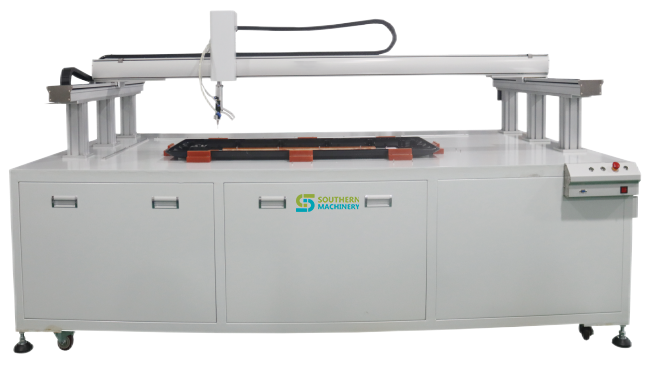
Single & Double-Head Dispensing and Screw Fastening Machines by Southern Machinery
Glue dispensing and screwdriving are two of the last operations that many EMS factories still trust to manual labor — and two of the easiest places to lose consistency. Southern Machinery's demo video, Single/Double-headed Dispensing Machine and Screwdriver Machine, Meet various needs, shows a different approach: a configurable workstation that performs controlled adhesive application and automatic screw fastening on the same platform, with single-head or double-head layouts.
Southern Machinery (founded 2011, Shenzhen, China) designs and builds SMT, THT and PCB assembly automation for more than 237 global customers. The machine family demonstrated in this video is documented on smthelp.com as the NBHZ Series, with published configuration references such as NBHZ-331, NBHZ-5331 and NBHZ-CFD-1 for dispensing workstations, and NBHZ-5331, NBHZ-5331X and NBHZ-331-2 for automatic screw locking platforms. As the product pages state, the final layout, head configuration, fixture design and feeding method are confirmed against each buyer's actual workpiece and workflow — which is exactly how a dispensing and fastening machine should be selected.
What Is This Machine Used For?
Put simply, a single/double-head dispensing and screwdriving machine automates two repetitive manual operations that sit between PCB assembly and final product:
- Dispensing. The machine applies glue, adhesive, sealant, silicone or thermal compound in controlled dots, lines or coating patterns. Where a hand operator's dispensing volume drifts through the shift — causing bleed, starved joints or messy housings — a machine applies the same amount at the same position every cycle.
- Screw fastening (screwdriving). The machine picks a screw from a feeding system, positions it over the hole, and drives it to a programmed depth or torque specification. This removes the ergonomic strain and quality variance of hand screwdriving on high-iteration assemblies.
The "single/double-head" point matters for buyers. A single-head configuration is a focused, lower-cost station for one operation. A double-head configuration can carry two tools on the same gantry — for example a dispensing valve and a screwdriving spindle — so one station completes both operations in one handling cycle, or doubles up the same tool to raise throughput on one operation.
It is not a replacement for a high-speed jet dispenser on an SMT line, nor for a multi-axis screwdriving robot on a fully automated assembly cell. It is a practical, flexible workstation for factories where dispensing and fastening volumes are real but do not yet justify two dedicated single-purpose machines.
Typical Applications
Factories typically evaluate this type of machine when they see the same manual glue-and-screw pattern repeated across many PCB variants:
- LED lighting and driver assembly. Bonding or sealing components and housings, then fastening covers and terminal covers with screws.
- Power supplies, adapters and chargers. Applying thermal adhesive or silicone where heatsinks and housings meet, followed by screw fastening of the enclosure after the board leaves wave soldering.
- Automotive electronics and car audio. Controlled sealant beads on module housings and repeatable screwdriving of control module covers, where joint quality and fastening consistency are customer-audited.
- Home appliance control boards. Fixing connectors, strain-relief parts and board assemblies into plastic or sheet-metal enclosures at the end of the SMT/THT line.
- General EMS box-build. Mixed, medium-volume products that need both an adhesive step and a fastening step, where a dedicated dispensing line and a dedicated screwdriving line would each be under-utilized.
How It Fits into a Complete PCB Assembly Line
A typical Southern Machinery-supported line flows from solder paste printing through SMT pick-and-place, reflow, AOI/SPI inspection, THT auto insertion, wave soldering and board cleaning — then into final assembly, where dispensing and fastening work begins.
Dispensing and screwdriving stations belong in that last segment, and they connect to the rest of the line in two ways:
- As an inline or near-line cell. Boards arrive on conveyors or board handling equipment (magazine loaders, unloaders, shuttles) and pass through the workstation between wave soldering/cleaning and final test or packing. Vision or fiducial registration aligns the program to each board.
- As a standalone cell. An operator loads a fixture, the machine dispenses and drives screws, and the operator unloads. This keeps the workstation independent of line takedown and makes it easy to move between products.
Because the NBHZ platform is configured around the workpiece, it pairs naturally with the rest of Southern Machinery's ecosystem: pick-and-place and auto insertion machines upstream, wave soldering and cleaning in the middle, and board handling systems that move panels in and out. For traceability-conscious EMS companies, dispensing counts and fastening results can be treated as data points for MES rather than as operator-reported figures.
Key Selection Parameters
Do not buy a dispensing and screwdriving machine on a datasheet alone. These are configuration-heavy purchases. Evaluate the following categories, and let the supplier confirm numbers against your product:
- Head configuration. Single or double head; which tools (dispensing valve, screwdriving spindle, or both); whether the head is interchangeable for future products.
- Working area. The travel envelope must cover your largest board or housing and every fastening point without repositioning the fixture twice.
- Dispensing requirements. Adhesive type, viscosity, curing and storage behavior; dot, line or coating pattern; required volume consistency and any process verification.
- Screw fastening requirements. Screw material, head type, diameter, length and torque specification; feeding method; bit and nosepiece changeover; detection of missing screws, stripped threads or incomplete driving.
- Positioning method. Taught points versus vision-guided positioning; how board position variation is compensated.
- Fixture and loading. Manual, semi-automatic or automatic loading/unloading; changeover time between SKUs; access direction for the dispensing path and screwdriver bit.
- Data and traceability. What the machine can record — dispensing cycles, fastening torque or depth results — and how that data is exported to MES.
- Layout and environment. Bench-top, single-station or floor-standing layout; ESD requirements; operator safety; available floor space.
Southern Machinery's engineering team reviews the product drawing, adhesive information, screw list and target output before recommending a practical NBHZ configuration — buyers should send the same information to any supplier they evaluate.
ROI and Quality Perspective
From a buyer's perspective, the business case for automating dispensing and screwdriving usually rests on three measurable problems:
- Material waste and rework. Hand-applied glue varies with operator, shift and fatigue. Over-dispensing creates bleed and cleaning cost; under-dispensing creates field failures. A machine applies a repeatable volume, which directly reduces both scrap and warranty risk.
- Fastening defects. Hand screwdriving produces stripped threads, tilted screws, missed fasteners and torque drift. A machine drives the same screw to the same result every cycle, and the process can be verified instead of assumed.
- Labor and ergonomics. Manual glue-and-screw operations are repetitive and physically demanding. Moving them to a workstation lets one operator supervise a process that previously required multiple hands, and removes the ergonomic exposure that drives turnover.
The honest way to evaluate ROI is with your own numbers: current defect and rework rates, labor cost per board, changeover frequency, and the value of traceability for your customers. Southern Machinery does not publish generic payback claims because the answer depends on those inputs — but the company will help you scope the machine and the configuration against them.
FAQ
What does a single/double-head dispensing and screwdriving machine do?
It automates two manual operations on one platform: controlled application of glue, adhesive or sealant in dots or lines, and automatic screw fastening to a programmed depth or torque. Single-head versions focus on one operation; double-head versions can carry two tools or double the throughput of one.
Can one machine both dispense glue and drive screws?
Yes — that is the point of the dual-purpose configuration shown in the demo video. The NBHZ platform can be arranged with dispensing and screwdriving tools on single or double heads. Because the layout is application-driven, the exact head and tool configuration must be confirmed with the supplier for your product.
Where does this machine fit in an SMT/THT line?
After wave soldering and board cleaning, in the final assembly segment where housings, heatsinks, covers and connectors are added. It can run as an inline cell fed by board handling equipment or as a standalone workstation for mixed products.
What information do I need to provide for a quotation?
Product drawings or photos, the screw list (head type, size, torque), the adhesive type and dispensing pattern, board or housing dimensions, target output per shift, and current assembly method. That is enough for a supplier to recommend a configuration.
Is screwdriving torque-controlled on these machines?
Automatic screw locking platforms are sized around your torque specification and can include fastening verification, data collection and traceability — but the exact scope depends on the configuration. Confirm the fastening and reporting features against your application before ordering.
Are these machines only for electronics?
No. The same platform is relevant wherever repeatable glue and screw operations occur — electronics assembly, electrical products, enclosures and appliances. Suitability depends on product design, screw specification, access direction and required throughput.
Contact Southern Machinery
If your factory still applies glue and drives screws by hand, a single/double-head dispensing and screwdriving workstation is a low-risk first automation step — and Southern Machinery can help you scope it around your real product mix.
- Email: jasonwu@smthelp.com
- Website: www.smthelp.com — see the NBHZ glue dispensing machine and NBHZ automatic screw locking machine product pages
- Catalog and technical files: file.autoinsertion.com
- Product images: ph.smthelp.com
- Watch the demo: Single/Double-headed Dispensing Machine and Screwdriver Machine, Meet various needs
Comments