
SH8650 3D SPI Machine for Solder Paste Inspection: Catch Solder Paste Defects Before Placement | Southern Machinery
3D solder paste inspection before placement: the SH8650 SPI from Southern Machinery measures paste on PCBs up to 510 x 460 mm for higher SMT yield.
Aug 25, 2026 · Updated Aug 25, 2026 · Southern Machinery
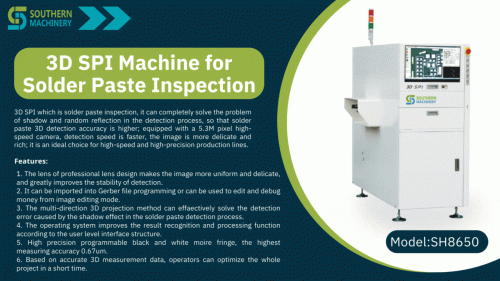
SH8650 3D SPI Machine for Solder Paste Inspection: Catch Solder Paste Defects Before Placement
If you run an EMS, ODM, automotive electronics, medical device, or industrial control operation, the quality of your SMT line is largely decided at the stencil printer—not at the reflow oven. Solder paste defects that survive to reflow turn into rework, field returns, or scrap. An SPI (Solder Paste Inspection) station between the stencil printer and the pick-and-place machine closes that gap. This article explains what the Southern Machinery SH8650 (also written SH-8650) 3D SPI machine does, where it fits in a PCB assembly line, and what to verify before you buy.
What is this machine used for?
What is the SH8650 SPI machine used for?
The SH8650 is a fully automatic, non-contact 3D Solder Paste Inspection machine. It measures solder paste deposits on a PCB immediately after stencil printing and before components are placed. Using 3D imaging technology, it checks whether paste volume, height, area, and position meet the process window. If the paste is wrong—too thin, too thick, bridged, or offset—the board is flagged before it ever reaches placement and reflow.
Why is SPI placed before Pick and Place?
Because solder paste is the only element holding the SMT process together at that stage. Once components are placed and the board passes through the reflow oven, paste defects are baked in. SPI gives the line a chance to clean, reprint, or adjust the printer immediately—at the cheapest possible point in the process.
Why solder paste inspection matters
- Solder paste defects (insufficient volume, excess height, bridging, offset) are a leading cause of SMT rework.
- Rework after reflow is expensive: it consumes operators, adds thermal stress to the board, and risks component damage.
- SPI changes inspection from "find the bad board after reflow" to "prevent the bad board from being created."
- SPI data feeds SPC—misjudgment statistics and trend analysis—so the printing process is corrected proactively instead of reactively.
SPI is not the same as AOI. AOI inspects assembled boards after placement or reflow; SPI inspects the paste itself, before placement. A complete line typically uses both.
SH8650 3D SPI machine at a glance
The SH8650 is a 3D SPI machine from Southern Machinery, a Shenzhen-based SMT/THT PCB assembly automation equipment manufacturer founded in 2011, serving 237+ customers worldwide. Verified features:
- 3D imaging technology for accurate, repeatable solder paste measurement
- Supports PCBs up to 510 mm x 460 mm
- Works with lead-free and leaded solder paste
- Fully automatic, non-contact measurement with micron-level precision
- Measurement based on plane camera, laser, or structured light / programmable stripes for 2D or 3D analysis
- User-friendly interface with software for inspection data analysis and SPC misjudgment statistics
- Positioned as an online SPI for SMT lines
Exact cycle time, inspection accuracy, and machine footprint are published in the Southern Machinery datasheet—confirm these against your target board and line tact when quoting. The machine is available with OEM/ODM options.

Typical applications
- Automotive electronics - ECUs, sensors, BMS: solder joint reliability is safety-critical, so paste inspection before reflow is standard practice.
- Medical electronics - where field failure is unacceptable and process traceability is required.
- Industrial control - PLCs, inverters, motor drives: high-mix, long-life products where rework cost and reliability matter.
- Power supply and LED lighting - high-volume boards where paste defects multiply into large scrap losses.
- EMS and ODM factories - multiple customers and board types: SPI shortens NPI ramp-up by catching printer setup errors early.
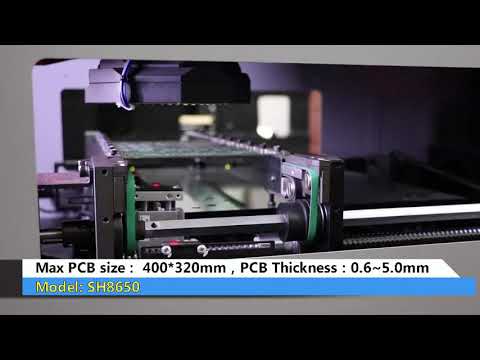
How it fits a complete PCB assembly line
A typical SMT line with the SH8650 looks like this:
- PCB loading and board handling (loader, magazine loader)
- Stencil printer - solder paste printing
- SH8650 SPI - solder paste inspection (the step covered in this article)
- Pick and Place - SMT component placement
- Reflow Oven
- AOI - assembled board inspection
- Board handling at the end of line (unloader, buffer, NG/OK separation)
The SH8650 sits directly after the stencil printer and feeds defect information back to the printing process. Because it is a fully automatic inline inspection station, it adds no operator to the line.
Southern Machinery provides the full line—SMT placement, THT auto insertion, wave soldering, board handling, cleaning, and inspection—so the SPI can be specified as part of one integrated solution rather than a standalone island: one line supplier, one service contract, one set of training and spare parts.
Key selection parameters to verify
When evaluating a 3D SPI machine, confirm the following with the supplier:
- PCB dimensions - does the machine accept your largest board? The SH8650 supports up to 510 mm x 460 mm.
- Paste types - lead-free and leaded compatibility.
- Measurement technology - true 3D vs 2D, and the measurement principle (laser, structured light, programmable stripes).
- Inspection speed - cycle time vs your line tact time; confirm the datasheet number against your board size.
- Software and SPC - how inspection data is analyzed, stored, and exported (CSV, MES integration).
- Board support and fiducial handling - how thin or flexible boards are supported during measurement.
- Training, installation, and warranty - Southern Machinery offers installation guidance, video tutorial programming training, and a 1-year warranty.
ROI, quality and capacity impact
The ROI case for SPI is usually built on three numbers:
- Quality - catching paste defects before placement eliminates whole classes of reflow defects (bridging, tombstoning, insufficient joints).
- Scrap and rework cost - a board stopped at SPI costs a reprint; the same board stopped after reflow costs stripping, rework labor, and possibly component damage.
- Capacity - automated inspection runs at line speed without an operator, and SPC data reduces printer tuning time during changeovers and NPI.
For high-reliability sectors such as automotive and medical, SPI is effectively a compliance decision: it proves the paste process was in control.
FAQ
What does SPI stand for?
SPI stands for Solder Paste Inspection. It is an automated optical inspection step that measures solder paste deposits on a PCB after printing and before component placement.
What is the difference between SPI and AOI?
SPI inspects solder paste before placement; AOI inspects assembled boards after placement or reflow. They check different stages of the SMT process and are complementary.
What defects does a 3D SPI machine detect?
Common detected issues include insufficient or excessive paste volume, paste height outside the process window, bridging between pads, and paste offset from the pad.
Can the SH8650 handle lead-free solder paste?
Yes. The SH8650 is compatible with both lead-free and leaded solder paste.
What PCB sizes can the SH8650 inspect?
The SH8650 supports PCBs up to 510 mm x 460 mm, covering most SMT production boards.
Is the SH8650 an inline machine?
The SH8650 is positioned as an online SPI for SMT lines—a fully automatic, non-contact station that runs between the stencil printer and the pick-and-place machine. Confirm conveyor height and the line interface (for example SMEMA) with Southern Machinery for your specific line.
Get a configuration recommendation
Choosing an SPI means matching the machine to your board set, line speed, and quality targets. Contact Southern Machinery at jasonwu@smthelp.com or +86 13602562576 for a configuration recommendation and line layout advice.
- Browse product catalogs and manuals at file.autoinsertion.com
- See real machine photos at ph.smthelp.com
- Watch the SH8650 in action: SH-8650 SPI 3D Inspection Machine and 3D SPI Machine demo
Comments