
3D SPI Machine | Solder Paste Inspection | Model: SH8650
SH8650 3D SPI machine for solder paste inspection in SMT lines. Detect paste defects early, reduce rework, and improve first-pass yield with Southern Machinery SPI solutions.
Aug 17, 2026 · Updated Aug 17, 2026 · Southern Machinery
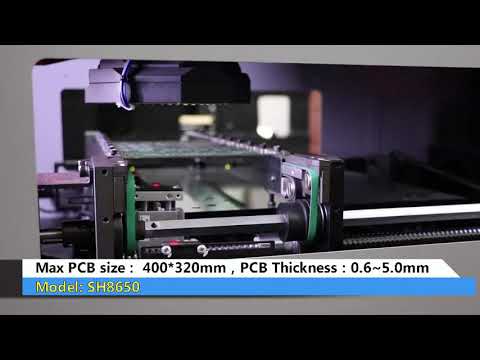
What is the SH8650 3D SPI Machine?
The SH8650 is a 3D Solder Paste Inspection (SPI) machine designed for quality control in SMT stencil printing processes. It inspects printed solder paste deposits on PCBs before component placement, detecting insufficient paste, excess paste, bridging, or misalignment — defects that are costly to repair after reflow.
In an SMT production line, the stencil printing stage is responsible for up to 60–70% of assembly defects. The SH8650 SPI system catches paste-related issues early, giving production engineers the data needed to adjust print parameters in real time and maintain high first-pass yield rates.
Typical Application Scenarios
The SH8650 3D SPI machine is deployed across a range of electronics manufacturing environments:
- Consumer electronics assembly — TV, home appliance, and mobile device PCB production where solder joint reliability is critical
- Automotive electronics — PCB assemblies requiring strict solder quality standards for safety-critical control modules
- Power supply manufacturing — High-density boards where paste volume variation directly impacts thermal and electrical performance
- LED lighting production — Aluminum-based MCPCB assemblies with thermal management requirements
- Contract manufacturing (EMS) — Multi-customer, high-mix production environments where yield tracking and defect trend analysis reduce costly rework cycles
Integrating the SH8650 into an SMT Assembly Line
The SH8650 sits between the stencil printer and the pick-and-place machine as a quality gate. A typical integration workflow:
- Printer outputs PCB → SH8650 scans the board using structured light projection and cameras
- 3D measurement — Captures paste height, area, and volume against the pad design data
- Pass/fail decision — Defective boards are flagged for operator review or routed to a rework station
- Data logging — Statistical process control (SPC) data feeds back to the stencil printer for closed-loop adjustment
This workflow reduces downstream placement defects, minimizes costly reflow-stage rework, and provides traceable quality records for customer compliance documentation.
Key Selection Criteria for 3D SPI Systems
When evaluating solder paste inspection equipment for your SMT line, focus on these measurable criteria:
- Measurement resolution — 3D SPI systems must resolve paste deposits on fine-pitch components (0201, 01005, and below) without missing defects
- Cycle time compatibility — Inspection speed must match or complement your printer and placement line takt time; SPI is typically the bottleneck in high-speed lines
- CAD/Gerber compatibility — The system should import paste mask data directly from your PCB design workflow without manual re-entry
- Closed-loop integration — Look for systems that can communicate with stencil printers via IPC (IPC-2591) protocols for real-time printer feedback
- Calibration and repeatability — Choose equipment with documented repeatability specifications (typically ±5 μm or better for volume measurement)
Note: Specific speed, resolution, and certification data for the SH8650 model should be confirmed directly with Southern Machinery, as specifications vary by configuration and production batch.
ROI and Quality Impact
Investing in a 3D SPI system like the SH8650 delivers measurable returns in SMT assembly operations:
- Reduced rework costs — Reworking a single PCB after reflow typically costs 5–20× more than catching the defect at the print stage
- Improved first-pass yield (FPY) — Consistent paste deposition drives higher FPY, directly affecting throughput and per-board cost
- Defect escape prevention — Post-reflow solder joint failures (bridging, insufficient solder) can cause field returns and reputational damage, especially in automotive and medical segments
- Data-driven process control — SPI trend data enables engineers to perform root-cause analysis on paste-related variability, reducing scrap and downtime
For a mid-volume EMS operation running 5,000–20,000 boards per day, even a 1–2% improvement in FPY from SPI integration can translate to significant annual savings in material and labor costs.
Frequently Asked Questions
Q: What is the difference between 2D and 3D SPI?
A: 2D SPI measures paste area and shape using top-down imaging. 3D SPI adds height and volume measurement, enabling detection of insufficient paste on tall components or areas where paste may be present but below the required volume threshold.
Q: Can the SH8650 handle both lead-free and leaded solder pastes?
A: The SH8650's structured light and imaging system can inspect a wide range of paste types including lead-free (SAC305, SAC405) and traditional leaded formulations. Confirm specific compatibility with Southern Machinery based on your paste profile.
Q: How does SPI data improve stencil printing performance?
A: By measuring every board rather than sampling, SPI provides statistical process control (SPC) data that identifies printer drift, stencil wear, and paste lot variation before they cause defect escapes.
Q: What board sizes can the SH8650 accommodate?
A: Board size capability varies by machine configuration. Standard SPI systems typically handle boards from 50 × 50 mm up to 510 × 460 mm or larger. Verify your maximum board dimensions with Southern Machinery.
Q: Does the SH8650 support MES/EAP integration?
A: Many modern SPI systems support factory integration protocols. Confirm SH8650's connectivity options (SECS/GEM, IPC-Hermes, custom APIs) against your production management system requirements.
Q: How does SPI contribute to RoHS and IPC compliance?
A: Consistent solder paste deposition supports reliable solder joint quality, which is essential for meeting IPC class 2 or class 3 acceptance criteria. SPI inspection records also provide audit-ready quality documentation.
Choose Southern Machinery for Your SPI and SMT Line Needs
Southern Machinery has been an SMT/THT PCB assembly automation specialist since 2011, headquartered in Shenzhen, China. With 237+ global clients across consumer electronics, automotive, LED lighting, and power supply sectors, we deliver cost-effective, high-efficiency production line solutions backed by spare parts supply, training, and technical support.
Our stencil printing and inspection equipment portfolio covers the full spectrum of SMT line requirements — from precision printers to 3D SPI and beyond. Whether you're setting up a new line or upgrading an existing facility, Southern Machinery provides equipment that integrates with your workflow and your quality standards.
Get a quote or discuss your SMT line requirements with our team today.
---
Cover image: SH8650 3D SPI Machine — Solder Paste Inspection for SMT Production Lines
Comments