
SDC-115 Dry Box for PCBA and Component Storage | Southern Machinery
Protect moisture-sensitive PCBs and SMT components with the SDC-115 dry box from Southern Machinery — low-humidity MSD storage for electronics assembly lines.
Aug 3, 2026 · Updated Aug 3, 2026 · Southern Machinery
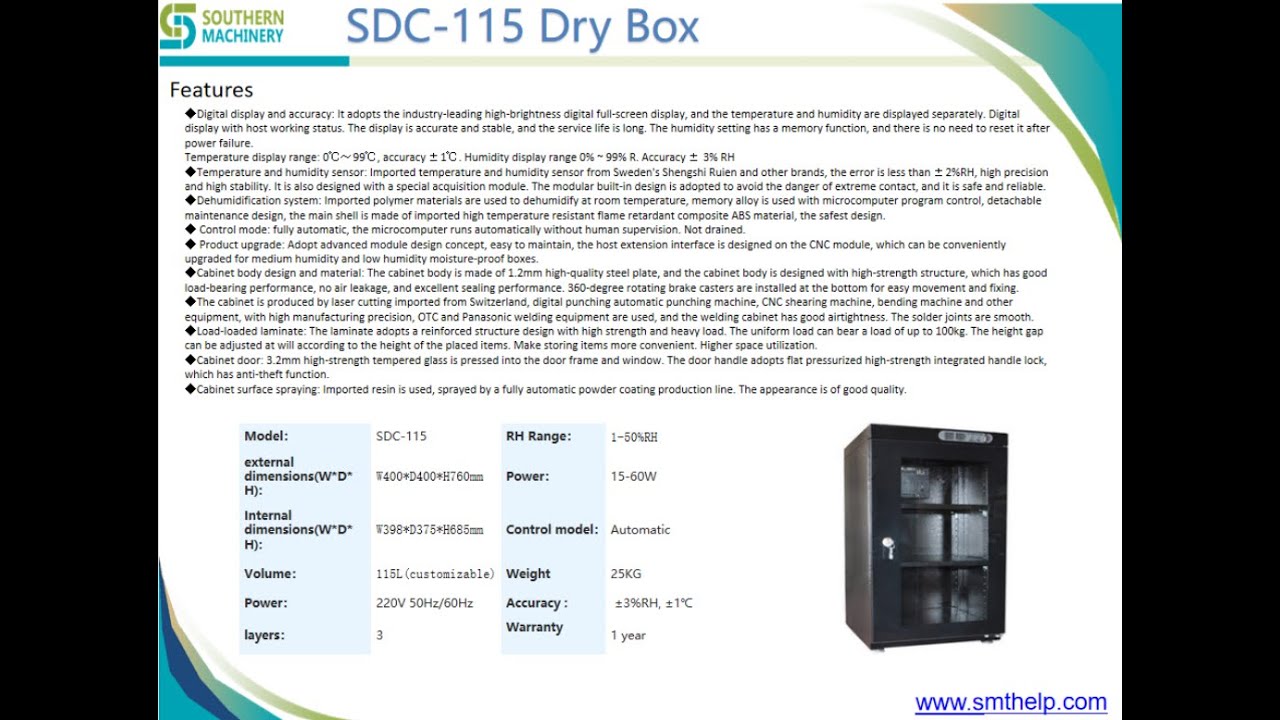
SDC-115 Dry Box for PCBA and Component Storage — Low-Humidity Protection for Moisture-Sensitive Devices
Moisture is one of the quietest killers in PCB assembly. The SDC-115 dry box from Southern Machinery gives EMS, ODM, and electronics manufacturers a controlled low-humidity storage environment for bare PCBs, assembled PCBA, and moisture-sensitive SMT components — protecting them from absorption damage before they ever reach the line.
What is this machine used for?
The SDC-115 is a dry storage cabinet — a "dry box" in everyday SMT factory language — used to hold printed circuit boards and electronic components at a controlled relative humidity (RH) level. Moisture-sensitive devices (MSDs) such as QFPs, BGAs, connectors, and LED components absorb humidity from the air. If they are reflowed or wave soldered before that moisture is driven out, trapped vapor can cause "popcorning," delamination, cracks, and hidden internal damage that shows up as field failures.
The SDC-115 addresses this by giving the production floor a dedicated low-humidity storage zone for:
- Bare PCBs and inner layers waiting for assembly
- Assembled PCBA between process steps
- Moisture-sensitive components removed from their original dry packaging
- Reels, trays, and tube components awaiting kitting and setup
The product video demonstrates the SDC-115 in operation, highlighting its relative-humidity control for PCBA and component storage — part of Southern Machinery's Storage, ESD & Smart Factory equipment range.
Typical Application Scenarios
EMS / contract manufacturing. Multi-customer production means components sit in inventory. An EMS line running many small batches needs to keep MSDs dry between work orders — the SDC-115 provides that buffer without sending parts back to a central warehouse.
Automotive electronics. High-reliability boards with BGAs and fine-pitch connectors demand controlled handling. Low-humidity storage reduces moisture-related defects before wave or selective soldering.
Medical electronics. Traceability and process control are audit-critical. A dedicated dry box supports documented MSD handling procedures and consistent assembly quality.
Industrial control and power electronics. Large boards and heavy THT components often sit in semi-finished state between insertion and soldering — a dry box protects them from ambient humidity on the shop floor.
LED manufacturing. LED components and modules are moisture-sensitive; a dry box prevents brightness drift and internal corrosion issues during storage.
How It Integrates into a Complete PCB Assembly Line
The SDC-115 fits into the material-management zone of an SMT/THT line, upstream of kitting and setup:
- Receiving — incoming MSD reels and components are logged and stored in the dry box instead of open shelving.
- Kitting — components are pulled from the dry box for line-side kitting, keeping exposure time to ambient humidity short.
- Line setup — pick-and-place feeders and THT insertion machines are loaded with components that have been stored at controlled RH.
- Between processes — assembled PCBA can be staged in the dry box between reflow, wave soldering, cleaning, and inspection when the line is not continuous.
- Inspection & rework — boards awaiting AOI or rework are protected rather than left exposed on benches.
For factories running Southern Machinery's smart reel storage systems (SIS series racks, smart silos), the SDC-115 complements the material flow: automated storage handles quantity and traceability, while the dry box handles humidity-sensitive items that need environmental protection.
Key Selection Parameters
When evaluating a dry box for your SMT/THT facility, confirm these parameters with the supplier:
- RH control range and accuracy — what humidity level the cabinet can hold and how precisely, matching your MSD storage requirements
- Capacity and shelf configuration — number of shelves, usable height, and whether it fits full reels, trays, or large PCBs
- Cabinet size and footprint — fits the material staging area and standard factory aisles
- Control and monitoring — digital display, alarm for RH excursions, and data logging if required by your quality system
- ESD-safe construction — conductive or dissipative materials compatible with electrostatic discharge control programs
- Power and environment — standard power supply requirements and placement conditions in your facility
ROI, Quality & Throughput Perspective
The SDC-115 pays for itself through defect prevention rather than speed:
- Lower scrap and rework. Moisture-related failures (popcorning, delamination, solder joint cracks) are expensive to detect and rework. Preventing them at the storage stage is far cheaper than repairing boards after soldering.
- Fewer field failures. Boards that survive initial test can still fail in the field from latent moisture damage. Controlled storage improves end-product reliability and reduces warranty costs.
- Better MSD handling compliance. Customers in automotive and medical supply chains increasingly audit MSD handling. A documented low-humidity storage practice supports those audits.
- Less material waste. Components that exceed their floor-life exposure limits are typically discarded. A dry box extends usable inventory life and reduces write-offs.
- Smoother production flow. Material staged under controlled conditions means fewer surprises when a line starts — less downtime, steadier throughput.
FAQ
Q: What is an SDC-115 dry box used for in PCB assembly?
A: It is a low-humidity storage cabinet for bare PCBs, assembled PCBA, and moisture-sensitive SMT/THT components, protecting them from humidity absorption before soldering.
Q: Why do SMT components need dry storage?
A: Moisture-sensitive devices such as BGAs, QFPs, and connectors absorb humidity. If soldered before drying, trapped moisture can cause popcorning, delamination, and hidden internal cracks.
Q: Does the SDC-115 fit into an existing SMT line?
A: Yes. It is standalone material-management equipment that sits upstream of kitting and line setup, complementing feeders, insertion machines, and smart reel storage systems.
Q: What industries use dry boxes for electronics?
A: EMS/contract manufacturers, automotive electronics, medical devices, industrial control, power electronics, and LED manufacturing all use dry storage for MSD protection.
Q: What support does Southern Machinery provide?
A: Southern Machinery (founded 2011, Shenzhen, China) serves 237+ global customers with SMT/THT assembly equipment, spare parts, training, and after-sales service.
Q: Can I see the SDC-115 in operation?
A: Yes — Southern Machinery's product video demonstrates the SDC-115 dry box on the Smthelping YouTube channel.
Contact Southern Machinery for Configuration Advice
Every SMT/THT line has different MSD exposure, component mix, and floor space. Southern Machinery helps you size the right dry storage solution for your material flow.
- Contact Jason Wu at jasonwu@smthelp.com
- Browse catalogs at file.autoinsertion.com
- View machine photos at ph.smthelp.com
- Explore the full equipment range at www.smthelp.com
Southern Machinery — SMT/THT PCB assembly automation equipment since 2011. High-efficiency, cost-effective, globally supported.
Comments