
SD6000-A Automatic PCB Separator by Southern Machinery: MES-Connected Depaneling for Mixed Stamp-Hole and V-Cut Panels
Depaneling is the last mechanical operation before a board leaves the PCBA line, and one of the easiest places to lose yield. The SD6000-A Automatic PCB Separator from Southern Machinery combines a Gong knife (V-cut scoring) head and a Hob (router milling) head on a two-table platform, so mixed-technology panels carrying both stamp holes and V-cut slots can be separated on one machine without a line change. Published specifications include ±0.02 mm cutting accuracy, a 3,000–60,000 RPM spindle, a 0.5–3 mm PCB thickness range and 0–80 mm Z clearance, plus QR code scanning, MES docking and real-time production records. This guide covers applications, line integration, key selection parameters and the ROI case for automated depaneling.
Sep 18, 2026 · Updated Sep 18, 2026 · Southern Machinery
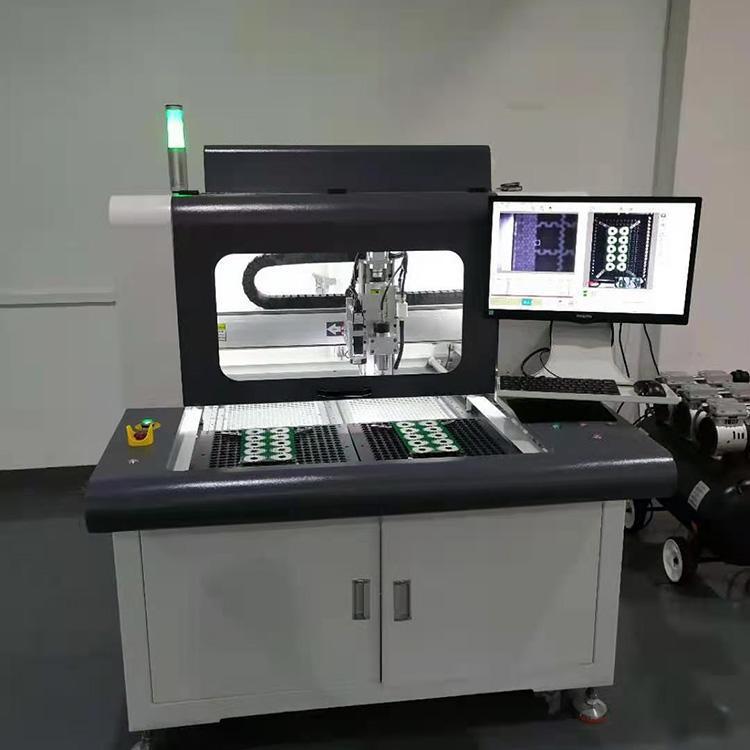
SD6000-A Automatic PCB Separator by Southern Machinery: MES-Connected Depaneling for Mixed Stamp-Hole and V-Cut Panels
Depaneling looks like the simplest operation on a PCBA line. In practice it is the last chance to destroy a board that has already cleared SPI, AOI and functional test. A cutting blade that is slightly out of alignment, a fixture that lets the panel shift a fraction of a millimetre, or a spindle that injects static into a finished assembly will all surface later as cracked solder joints, chipped edges and field failures.
Southern Machinery has designed and built SMT and THT PCB assembly automation equipment in Shenzhen since 2011, and today supports more than 237 customers worldwide — from single machines to complete inline solutions covering SMT placement, THT auto insertion, Wave Soldering, board handling, cleaning and inspection. The SD6000-A Automatic PCB Separator is the machine the company positions at the depaneling end of that line: a dual-table platform that performs both Gong knife (V-cut scoring) and Hob (router milling) separation on the same system.
This guide explains what the SD6000-A is used for, why mixed-technology panels defeat conventional separators, how the machine integrates into a complete PCB assembly line, which parameters a buyer must confirm before ordering, and how to build the ROI case for automated depaneling.
What is the SD6000-A Automatic PCB Separator used for?
Q: What is the SD6000-A used for?
The SD6000-A is an automatic PCB separator — a depaneling machine that separates individual PCBs from a production panel after SMT and THT assembly is complete. It combines two cutting structures, a Gong knife head and a Hob head, on a two-table platform, and it cuts with a spindle running from 3,000 to 60,000 RPM at a stated cutting accuracy of ±0.02 mm.
Q: What makes it different from a standard V-cut separator?
Most separators are designed for one panel style. A V-cut machine handles scored FR4 panels; a router handles routed or stamp-hole panels. A panel that carries both — stamp holes and V-cut slots on the same board, which is common on power supply, appliance and industrial control assemblies — normally forces either a two-machine sequence or a manual snap-off step. Southern Machinery's SD6000-A documentation states that the platform is built specifically to address this "mixing plate (stamp hole and V card slot)" separation problem, and that switching between V-cut panel types and stamp-hole panel types does not require changing lines.
Q: Does it work offline or inline?
The SD6000-A is an automatic standalone depaneling station with QR code scanning and MES docking and real-time production record collection, so it can be run as a self-contained cell and still feed board-level traceability data back to your MES.
Why mixed-technology panels break conventional depaneling
The stamp-hole and V-cut conflict
A V-cut blade needs a continuous, straight score line to follow. A routed panel with stamp holes has no continuous score — the board is held by small bridges of material that must be milled away. When both features appear on one panel, an operator running a V-cut-only machine has to skip the routed sections and finish them by hand. Southern Machinery's own summary of the problem is blunt: mixed plates expose the shortcomings of single-method separation machines and create line-changeover overhead between stamp-hole and V-cut product families.
Two cutting structures, one platform
The SD6000-A answers this with two heads. The Gong knife structure handles the scored/V-cut side of the panel; the Hob (milling) structure removes the material bridges that hold routed boards. Because both live on the same platform, the operator does not move the job to a second machine, and the board is not handled twice. This is the core of the machine's documented benefit case: increase production capacity, stabilise quality and reduce manpower.
Positioning accuracy is the real specification
Depaneling quality is decided by how well the panel is held. The SD6000-A documentation states that the substrate is fixed more firmly during cutting specifically to avoid the accuracy errors caused by poor base positioning, and that a special fixture is made per product so that the piece being cut is positively located. If you are evaluating any separator, the fixture design is worth more of your attention than the blade.
Typical application scenarios
Power supply and adapter PCBA
Power supply boards are the classic mixed-technology panel — heavy THT components on one side, scored sections on the other. The SD6000-A's working area of X 350 mm, Y1 450 mm / Y2 450 mm with Z travel 0–80 mm suits the dense, component-heavy panels typical of adapters, ballasts and switching power supplies, where a 0–80 mm Z window matters because the board is being cut with tall THT parts already inserted.
LED lighting and aluminum-backed boards
LED tube and strip assemblies are long, narrow and often aluminum-backed, and they are usually scored rather than routed. A dual-table layout lets the operator load the second table while the first is cutting, which keeps the spindle productive on high-volume LED runs instead of idling during load/unload.
Automotive, industrial control and appliance electronics
These programs combine stamp-hole panels, V-cut panels and mixed panels in the same plant, often in low-to-medium volumes. Avoiding a line changeover between stamp-hole and V-cut product types is the operational win here, and the MES docking plus QR scanning support the traceability expectations that automotive and industrial customers increasingly place on contractors.
EMS and ODM high-mix production
For contract manufacturers, the recurring cost of depaneling is not the blade — it is the labour, the rework and the fixture changes. A separator with an English-language program, per-product fixtures and recorded production data reduces the skill level required to run the station and gives the process engineer data to defend the yield number.
How the SD6000-A integrates into a complete PCB assembly line
Depaneling is a downstream operation, so the SD6000-A sits after soldering and inspection, not before. A typical sequence looks like this:
- Solder paste printing and SPI — verify print volume and alignment before placement.
- SMT placement into a Reflow Oven — surface mount components are placed and reflowed.
- THT auto insertion or odd-form insertion — radial, axial, odd-form and terminal components are inserted into the plated holes.
- Wave Soldering or selective soldering — through-hole joints are soldered.
- AOI and, where required, X-ray — defects are caught before the board is cut, because once the panel is separated there is no second chance at the panel-level fixture.
- Board handling — loaders, unloaders, buffers and conveyors move panels between stations.
- Depaneling on the SD6000-A — panels are separated with a per-product fixture.
- Cleaning and final inspection — flux residue is removed and the board is released.
Because Southern Machinery supplies every stage in that list — insertion machines, Wave Soldering, board handling, cleaning equipment and inspection — the SD6000-A can be specified as part of an integrated line rather than a standalone purchase. That matters for board handling compatibility and for the cycle-time balance between the depaneling station and the rest of the line.
Key selection parameters to confirm before ordering
The SD6000-A datasheet publishes specific figures. Confirm each of these against your own product mix before you ask for a quotation:
- Panel working area — X 350 mm, Y1 450 mm, Y2 450 mm. Confirm the largest panel you intend to run, including the rail/edge allowance.
- Z / component clearance — 0–80 mm. This is the constraint that decides whether the machine can cut panels that already carry tall THT components.
- PCB thickness range — 0.5–3 mm.
- Cutting accuracy — ±0.02 mm. Confirm against your edge-quality and clearance requirements.
- Spindle speed — 3,000–60,000 RPM. Different substrate and panel constructions prefer different speeds; confirm the head and tooling for your material set (FR4, aluminum-backed, FR2).
- X/Y axis cutting speed — 0–1,000 mm/s, with X/Y drive speed at least 700 mm/s and Z drive speed at least 300 mm/s. Use these to sanity-check the cycle time against your takt.
- Table configuration — 2 tables. Confirm how you intend to use the second table (load/unload overlap versus parallel production).
- Head configuration — Gong knife, Hob, or both. Match this to whether your panels are scored, routed/stamp-hole, or mixed.
- MES and traceability — automatic QR code scanning and MES docking are documented. Confirm your MES protocol, data format and what production records you need returned.
- Fixture requirement — a special fixture is made per product. Budget for fixture design and build per part number, and confirm the lead time with your supplier.
- Power supply — 380 V, 50 Hz. Verify this against your facility supply before ordering; this is a three-phase requirement in most installations.
- Safety and environment — safety door or sensor, plus up/down vacuuming mode and a dust collector with a dust box. Confirm your local machine-safety requirements and your dust-extraction capacity.
- Software language — an English version of the program is available.
ROI, quality and throughput: what actually changes
Depaneling ROI is usually argued in three places.
Labour. Manual snap-off and hand-trimming of mixed panels consumes operator time that scales with panel complexity, not with volume. The SD6000-A documentation positions the machine as a way to increase production capacity while reducing manpower — the same framing Southern Machinery uses across its insertion and soldering platforms, where the labour content of a manual step is the primary cost driver.
Quality and rework. A ±0.02 mm cutting accuracy claim only holds if the panel is located properly, which is why the reinforced substrate clamping, whole-board image scanning and stitching, and per-product fixtures matter. Edge chipping and micro-cracks at the V-cut line are the defects that pass AOI and fail in the field, and they are the ones depaneling setup controls.
ESD. An antistatic generator is mounted at the front section of the spindle and blows continuously during cutting to reduce the static generated at high spindle speed — a real concern on assemblies that are already populated with sensitive devices. This is documented equipment, not a claim about outcome; the process still needs verifying on your own boards.
Traceability. QR scanning, MES docking and real-time production record collection convert the depaneling station from a blind spot into a data point. For automotive, medical and industrial customers auditing a supplier, that is often the deciding capability.
Service and support
Southern Machinery's SD6000-A documentation lists 7x24 worldwide support, free installation and training, a 1-day lead time on spare parts, and customised solutions quoted within one month. For a machine whose fixtures are product-specific, the training and fixture pipeline are as important as the hardware specification.
FAQ
What is the SD6000-A Automatic PCB Separator?
It is an automatic PCB depaneling machine from Southern Machinery that separates assembled PCBs from production panels on a two-table platform. It supports both Gong knife (V-cut scoring) and Hob (router milling) cutting structures, with QR scanning and MES docking.
Can the SD6000-A handle a panel that has both stamp holes and V-cut slots?
Yes — this is the mixed-plate case the machine is documented to address. Southern Machinery's specification notes that switching between stamp-hole panel types and V-cut panel types does not require a line change, because both cutting structures are available on the same platform.
What is the cutting accuracy and spindle speed?
The published SD6000-A specification states ±0.02 mm cutting accuracy and a spindle speed range of 3,000–60,000 RPM.
What PCB thickness and panel size can it cut?
The documented PCB thickness range is 0.5–3 mm, with a working area of X 350 mm, Y1 450 mm and Y2 450 mm, and Z travel of 0–80 mm.
Does the SD6000-A connect to an MES?
Yes. Automatic QR code scanning and MES docking are documented features, and production records are collected in real time so the depaneling step can report into your traceability system.
Does it need a custom fixture?
Yes. A special fixture is made for each product to hold the piece securely during cutting and protect the stated cutting accuracy, so fixture design and build must be planned per part number.
What power supply does it require?
380 V, 50 Hz, per the SD6000-A specification. Confirm this against your facility supply before ordering.
Get a configuration recommendation
Depaneling selection comes down to your panel construction, your component height and your traceability requirements — not to a catalogue headline. Southern Machinery will review your panel drawings and recommend the correct SD6000-A head configuration, table setup and fixture approach, and can position the machine inside a complete SMT and THT line solution.
- Email jasonwu@smthelp.com or call +86 13602562576 for a configuration review against your panel stack-up.
- Browse machine catalogues, manuals and datasheets at file.autoinsertion.com.
- See machine photos and product albums at ph.smthelp.com.
Southern Machinery — Shenzhen, China. Precision SMT and THT PCB assembly equipment since 2011, serving 237+ customers worldwide.
Comments