
SCN250 90° PCB Turning Conveyor by Southern Machinery
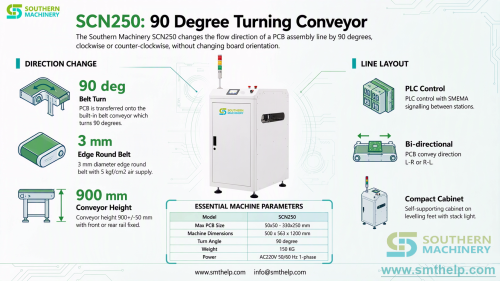
The SCN250 is a 90° PCB turning conveyor from Southern Machinery that moves boards or fixtures around a corner in an SMT line and can merge or split lines. Based on the SCN250 operation manual, this guide covers routing
Oct 27, 2026 · Updated Oct 27, 2026 · Southern Machinery
SCN250 90° PCB Turning Conveyor by Southern Machinery
What is the SCN250 used for? The SCN250 is a 90° PCB turning conveyor that moves PCBs or fixtures around a corner in an SMT production line and can merge or split multiple lines. It connects to neighbouring machines through standard SMEMA four-core signal cables, so a corner in the factory layout no longer has to mean a manual hand-off.
Why does a floor corner quietly cost you throughput?
Most line-layout discussions start with the placement machine. The corner rarely makes the list. Yet as soon as boards are carried by hand between two conveyors, you have added a person, a stack of unprotected boards and a spot where the line can stall.
Engineers feel this without naming it. The line runs, but someone keeps walking boards around a pillar, a fixture waits for a free operator, and nobody can say whose job the gap is. A turning conveyor turns that hidden gap into a defined, signalled station.
What should you check before choosing a 90° turning conveyor?
Use a simple four-question model before buying any board-handling device:
- Geometry: Which direction do boards arrive from, and which way must they leave?
- Compatibility: Do board sizes and conveyor heights match the adjacent machines?
- Signals: Do both neighbours speak SMEMA?
- Care: Who lubricates, cleans and adjusts it, and how often?
Geometry and routing modes
According to the source manual, the SCN250 has a PASS (straight-through) position and a Rotation (corner) position, plus four selectable modes: Mode 1 — boards enter at the straight-through position and exit from the right side of the corner position; Mode 2 — same entry, exit from the left side; Mode 3 — boards enter from the left side of the straight-through and corner positions and are turned out of the right side of the corner position; Mode 4 — boards enter at the straight-through position and exit at the right side of the straight-through and corner positions.
Compatibility and signals
The manual specifies a conveyor height of 900 ± 20 mm and threaded feet to match adjacent machines. A board jam at the entry is listed in the manual as being caused by a height mismatch with the upstream machine, so measure first. SMEMA in/out connections are provided on both the PASS and Rotation positions, with signal lamps shown on the main page.
Which SCN250 specifications matter for line planning?
| Item | Specification (from source manual) |
|---|---|
| Model | SCN250 |
| Dimensions (L × W × H) | 650 × 650 × 1200 mm |
| PCB size | 50 × 50 mm to 330 × 250 mm |
| Conveyor height | 900 ± 20 mm |
| PCB direction | Right → Left (or Left → Right) |
| Power supply | Single phase 220 V AC, 50/60 Hz |
| Power | 0.2 kW |
| Belt type | Round or flat ESD belt |
| Communication | SMEMA signal plug |
| Net weight | 150 kg |
The manual also lists Panasonic PLC control, stepper motor drive and a precision ball screw. Throughput per hour is not specified in the source — contact Southern Machinery to confirm.
How does the SCN250 fit into a complete PCB assembly line?
It sits at the corner of the line, with its rails aligned to the upstream and downstream machines. Because it supports merging and splitting, it can join two feeder lines or fan out to several processes. It belongs with other board handling systems, next to THT machines, wave soldering equipment and inspection equipment.
Commissioning in a few steps
The manual describes teaching three positions: a safe position for the telescopic axis, the corner position for the rotary axis (set to the angle of the downstream machine), and the telescopic output position near the exit rail. The rotary axis can only turn when the telescopic axis is at its safe position. Track width is adjusted with a tool at the adjustment point in the control box.
How do you keep a turning conveyor reliable?
The manual's schedule is concrete. Daily: keep the cover clean, clean the width adjustment shaft and keep the conveyor chain free of components and adhesive paper. Weekly: check belt tension and wear, and lubricate the ball screw; oil the lead screw at least every 2 weeks. Monthly: grease ball nuts, rotary bearing, guides and screws. Every 6 months: grease the PCB conveyor chain. Quarterly: check chain slack and track-width consistency.
Common faults listed in the manual: entry jams (fix the height with the threaded feet), belt not running (replace the motor or tighten tension), and a dead main-switch indicator (check wiring or replace the switch). Disconnect power before any electrical repair.
What is the value of a turning conveyor? A formula, not a promise
ROI formula (example only): Payback (months) = Investment ÷ (Monthly labour hours saved × hourly labour cost + Monthly rework cost avoided).
Illustrative example, depending on configuration and subject to final technical confirmation: if a corner hand-off took 20 labour hours a month at a cost of 10 per hour, and avoided rework were 100 per month, monthly benefit would be 300. Every input here is an assumption of yours; the source gives no price, labour or rework data.
Frequently asked questions
What does the SCN250 do? It turns PCBs or fixtures through 90° and can merge or split lines.
Does it use SMEMA? Yes, standard SMEMA four-core signal cables for direct connection to other machines.
What board sizes can it carry? 50 × 50 mm to 330 × 250 mm per the manual.
What power does it need? Single phase 220 V AC, 50/60 Hz, 0.2 kW.
Where is the service contact? The manual lists info@SMThelp.com and WhatsApp +86 136 0256 2576; quote model SCN250 and the serial number.
What to read next
Southern Machinery was founded in Shenzhen in 2011 and serves 237+ global customers with SMT/THT PCB assembly automation, with spare parts support and training. Next in this series: how to plan conveyor height and SMEMA handshakes across a whole line. Ready to plan your corner? Request a quote or browse the machine catalog.
Comments