
SCM800 Electric Stencil Cleaning Machine: Closed-Loop Stencil Cleaning for SMT and Red Glue Processes
A solder paste stencil is the most precise tooling on an SMT line — and the easiest thing to neglect. The SCM800 Electric Stencil Cleaning Machine from Southern Machinery runs a fully enclosed, PLC-controlled four-stage
Sep 24, 2026 · Updated Sep 24, 2026 · Southern Machinery
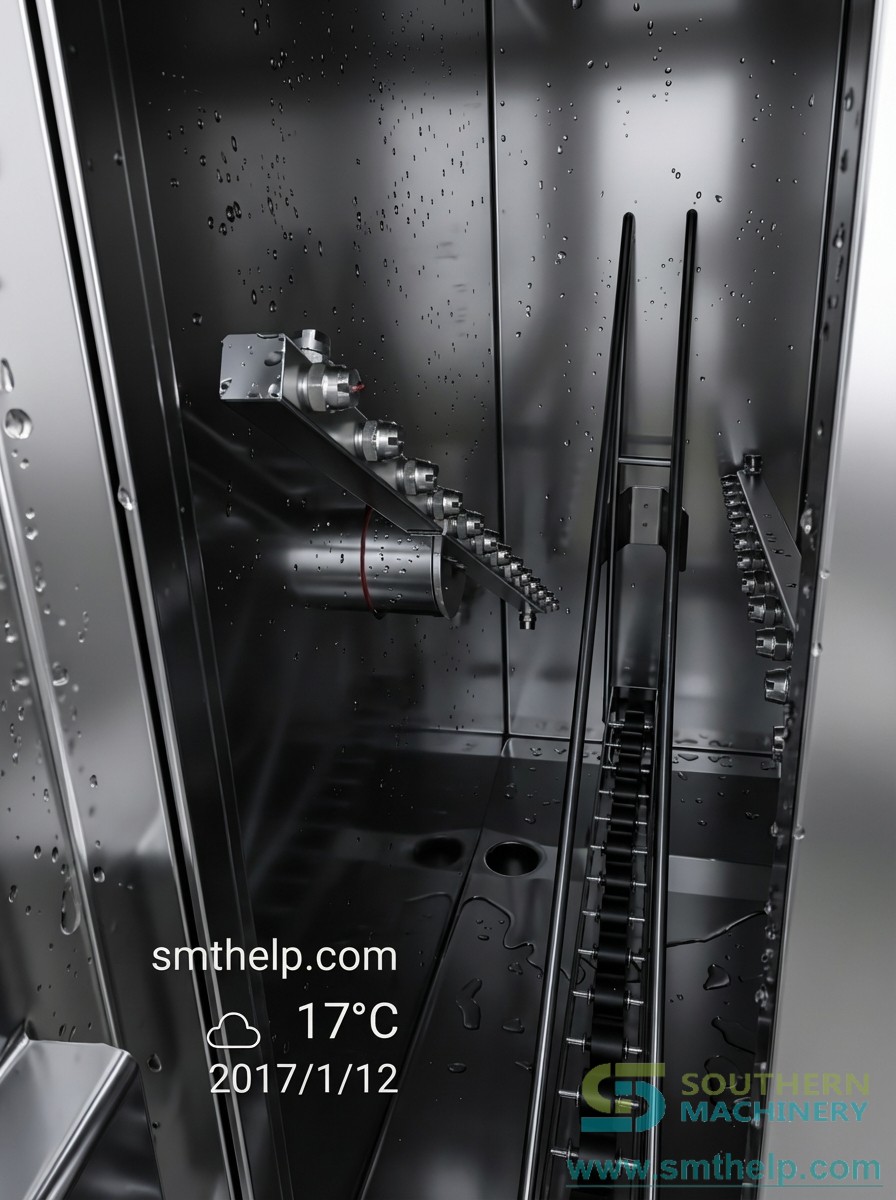
SCM800 Electric Stencil Cleaning Machine: Closed-Loop Stencil Cleaning for SMT and Red Glue Processes
A solder paste stencil is the most precise piece of tooling on an SMT line, and the easiest to neglect. Every print cycle leaves paste residue inside the apertures and on the underside of the foil. When that residue is not removed on a controlled schedule, the result shows up downstream as bridging, insufficient solder, solder balls and stubborn false calls at AOI. The SCM800 Electric Stencil Cleaning Machine from Southern Machinery is a fully enclosed cleaning system that runs a four-stage, PLC-controlled cycle — water-based spray cleaning, ultrasonic washing, DI water rinsing and hot air drying — so stencil condition becomes a scheduled process instead of an operator judgement call.
What is the SCM800 stencil cleaning machine used for?
The SCM800 removes solder paste, flux residue, red glue (SMT adhesive) and dust from SMT printing tooling and from boards that were printed incorrectly. In one enclosed cycle it cleans:
- SMT solder paste stencils (framed and, with the appropriate fixture, frameless)
- Red glue copper stencils and plastic masks used in bottom-side adhesive printing
- Misprinted PCBs, so a misprint can be recovered instead of scrapped
- Squeegees and other printing accessories
It is a support-process machine rather than an inline machine: it sits beside the printer or in the stencil storage area, and its output directly feeds the quality of the next printing shift.
Why stencil cleanliness decides SMT yield
Three failure modes trace back to stencil condition more often than most lines admit:
- Aperture clogging. Paste dries and hardens inside small apertures. Volume per deposit drops, and the defect appears as insufficient solder or open joints after reflow — sometimes thousands of boards after the stencil was last inspected.
- Underside contamination. Paste smeared under the foil transfers onto the next PCB and prints as bridging between fine-pitch pads.
- Red glue contamination. Adhesive printing for bottom-side reflow leaves a tacky film that ordinary paste cleaners do not fully release, especially on 3 mm thick red glue stencils and plastic masks.
Manual cleaning with solvents and a lint-free wipe addresses the visible surface and misses the apertures. It is also operator-dependent, wet-chemistry heavy, and hard to schedule around production.
How the SCM800 cleaning cycle works
The SCM800 has one wash cabinet and one DI water rinse cabinet, with an X-Y-Z moving robot structure that moves the spray and drying assembly relative to the stencil. The published process sequence is:
Step 1 — Water-based liquid spray clean
A water-based cleaning liquid is sprayed at 4~5 kg/cm² through a 1 µm filtration loop. The published liquid temperature range is room temperature to 60 °C. Water-based chemistry was chosen because it is safe to handle, easy to rinse and far easier to discharge responsibly than solvent-based alternatives.
Step 2 — Ultrasonic wash
Ultrasonic energy plus side spray reaches into apertures and fine holes that spray pressure alone cannot clear. According to the SCM800 Q&A, the cleaning pressure is sufficient to penetrate very small holes in the stencil and mask and release red glue from a 3 mm thick printed copper stencil or plastic mask.
Step 3 — DI water rinse
The stencil is rinsed with DI water (or DM water) at room temperature to 60 °C, again through a 1 µm filter. Liquid and DI water are both recycled within the machine, and the tanks auto-fill and auto-discharge.
Step 4 — Hot air blow dry
Hot air at up to 100 °C dries the stencil inside the cabinet. Because the stencil is dry on exit, there is no water carry-over into the printer, no waiting time before the next print run and no risk of moisture-related paste behaviour changes.
The whole wash–rinse–dry sequence is visible through a large observation window, so an operator can confirm the stencil is clean rather than assume it.
SCM800 published specifications
The following is the specification table published on the SCM800 product page. Final configuration should be confirmed at quotation.
| Item | Specification |
| --- | --- |
| Stencil size | L750 × W750 × T40 mm |
| Wash time | 3~5 min |
| Rinse time | 1~2 min |
| Dry time | 3~5 min |
| Wash liquid temperature | Room temp ~ 60 °C |
| DI water temperature | Room temp ~ 60 °C |
| Hot air temperature | Room temp ~ 100 °C |
| Liquid tank / water tank capacity | 60 L / 60 L |
| Liquid / water spray pressure | 4~5 kg/cm² |
| Liquid type | Water-based liquid |
| Water type | DI water or DM water |
| Liquid / water filter precision | 1 µm / 1 µm |
| Liquid heat power | 9 kW |
| Water heat power | 9 kW |
| Hot air heat power | 6 kW |
| Electric power and air supply | AC380 V, 3P, 50/60 Hz, 28 kW, 0.5 MPa |
| Machine size | L1300 × W1400 × H1970 mm |
| Machine weight | 730 kg |
Control, construction and safety features
- PLC control with a touch-screen English operator interface
- Settable and modifiable liquid temperature, liquid wash time, DI water rinse time, DI water temperature, hot air dry time and temperature
- Real-time liquid and DI water filter system with a filter replacement alarm
- Automatic liquid and DI water add and discharge
- SUS304 stainless steel construction with acid and alkali corrosion protection
- Electrical and pneumatic components from Schneider, Mitsubishi, SMC, CKD and Omron
Typical application scenarios
Because stencil and misprint cleaning is common to every assembly process, the SCM800 is relevant across a wide band of manufacturing:
- EMS / contract manufacturing. High-mix lines change stencils several times per shift. A repeatable cleaning cycle keeps the changeover from becoming a source of quality variation.
- Automotive electronics. Control units, sensor boards and power modules usually run double-sided assemblies, which means both solder paste stencils and red glue stencils are in rotation, and traceability of process control is audited.
- Medical electronics. Low-volume, high-reliability builds where a misprint should be recovered and re-verified rather than scrapped, and where cleaning residues cannot be tolerated.
- Industrial control and power supply. Heavier copper and thicker stencils, plus misprints on high-value power boards where scrapping one panel is expensive.
- LED lighting and lighting drivers. Adhesive printing processes that leave tacky red glue films conventional paste cleaners do not release well.
How the SCM800 fits into a complete SMT/THT PCB assembly line
The SCM800 is an offline support machine, not an inline station. In a typical Southern Machinery line configuration the material flow and the cleaning loop look like this:
SMT flow:    Loader → Stencil Printer → SPI → Pick & Place → Reflow Oven → AOI → Unloader
THT flow:    Magazine Loader → Radial / Axial / Odd-Form Insertion → Wave or Selective Soldering → Lead Cutter → Unloader
Support:     Stencil Printer ⇄ SCM800 stencil cleaning loop
             Printing area ⇄ SCM800 misprinted PCB recovery
Stencil cleaning sits in a closed loop with the printer: stencils rotate between the printer and the SCM800 on a fixed schedule, and misprints return to production instead of the scrap bin. This is the same process-support logic Southern Machinery applies when configuring complete SMT/THT lines, from printing and placement through wave soldering, board handling, depaneling and inspection.
Key selection parameters to confirm before ordering
These are the practical questions Southern Machinery will ask during configuration. They are generic to stencil cleaning, and they are the ones that change the machine you need:
- Maximum stencil frame size and thickness — the SCM800 is published for stencils up to L750 × W750 × T40 mm
- Frame type — framed stencils load directly; frameless stencils and mesh-tensioned stencils need the appropriate fixture
- Squeegee length and type — metal or polyurethane squeegees require the squeegee fixture
- Misprinted PCB size range and expected monthly volume — this sets how much of the cleaning capacity is reserved for board recovery
- Cleaning chemistry — water-based liquid is the published specification; confirm compatibility with your paste and adhesive chemistry
- DI water availability and drain/ventilation — the machine recycles its water, but it still needs a supply and a discharge route
- Utilities and floor space — AC380 V three-phase, 28 kW total heating power, 0.5 MPa air, machine footprint L1300 × W1400 mm, height 1970 mm
- Throughput and shift pattern — how many stencils and misprints need to be processed per shift, so cleaning capacity is sized against printing capacity rather than guessed
- Fixtures required — misprinted PCB fixture, squeegee fixture and frameless stencil fixture are the three accessory sets referenced for the SCM800
Quality, throughput and ROI perspective
Cleaning equipment rarely gets the same attention as printers and placement machines, but it produces three measurable effects that show up in the numbers production managers already track:
- Defect reduction. A clean aperture deposits the paste volume the stencil was designed to deposit. That removes a whole class of bridging and insufficient-solder defects before AOI ever sees them, and it reduces the false-call load on operators.
- Misprint recovery. A misprinted PCB that can be cleaned and re-printed is a recovered panel, not scrap. On dense, multi-layer or large-format panels this is one of the fastest paybacks in the printing area.
- Labour and consistency. A scheduled automated cycle replaces operator-variable manual cleaning. Cleaning becomes a fixed process time that can be planned, not an activity squeezed in when someone is free.
- Chemistry and consumable cost. Water-based liquid with a 1 µm filtration loop and recycled DI water reduces solvent consumption and the associated handling and disposal burden.
Like every Southern Machinery quotation, payback is modelled case by case against your stencil count, misprint rate, shift pattern and panel value — not against generic assumptions.
Service and support
Southern Machinery has supplied SMT and THT equipment and services since 2011 from Shenzhen, China, and serves more than 237 customers worldwide. Support around a machine like the SCM800 includes installation guidance, operator training, commissioning support, spare parts and sub-assemblies, retrofit and upgrade kits, and repair services — so a cleaning machine bought today stays serviceable as the line evolves.
FAQ
What is the SCM800 used for?
The SCM800 removes solder paste, red glue, flux residue and dust from SMT stencils, red glue copper stencils, plastic masks, squeegees and misprinted PCBs. It combines water-based spray cleaning, ultrasonic washing, DI water rinsing and hot air drying in one enclosed PLC-controlled cycle.
What is the cleaning sequence of the SCM800?
Published process sequence: water-based liquid spray clean, ultrasonic wash, DI water rinse, then hot air blow dry. The machine has one wash cabinet and one DI water rinse cabinet with an X-Y-Z moving robot structure.
What stencil sizes does the SCM800 handle?
The published specification is stencil size L750 × W750 × T40 mm.
How long does one cycle take?
Published cycle times are 3~5 minutes wash, 1~2 minutes rinse and 3~5 minutes dry. Wash liquid, DI water and hot air temperatures are all settable and can be modified by the operator through the touch screen.
Can the SCM800 clean red glue stencils and plastic masks?
Yes. According to the manufacturer's Q&A for the machine, the cleaning pressure is strong enough to penetrate very small holes in a 3 mm thick red glue printed copper stencil or plastic mask and wash the red glue out.
Can it clean misprinted PCBs, squeegees and frameless stencils?
Yes — using the misprinted PCB fixture, the squeegee fixture and the frameless stencil fixture.
Does the stencil come out dry?
Yes. Hot air drying at up to 100 °C means the stencil is dry on exit, so it can go straight back to the printer without a waiting period.
Next steps
If stencil condition is a variable in your SMT yield, send Southern Machinery your stencil sizes, frame types, squeegee details, misprint volume and utility information. We will confirm whether the SCM800 fits your printing area, or propose a different cleaning configuration if your throughput requires it.
- Request a configuration review: jasonwu@smthelp.com | WhatsApp: +86 13602562576
- Machine photos and images: https://ph.smthelp.com
- Catalog, 3D machine drawings and downloads: https://file.autoinsertion.com
- Product page: https://www.smthelp.com/scm800-electric-stencil-cleaning-machine.html
Published by Southern Machinery — SMT/THT PCB Assembly Automation Lines. Established 2011 in Shenzhen, serving 237+ global EMS, ODM and OEM manufacturers. Specifications quoted above are the published figures from the SCM800 product page; final configuration is confirmed at quotation.
Comments