
SC-500 and SC-509 V-Cut PCB Separators: Benchtop Depaneling Guide by Southern Machinery
For low-volume, high-mix and NPI production, depaneling is often the last manual step left on the floor. Southern Machinery's SC-500 and SC-509 V-cut PCB separators bring microcomputer-controlled, blade-based separation to a bench-top footprint: up to 360 mm of cut per stroke, 0.2-5 mm board thickness, two selectable cutting speeds and regrindable SKD61 high-speed steel blades running on 40 W of single-phase power. This guide explains what these V-cut separators are used for, where they fit in a THT/SMT PCB assembly line, which parameters to confirm before ordering, and how to judge payback against manual board snapping.
Sep 26, 2026 · Updated Sep 26, 2026 · Southern Machinery
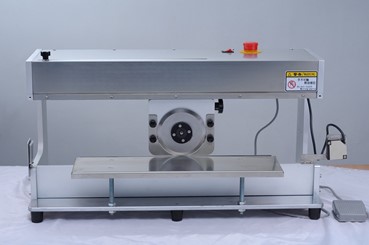
SC-500 and SC-509 V-Cut PCB Separators: Benchtop Depaneling Guide by Southern Machinery
Panelized PCBs have to be split into single boards at some point, and in low-volume, high-mix or NPI production that step is still done by hand on many shop floors. The SC-500 and SC-509 V-cut PCB separators from Southern Machinery are bench-top machines built for exactly that job: they separate V-scored panels along the score line with a motorised blade instead of an operator snapping the board over a table edge.
Both machines use microcomputer control to fix the cut position, run on single-phase power, and are documented with SKD61 high-speed steel blades that can be reground rather than replaced. This guide covers what they are used for, how they differ, where they fit in a full PCB assembly line, and what a buyer should confirm before ordering.
What is this machine used for?
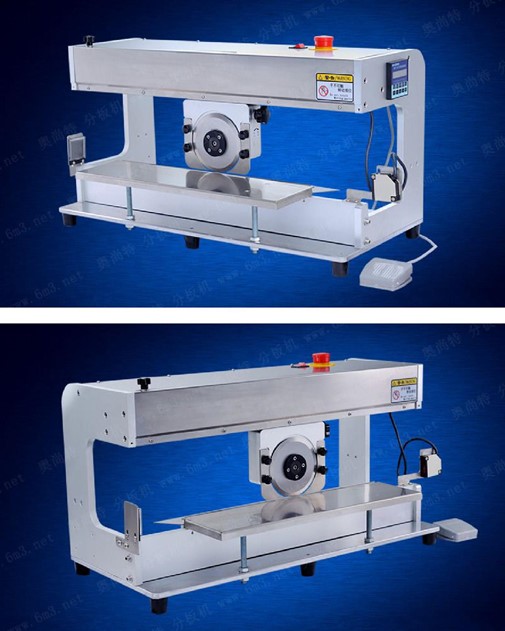
A V-cut PCB separator cuts a panelized PCB apart along the V-score (V-groove) lines that were machined or routed into the panel. After SMT Reflow Oven processing and after THT components have been through Wave Soldering, the multi-up panel still carries several identical circuits joined by thin V-grooves. The separator runs a round blade (or a blade group) down each score line to release individual boards.
In the SC-500 and SC-509, the operator loads the panel by hand, aligns the V-cut with the blade wheel, and the machine drives the blade through the score at a controlled speed. That covers three jobs that manual snapping cannot do reliably:
- Clean board edges. A blade leaves a controlled, even edge instead of the burrs and glass-fibre fraying that come with snapping FR4 over an edge.
- Repeated, position-locked cuts. Microcomputer control fixes the cut point, so the same panel splits the same way on every unit.
- Lower mechanical stress. Controlled blade travel and 0-2 mm knife-wheel height adjustment let the operator work with the actual V-cut depth instead of forcing the laminate.
SC-500 and SC-509: what actually differs
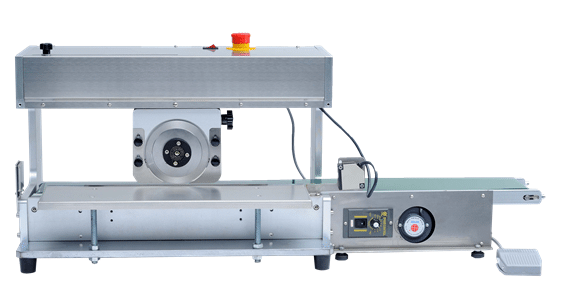
The two models are close relatives. The SC-500 has a longer blade travel (0-500 mm) and a compact 823 x 405 x 425 mm body; the SC-509 is documented as the *Moveable V-cut PCB Separator with a moveable cutting blade*, has a 0-360 mm knife-wheel path, and is listed together with a conveyor belt assembly, which points to a slightly longer overall bench footprint and a light-duty transport belt.
SC-500 documented specifications
| Item | Documented value |
|---|---|
| Control | Microcomputer control, precision fixed point |
| Cut length per stroke | 0-360 mm single board |
| Cutting speed | Two settings: 500 mm/s and 300 mm/s |
| Knife travel | 0-500 mm (tool length customizable) |
| Knife wheel height adjustment | 0-2 mm (for different V-cut slot depths) |
| Console height adjustment | 0-50 mm |
| Rear baffle depth | Unlimited |
| Max board cut-off width | Unlimited |
| Max board cut-off length | 360 mm |
| Board thickness range | 0.2-5 mm |
| Power | Single-phase AC 230 / 110 V, 50-60 Hz, 40 W |
| Machine size | L 823 x W 405 x H 425 mm |
| Net weight | 350 kg as documented (see note below) |
| Tool material | SKD61 (listed as "SHD61" on the same page) imported high-speed steel |
| Blade geometry | Round knife dia. 125 mm; lower straight knife length 500 mm |
SC-509 documented specifications
| Item | Documented value |
|---|---|
| Control | Microcomputer control, precision fixed point |
| Cut length per stroke | 0-360 mm single board |
| Cutting speed | Two settings: 500 mm/s and 300 mm/s |
| Knife wheel path | 0-360 mm |
| Knife wheel height adjustment | 0-2 mm |
| Console height adjustment | 0-50 mm |
| Max board cut-off width | Unlimited |
| Max board cut-off length | 360 mm |
| Board thickness range | 0.2-5 mm |
| Power | Single-phase AC 230 / 110 V, 50-60 Hz, 40 W |
| Machine size | L 1000 x W 395 x H 425 mm |
| Packing size | L 1100 x W 420 x H 450 mm |
| Conveyor belt size | L 1030 x W 220 x H 130 mm |
| Net weight | 47 kg |
| Tool material | SKD61 imported high-speed steel; round knife dia. 125 mm, lower straight knife length 360 mm |
Typical application scenarios
Bench-top V-cut separation shows up in these spots:
- Appliance and small-appliance control boards built in mixed-model batches, where panels change several times a shift.
- Power supply and ballast boards with large THT components and generous board-thickness variation.
- LED lighting and LED display strips, where long, thin panels have to be split without cracking the laminate or the copper.
- NPI, pilot and prototyping lines, where an inline depaneling system cannot be justified yet but hand-snapping is already causing scrap.
- Rework and re-panelization benches, where a single board has to be released outside the normal flow.
- Industrial control and instrumentation boards produced in the tens-to-low-hundreds per order.
If your panels are LED metal-core boards, long tube-lighting strips, or FPC, tell Southern Machinery the material up front. V-cut separation behaves differently on aluminium MCPCB than on FR4, and Southern Machinery also lists multi-blade and MCPCB-specific separator platforms for those cases.
Where a benchtop separator fits in a full PCB assembly line
A depaneling step is one station in a longer chain. A typical Southern Machinery SMT/THT line runs:
*bare-board loader -> stencil printing -> SPI -> Pick and Place -> Reflow Oven -> AOI -> THT auto insertion -> Wave Soldering -> lead cutting -> depaneling -> PCBA cleaning / conformal coating -> NG/OK unloader -> MES reporting*
A bench-top SC-500 or SC-509 normally sits off-line, downstream of the soldering and lead-cutting stations, fed by an operator with panels from a magazine or a tote. That keeps it useful in three line configurations:
1. Offline parallel depaneling. Two bench-top separators fed from one soldering line let you balance throughput without buying an inline system.
2. Inline depaneling. When volume and panel output justify it, Southern Machinery's inline router and multi-blade separators - for example the SC-3500S and SC-2500S router separators, the SC-900 and SD5140 multi-cutter separators, or the S-D5500 snap-hole separator - are designed to sit in the SMEMA chain instead. The bench-top models then become the rework station.
3. Hybrid. Inline depaneling for the high-runner product, bench-top separation for the mixed-model tail, which is the pattern most EMS plants in the 237+ customer base we support end up running.
Note on terminology: "V-cut separator", "PCB depaneling machine" and "PCB separator" describe the same function in this market, and the Southern Machinery catalogue uses all three names. The Southern Machinery YouTube board also documents related moveable V-cut and multi-blade separators (for instance the S-D508, S-D509 and S-D510 family and the "40 blades multi cutter" separator), so ask for a family comparison if your requirement is not a perfect match for the SC-500 or SC-509.
Key selection parameters - the checklist
Only a few numbers decide whether a bench-top V-cut separator is the right machine, and nearly all of them come from your own panel drawing rather than from the machine datasheet. Confirm these before you request a quotation:
- Maximum cut length per stroke. Both machines are documented at 0-360 mm. Any panel score line longer than that needs multiple passes or a different platform.
- Board thickness range. Documented at 0.2-5 mm. Check where your thinnest and thickest build sit inside that window, including the laminate plus copper.
- V-cut depth and residual web. The 0-2 mm knife-wheel height adjustment is what matches the blade to your score depth; confirm the supplier's recommended setting for your panel.
- Component clearance next to the score line. Tall THT parts or a transformer close to the V-groove can foul the blade guard - send the assembly drawing.
- Blade material and regrind policy. Both models document SKD61 high-speed steel and a regrindable blade. Ask for the spare-blade part number and the regrind interval.
- Panel material. FR4, aluminium MCPCB, copper and glass-filled boards behave differently. State the material on the RFQ.
- Utilities and footprint. Documented as single-phase AC 230/110 V at 40 W, which makes staging easy. Also confirm net weight and bench loading, plus whether the conveyor-equipped SC-509 configuration is required.
- Static and debris control. V-scoring generates dust. Inline Southern Machinery separators document static eliminators and vacuum/dust-collection boxes; for a bench-top unit, confirm what dust extraction is recommended for your class of product.
- Alignment and repeatability needs. If your tolerance is driven by a fine-pitch connector or an edge-mounted component, describe it - microcomputer-controlled fixed-point cutting is a documented feature, but the acceptance criterion is yours to define.
- Rework and traceability. If boards must be logged back into MES after release, say so at quotation stage so the line-level data flow is designed once.
ROI, quality and throughput arguments
Depaneling is a small step with an outsized cost of failure, because a cracked board is discovered after every cent of SMT and THT value has been added. The economics of moving off manual snapping usually come down to four lines:
- Scrap and rework. Snapping FR4 over a bench edge produces micro-cracks, lifted pads and frayed edges that survive visual inspection and fail later in the field. Bladed separation is documented to deliver a clean cut with "no flash, no glitches".
- Labour and consistency. Microcomputer-controlled fixed-point cutting removes the skill variable. Two operators on the same panel produce the same cut, which is what makes mixed-model shifts predictable.
- Consumables. A regrindable SKD61 blade is a recurring-cost item you can budget and extend, not a throwaway. Ask for the documented blade life and the regrind limit.
- Utility and staging cost. 40 W of single-phase power per machine means no compressed-air drop, no three-phase feed, and no facilities project to add a second separation bench - which matters when you are scaling a low-volume cell in an existing building.
A simple payback test for a procurement team: take the annual cost of boards scrapped and reworked at the depaneling step, add the labour hours currently spent on manual snapping, and compare that with the delivered cost of the separator plus blades. In most mixed-model plants the scrap line alone is the dominant term.
What to confirm before ordering
We publish what the manufacturer datasheets publish, and we flag the gaps rather than paper over them:
- The SC-500 page documents a 350 kg net weight, which is inconsistent with its 823 x 405 x 425 mm envelope and with the SC-509's documented 47 kg. Treat this as a documentation issue and have Southern Machinery confirm the actual machine and shipping weight before you plan rigging or bench reinforcement.
- The SC-500 tool material appears as both "SKD61" and "SHD61" on the same datasheet. SKD61 is the standard high-speed steel grade; ask for the confirmed blade grade on the quotation.
- No CE, UL or IATF certification is stated on these product pages. If your quality system requires a specific mark or a declared conformity document, request it explicitly - do not assume it.
- No pieces-per-hour throughput figure is published for the SC-500 or SC-509. Both document 500 mm/s and 300 mm/s cutting speeds; convert that against your own score length and handling time to build a realistic cycle estimate.
FAQ
*What is the difference between the SC-500 and the SC-509 V-cut PCB separator?*
Both are bench-top, microcomputer-controlled V-cut separators with a 0.2-5 mm board thickness range, 0-360 mm cut length, 0-2 mm knife-wheel height adjustment and the same 40 W single-phase power requirement. The SC-500 documents a longer 0-500 mm knife travel and a compact 823 x 405 x 425 mm body; the SC-509 documents a 0-360 mm knife-wheel path, a longer 1000 x 395 x 425 mm body and a conveyor belt assembly for moveable-blade operation.
*What does a V-cut PCB separator do?*
It separates a panelized PCB into individual boards by running a blade along the V-score lines left in the panel, instead of breaking the board by hand. It is used after SMT Reflow Oven and THT Wave Soldering, at the end of the board's build.
*What board thickness can these separators handle?*
Both the SC-500 and SC-509 are documented for 0.2-5 mm board thickness, with infinite cut-off width and a 360 mm maximum cut-off length per stroke.
*Do they need compressed air or three-phase power?*
No. Both machines are documented as single-phase AC 230 V or 110 V, 50-60 Hz, 40 W, which makes them easy to place on an existing bench. Confirm your local voltage option and plug type at order stage.
*Can a benchtop V-cut separator replace manual board snapping?*
For panelized boards with machined V-scores, yes - that is the designed use case, and it removes the micro-cracking and burr problems associated with snapping FR4 by hand. It is not a replacement for routing when your separation method is tab-routing rather than V-scoring; in that case you need a router separator or a snap-hole/breakaway process.
*When should I move from a benchtop separator to a multi-blade or router separator?*
When depaneling becomes a line bottleneck rather than a bench task: high and steady panel volume, long repetitive runs, or a requirement to run in the SMEMA chain next to AOI and the NG/OK unloader. Southern Machinery's inline platforms - including multi-blade V-cut separators and online router separators - are built for that step-up, and the bench-top unit stays useful as the rework station.
Talk to Southern Machinery about your panel
Southern Machinery has supplied SMT and THT PCB assembly automation equipment since 2011 from Shenzhen, China, and supports more than 237 customers worldwide. Alongside depaneling we cover SMT placement, THT auto insertion, Wave Soldering, board handling, cleaning and inspection, so we can advise on the separator in the context of the whole line rather than as a stand-alone purchase.
- Send us your panel drawing, V-cut specification, board material and target output and we will recommend a bench-top or inline separation configuration: jasonwu@smthelp.com or +86 13602562576
- Browse product catalogues, manuals and PDFs: https://file.autoinsertion.com
- See machine photos and albums: https://ph.smthelp.com
- More SMT/THT line configuration guides: https://www.smthelp.com
All SC-500 and SC-509 specifications in this article are quoted from the published Southern Machinery product datasheets for those models. Values that are ambiguous or inconsistent on the source datasheets are flagged in the "What to confirm before ordering" section rather than presented as settled specification.
Comments