
SC3500 Automatic PCB Separator with Vacuum Loading: Clean Depaneling for SMT & EMS Lines
SC3500 automatic PCB separator uses vacuum loading and precision cutting to separate PCBA panels cleanly: lower scrap, stable EMS throughput.
Aug 7, 2026 · Updated Aug 7, 2026 · Southern Machinery

SC3500 Automatic PCB Separator with Vacuum Loading: Clean Depaneling for SMT & EMS Lines
What is this machine used for?
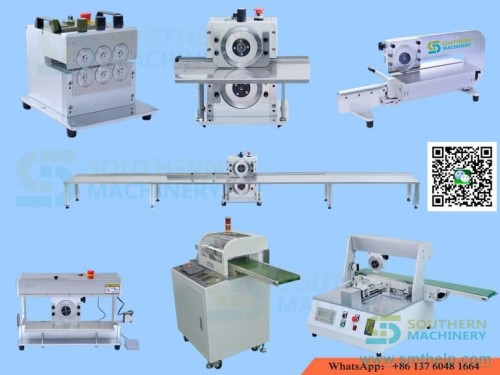
The SC3500 automatic PCB separator is a depaneling machine that separates assembled PCB panels into individual boards after SMT and THT processing. Its defining feature is vacuum loading: the panel is held flat and secure by vacuum during the cutting cycle, then cut automatically along the defined separation path.
For an EMS or ODM factory, the SC3500 answers one practical question: how do we break our PCB panels apart without damaging the boards we just spent a whole line building? Manual snapping of populated boards is fast to start and expensive to finish — it cracks solder joints, chips components, and creates irregular edges that fail downstream handling and inspection. An automatic separator with vacuum hold-down replaces that uncontrolled step with a repeatable, low-stress process.
Because the panel is held by vacuum rather than clamped only at the edges, the SC3500 is especially relevant for large panels, thin boards, and boards with components close to the cut line — exactly the cases where edge clamping or manual bending causes the most damage.
Why vacuum loading matters in PCB separation
The separation step is the last mechanical stress a board sees before test and shipment. Three things go wrong on manual or poorly controlled separation:
- Solder joint cracking — flexing the panel while breaking V-grooves transmits stress into nearby joints.
- Component damage — vibration and bending can crack ceramic capacitors and dislodge tall components.
- Irregular edges and dust — rough edges create handling problems in test fixtures and downstream assembly.
Vacuum loading addresses all three at the source. The panel is held rigid against a flat reference surface, so the cutting tool — rather than the operator's hands — controls where and how the board separates. The result is a cleaner edge, lower mechanical stress, and consistent behavior from panel to panel. For quality-driven customers (automotive electronics, medical devices, industrial controls), this repeatability is often the deciding factor between in-house separation and outsourcing.
Typical application scenarios
- EMS / ODM factories running mixed panels with SMT and THT components, where one panel carries several different PCBA designs.
- LED lighting manufacturers separating aluminum-core MCPCB panels and LED strip boards, where brittle substrate material makes manual breaking risky.
- Power supply and adapter plants depaneling high-volume, panelized power PCBA boards.
- Automotive electronics suppliers who need documented, repeatable separation quality for PPAP and IATF-style quality systems.
- Medical and industrial control assembly where long boards and sensitive components sit close to the V-groove or routing path.
How the SC3500 fits into a complete PCB assembly line
A typical Southern Machinery line flows like this:
SMT segment: solder paste printing → Pick and Place → Reflow Oven → SPI / AOI inspection THT segment: radial / axial / odd-form auto insertion → Wave Soldering → AOI Back-end: PCB separation (SC3500) → cleaning / lead cutting → functional test → packing
The separator sits in the back-end, after soldering and inspection, before testing. In that position it:
- Converts one large panel into multiple finished PCBA units for test and packing.
- Removes a manual, labor-dependent step from the line — an operator who used to snap boards by hand can be redeployed to test or quality tasks.
- Protects the value added upstream: everything printed, placed, soldered, and inspected stays intact through the final mechanical step.
For factories planning a full line, Southern Machinery can supply the complete solution — SMT placement, THT auto insertion, Wave Soldering, board handling conveyors, and inspection — with the separator matched to the panel format and throughput you actually run.
Key selection parameters to confirm with the supplier
The SC3500 is an automatic PCB separator with vacuum loading and cutting; the exact specification set for your panel format should be confirmed against your actual boards. Before requesting a configuration, prepare these parameters:
- Panel and board dimensions — maximum panel size the machine must accept, and final board size after separation.
- Board thickness — the PCB or MCPCB thickness range you produce (both FR4 and aluminum-core substrates).
- Separation method — V-groove breaking, straight-line cutting, or curved/irregular path routing. Curved boards require a router-type cutting head.
- V-groove condition — remaining thickness at the score line; separation stress is directly affected by how deep the groove is scored.
- Throughput requirement — panels per hour or boards per shift, and whether the separator must run inline or offline.
- Dust and static control — for routing-type separation, dust collection and static elimination affect yield on sensitive boards.
- MES / traceability — whether barcode scanning and data upload are needed for line reporting.
- Utilities and footprint — power supply, compressed air, and floor space available in your back-end area.
For reference, Southern Machinery's PCB separator family covers both V-cut and routing technologies: the S-D600 moveable V-cut separator handles 0.2–3.0 mm boards with high-speed steel blades, the S-D601 is built for LED MCPCB panels up to 600 × 600 mm, and the SQX350 full-visual router separator reaches ±0.02 mm cutting accuracy with MES/ERP connectivity. The SC3500 sits in this family as the automatic, vacuum-loading option — ask Southern Machinery which configuration matches your panel set.
ROI, quality, and throughput perspective
The business case for an automatic separator is built on three lines:
Scrap reduction. A populated panel that cracks during manual separation loses every component on that board — not just the board cost, but placement, soldering, and inspection cost already invested. Even a small percentage-point improvement in separation yield pays for the machine quickly.
Labor redeployment. Manual snapping is a dedicated operator task in most THT-heavy lines. Automating it frees that person for test, quality, or material handling roles where their time creates more value.
Consistency for quality systems. Automated separation with vacuum hold-down produces repeatable edge quality and documented process conditions. For automotive and medical customers, that repeatability is a competitive requirement, not a nice-to-have.
Southern Machinery: your SMT/THT line partner
Shenzhen Southern Machinery Sales And Service Co., Ltd — founded in 2011 in Shenzhen, China — focuses on SMT and THT PCB assembly automation equipment and has served 237+ global customers across EMS, ODM, power supply, LED lighting, automotive, and industrial electronics. The company provides SMT, THT, Wave Soldering, board handling, and inspection equipment, and can engineer a complete line around your product mix — from solder paste printing to final separation.
Every Southern Machinery machine is backed by practical after-sales support: spare parts, repair service, training, retrofits, and line integration, so the equipment you buy today keeps running as your product mix evolves.
FAQ
Q: What is the SC3500 PCB separator used for? A: The SC3500 is an automatic PCB separator that uses vacuum loading and cutting to separate assembled PCB panels into individual boards after SMT and THT processing, replacing manual board snapping.
Q: Why is vacuum loading important in PCB depaneling? A: Vacuum hold-down keeps the panel flat and rigid during cutting, reducing flex and vibration. That lowers the risk of cracked solder joints, damaged ceramic components, and rough board edges during separation.
Q: Can the SC3500 handle aluminum-core LED MCPCB panels? A: Southern Machinery's separator family includes machines built for LED MCPCB panels and aluminum substrates. Confirm your board thickness and panel size with the supplier to select the right configuration.
Q: Where does a PCB separator go in the assembly line? A: In the back-end, after Wave Soldering and AOI inspection and before functional test and packing, where it converts one panelized board into multiple finished PCBA units.
Q: Does Southern Machinery provide complete SMT and THT lines? A: Yes. Southern Machinery supplies SMT placement, THT auto insertion, Wave Soldering, board handling, and inspection equipment, with 237+ global customers served since 2011.
Q: How do I get a configuration recommendation for the SC3500? A: Contact Southern Machinery with your panel dimensions, board thickness, separation method, and throughput target. Product catalogs are available at file.autoinsertion.com and machine photos at ph.smthelp.com.
Get a configuration recommendation
Every panel set is different, and the right separator configuration depends on your board size, material, and throughput. Send Southern Machinery your panel drawing and production targets for a practical configuration recommendation.
- Contact: Jason Wu — jasonwu@smthelp.com · +86 13602562576
- Website: https://www.smthelp.com
- Product catalogs: https://file.autoinsertion.com
- Machine photos: https://ph.smthelp.com
Comments