
SC-460W-BN PCB Destacker Loader by Southern Machinery
The SC-460W-BN PCB destacker loader from Southern Machinery feeds boards from a stack to the downstream machine one at a time, or passes boards straight through from upstream. Per the 2025 manual, it serves SMT and THT l
Oct 24, 2026 · Updated Oct 24, 2026 · Southern Machinery
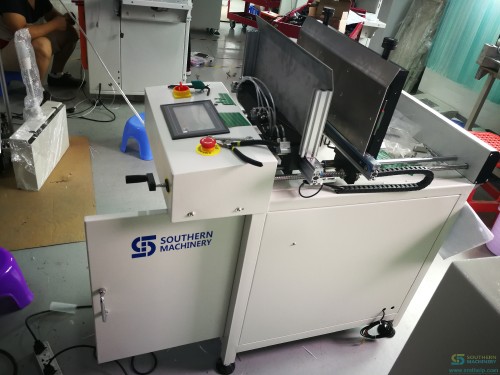
SC-460W-BN PCB Destacker Loader by Southern Machinery
The SC-460W-BN is a PCB destacker loader that feeds boards from a stack, one at a time, to the downstream machine, or passes boards straight through from upstream. According to the 2025 operation manual, it is used in SMT and THT lines for PCB transfer, inspection, testing and buffering, linking and buffering two machines.
Why does a "simple" conveyor decide how smooth your line runs?
Most line problems are blamed on expensive machines. Yet many stoppages start at the handoff: a board waits, a signal is missing, and a downstream machine idles.
If you run an EMS, ODM or industrial-control line, you have probably seen it. Operators stand at a stack of loose boards and feed them by hand. Nobody logs that time, so it never appears in a cost report.
What framework helps you decide where a destacker belongs?
Use a three-question handoff check before you choose any board-handling unit:
- Where does a board wait? Look for stations where boards sit in a stack or a buffer before the next machine.
- Who moves it today? If a person releases each board, that is a candidate for destack mode.
- What does the next machine expect? Check the board-request and board-available signals of the neighbouring equipment.
The SC-460W-BN maps directly onto these questions through its two operating modes.
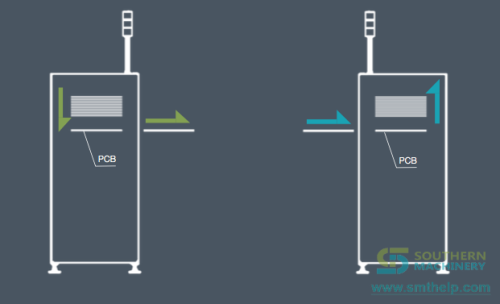
Destack mode
When a board is detected on the stack by the photoelectric sensor, the machine sends a board-available signal downstream. When the downstream machine requests a board, the PCB is sent. The manual notes that after each board you confirm with the Add board button on the Automatic page of the touch screen.
Pass-through mode
Boards from the upstream machine run through the conveyor. The belt starts when a board reaches the entry sensor, stops at the exit sensor if the downstream machine does not need a board, and resumes when it requests one. If a board is on the conveyor, the upstream machine is held until it is free.
How does the SC-460W-BN connect to a PCB assembly line?
The unit uses an SMEMA-style I/O interface. Upstream: C0 and Y0 (this machine requires a board). Downstream: X1 and 0 V (downstream machine requires a board), C1 and Y1 (this machine has a board). Installation, per the manual, is to place it between upstream and downstream equipment, align rails and set the same width, connect signal cables and the anti-static ground wire, supply 220 V / 50 Hz, then adjust rail width so PCBs pass smoothly.
It can link two machines on its own, or be used in sections or groups. For wider planning, see Southern Machinery's board handling systems, THT machines and wave soldering machines. The machine catalog lists the manuals.
What are the key selection parameters?
| Item | Specification (source: 2025 manual) |
|---|---|
| Model | SC-460W-BN |
| Guide-rail length | 600 mm (customisable) |
| Rail width adjustment | 50-460 mm |
| Transfer speed | 0.2-9 m/min |
| PCB transport height | 940 +/- 20 mm |
| Drive motor | 42 stepper motor |
| Power supply | 220 V AC, 50 Hz |
| Power consumption | approx. 40 W |
| Total weight | 85 kg |
| Control | PLC with touch screen |
| Compressed air | Required for lifting cylinder and pushers |
Features listed in the manual: PLC control with a motion program adaptable to customer requirements, entry, middle and exit photoelectric sensors with freely settable positions, a steel frame, aluminium guide-rail profiles, and options such as a fluorescent lamp, computer bracket and PCB sample frame. The machine handles rectangular boards only; non-rectangular boards must be carried in a rectangular fixture.
What does it cost, and how do you estimate the return?
Price, lead time and throughput are not specified in source. Contact Southern Machinery to confirm. You can still build your own estimate:
Annual labour value recovered = hand-feed minutes per shift x shifts per day x working days x labour cost per minuteExample only, depending on configuration and subject to final technical confirmation: 20 minutes per shift x 2 shifts x 250 days = 10,000 minutes, about 167 hours of operator attention that could be redirected. Replace each figure with your own data. This is an illustration, not a guaranteed result.
How do you keep it running?
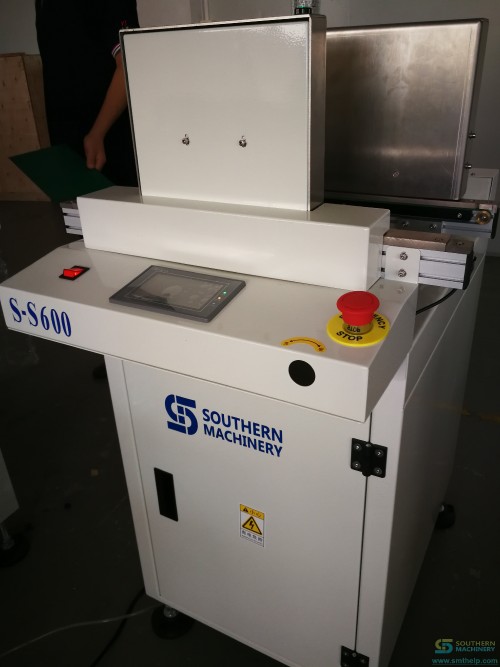
The manual's maintenance plan is short: keep photoelectric sensors free of dirt and oil, apply a small amount of grease to belt pulleys, core shafts and linear bearings every 30-50 days, and periodically re-tighten connection screws. Disconnect power and compressed air before any maintenance. Move the machine by the frame only, never the guide rails, and do not change the PLC program unless qualified.
Common troubleshooting items from the manual: if the machine does not run, check the switch, air supply, PLC power, fuse, cables, interlock signals and entry sensor; if a board stops in the wrong position, check rail width, PLC program and sensor position.
FAQ
What is the SC-460W-BN used for? PCB transfer, inspection, testing and buffering between two machines in SMT and THT lines.
What board widths does it accept? Rail width adjusts from 50 to 460 mm; boards must be rectangular or carried in a fixture.
Can it work without stacking boards? Yes. Pass-through mode lets boards from the upstream machine go straight to the downstream machine.
What utilities does it need? 220 V AC at 50 Hz, approx. 40 W, plus compressed air for the lifting cylinder and pushers.
Is the control program adjustable? The motion program can be adapted to customer requirements; it is loaded at the factory and should only be changed by qualified personnel.
What should you do next?
Make a one-page handoff map of your line this week: mark every station where a board waits or is hand-fed. Bring it to a conversation about destack or pass-through placement.
Founded in Shenzhen in 2011, Southern Machinery supports SMT/THT PCB assembly automation for 237+ global clients, with spare parts support, training and service. Request a quote or contact us, quoting model SC-460W-BN.
Next in the series: how a 90-degree PCB turning conveyor changes line layout.
Comments