
SBN250 NG Buffer Conveyor: Smart Inline PCB Buffering for Balanced SMT & THT Lines
The SBN250 NG buffer conveyor stores up to 12 PCBs after AOI or SPI, keeps OK boards flowing, and holds NG boards for rework without stopping your line.
Aug 25, 2026 · Updated Aug 25, 2026 · Southern Machinery
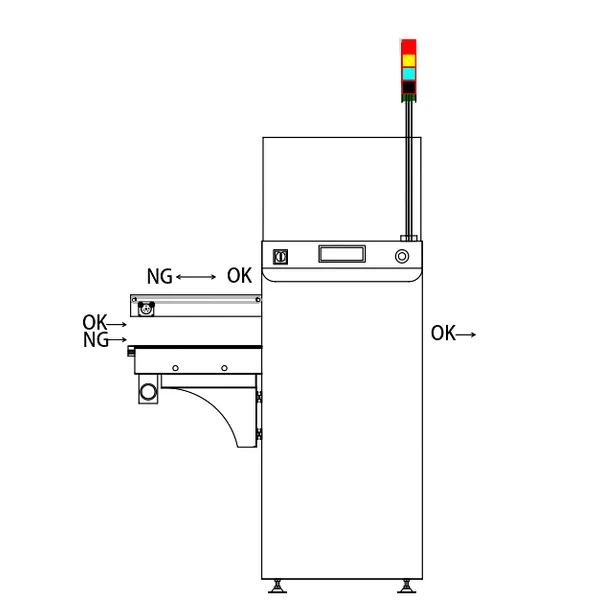
SBN250 NG Buffer Conveyor: Smart Inline PCB Buffering for Balanced SMT & THT Lines
Inline PCB buffering is one of the most overlooked elements of a productive SMT or THT line. When an AOI or SPI machine rejects a board, when a downstream machine pauses, or when two stations run at different cycle times, the whole line can stall — unless a buffer is in place. The SBN250 NG buffer conveyor from Southern Machinery (also known as the SPI vertical buffer) is an inline board-handling machine that absorbs that variation automatically, so good boards keep moving and failed boards are stored for rework without stopping production.
Southern Machinery (Shenzhen, China, founded 2011) designs and manufactures SMT/THT PCB assembly automation equipment for more than 237 customers worldwide — from complete SMT, THT, wave soldering, and board handling lines to individual stations like this buffer conveyor. The SBN250 is built to the same standard as the rest of the line: SMEMA-compatible, ESD-safe, and simple to operate.
What Is This Machine Used For?
The SBN250 NG buffer conveyor temporarily stores PCBs inline between process stations. Its most common application is after an AOI or SPI inspection step: boards that pass (OK) continue downstream immediately, while boards that fail (NG) are diverted into the vertical buffer and held until an operator or rework station removes them.
The machine supports three operating modes — First In First Out (FIFO), Last In First Out (LIFO), and pass-through — so you control exactly how boards are released. With a buffering capacity of 12 PCBs (custom capacity available) and a cycle time of about 10 seconds, it keeps a steady flow even when inspection or rework is slower than the rest of the line.
Key functions in plain terms:
- NG board storage after AOI/SPI — failed boards are held in the buffer instead of mixing with good boards or jamming the line.
- Vertical buffer design — boards are stored on levels and can be sent to the upper level for inspection or rework.
- Takt-time decoupling — the machine absorbs speed differences between stations, so a slow step does not stop the whole line.
- Traceable flow — FIFO/LIFO modes support consistent quality and traceability practices.
Typical Application Scenarios
The SBN250 fits any board-handling system where inspection, rework, or unbalanced cycle times interrupt the flow:
- EMS / ODM production lines with inline AOI after reflow or SPI before placement, where NG boards need a dedicated holding point.
- THT insertion and wave soldering lines, where manual rework and differing station speeds create bottlenecks.
- High-mix, low-volume lines with frequent changeovers, where temporary accumulation smooths production.
- LED lighting, power supply, home appliance, automotive electronics, and industrial control PCB assembly — the industries Southern Machinery serves most.
- Lines with downstream machines that pause for maintenance, splicing, or setup, where buffering prevents upstream stoppage.
How It Integrates into a Complete PCB Assembly Line
The SBN250 is an inline machine designed to sit between standard SMT/THT equipment. It connects to loaders, unloaders, shuttle conveyors, 90-degree turn conveyors, gate conveyors, and inspection machines through the SMEMA interface, at the standard 900 mm ±20 mm transport height, with transfer direction L to R or R to L.
Typical placement options:
- After AOI (post-reflow): OK boards proceed to the next station; NG boards are buffered for re-inspection.
- After SPI (post-print): paste inspection results are separated before placement, protecting the pick-and-place and reflow processes.
- Between THT insertion and wave soldering: buffers absorb differences in insertion and soldering cycle times.
- Before or after manual stations: keeps a small work-in-progress bank so operators never wait for boards.
Width adjustment uses a leadscrew, keeping both rails parallel and square to the board path, and the ESD round belt transports boards without damaging sensitive components. For simple pass-through accumulation without NG separation, the related S-350C PCB Board Buffer Conveyor (widths up to 500 mm, speed 0–2 m/min, SMEMA signal plug) is a lower-cost alternative in the same product family.
Watch the machine in operation: SMT PCB NG/OK Buffer Conveyor and How the Dual-Lane NG-OK Buffer Conveyor Works.
Key Selection Parameters
When choosing a buffer conveyor for your line, confirm these parameters with Southern Machinery — the right configuration depends on your board mix and line layout:
- PCB size range — SBN250 handles boards from 50×50 mm to 330×250 mm; the larger SBN330 handles up to 460×330 mm.
- Buffering capacity — 12 PCBs standard, with custom capacity available on request.
- PCB thickness — 0.6 mm to 4 mm.
- Transport height — 900 mm ±20 mm standard, or specify your line height.
- Transfer direction — L to R or R to L.
- Operating modes — FIFO, LIFO, and pass-through.
- Power and air — AC 110 V or 220 V, single phase, 250 VA maximum; no air required for the standard version.
- Interface — SMEMA-compatible signals for connection to other machines.
- Footprint — SBN250: 1000×910×1600 mm, approx. 160 kg; SBN330: 1200×990×1600 mm, approx. 300 kg.
- For simple accumulation only — ask about the S-350C buffer conveyor (board width 50–250/300/400/500 mm, 0–2 m/min).
ROI, Quality & Throughput Perspective
- Higher line efficiency (OEE): buffering absorbs takt-time imbalance, so a slow inspection or rework step no longer stops the entire line.
- Fewer rework escapes: NG boards are physically separated from OK boards at the inspection point, preventing mixed lots and missed rework.
- Less manual handling: boards move on an ESD belt instead of being carried by operators — fewer dropped boards, fewer ESD events, less labor.
- Better traceability: FIFO/LIFO flow control supports consistent lot sequencing and quality records.
- Fast payback in high-mix lines: the machine removes the most common cause of short stoppages in EMS factories — waiting for the next board or clearing a rejected one.
FAQ
Q: What is a PCB buffer conveyor?
A: A PCB buffer conveyor is an inline board-handling machine that temporarily stores printed circuit boards between process stations. It absorbs differences in station speed and holds boards — for example, NG boards after inspection — so the line does not stop.
Q: How does an NG/OK buffer conveyor work after AOI or SPI?
A: The inspection machine sends its result with the board. OK boards pass through the buffer and continue downstream; NG boards are diverted into the buffer's storage levels and can be sent to an upper level for re-inspection or rework, all without stopping the line.
Q: What is the difference between a buffer conveyor and a shuttle or turn conveyor?
A: A shuttle (translational) conveyor moves boards sideways between parallel lanes or machines, and a turn conveyor rotates boards 90 degrees. A buffer conveyor stores boards vertically for a period of time — its job is accumulation and separation, not direction change.
Q: Can it connect to my existing SMT line?
A: Yes. The SBN250 is SMEMA-compatible, uses the standard 900 mm transport height, and is available in L-to-R or R-to-L configurations, so it can be inserted into most existing lines. Width adjustment is via leadscrew for fast changeover.
Q: What board sizes can the SBN250 handle?
A: The SBN250 handles PCBs from 50×50 mm to 330×250 mm, with PCB thickness 0.6–4 mm. The larger SBN330 model handles boards up to 460×330 mm. Custom capacities and sizes can be confirmed with Southern Machinery.
Q: What support does Southern Machinery provide?
A: Southern Machinery provides global support, spare parts, training, and after-sales service from Shenzhen, China, and has served 237+ customers worldwide since 2011. Contact the team for configuration advice, machine videos, catalogs, and spare parts.
Contact Southern Machinery for Configuration Advice
Choosing the right buffer conveyor comes down to your board sizes, line height, and where the bottleneck actually is. Send your board dimensions and line layout to Southern Machinery for a recommendation.
- Contact: Jason Wu — jasonwu@smthelp.com | +86 13602562576
- Website: www.smthelp.com
- Catalogs & downloads: file.autoinsertion.com
- Machine photos: ph.smthelp.com
- Product page: SBN250 NG Buffer Conveyor / SPI Vertical Buffer
Comments