
6-Head Odd Shape Insertion Machine by Southern Machinery: Precision Automation for Complex THT PCB Assembly
Manufacturers facing rising labor costs and quality inconsistencies in through-hole assembly need a scalable alternative to manual insertion of odd-shaped components. Southern Machinery's 6-head odd shape insertion machine — the S7900VI — brings high-speed automated placement to connectors, relays, transformers, electrolytic capacitors, and other non-standard THT components. With a multi-bowl feeder system supporting up to 8 simultaneous component types and vision-guided placement, the S7900VI delivers throughput and repeatability for EMS, automotive, and industrial control manufacturers.
Aug 7, 2026 · Updated Aug 7, 2026 · Southern Machinery
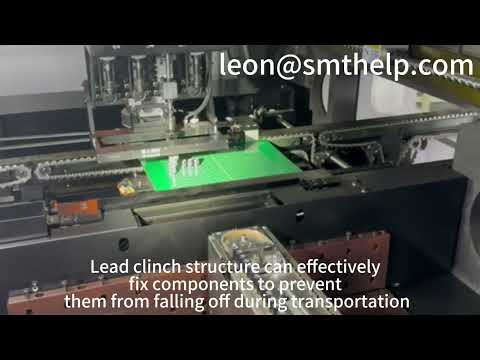
6-Head Odd Shape Insertion Machine by Southern Machinery: Precision Automation for Complex THT PCB Assembly
Excerpt
Manufacturers facing rising labor costs and quality inconsistencies in through-hole assembly need a scalable alternative to manual insertion of odd-shaped components. Southern Machinery's 6-head odd shape insertion machine — the S7900VI — brings high-speed automated placement to connectors, relays, transformers, electrolytic capacitors, and other non-standard THT components. With a multi-bowl feeder system supporting up to 8 simultaneous component types and vision-guided placement, the S7900VI delivers the throughput and repeatability that EMS providers, automotive electronics manufacturers, and industrial control builders demand. This article explores how odd-form insertion automation fits into a complete PCB assembly line, what selection parameters matter for procurement teams, and the ROI considerations that make the S7900VI a compelling investment for factories transitioning from manual to automated through-hole processes.
---
What Is This Machine Used For?
Q: What does a 6-head odd shape insertion machine do?
An odd shape insertion machine automates the placement of through-hole components that cannot be handled by standard axial or radial insertion equipment — the "odd-form" parts: large connectors, relays, transformers, electrolytic capacitors, terminal blocks, fuses, heat sinks, and custom electromechanical components.
The S7900VI uses 6 independent insertion heads working in parallel, fed by up to 8 bowl feeders, to pick, orient, and insert components into PCB through-holes at speeds far exceeding manual assembly. Vision-guided alignment ensures every component lands with the correct orientation and pin alignment — eliminating the bent pins, mis-seated parts, and rework that plague hand-insertion lines.
Q: Why not use manual insertion?
Manual insertion suffers from three structural problems at scale:
- Inconsistent quality — operator fatigue leads to missed pins, reversed polarities, and skipped placements
- Labor dependency — peak production requires large teams; off-peak means idle workers
- Speed ceiling — even skilled operators max out at 1–2 components per second, while a multi-head machine sustains higher rates with 24/7 availability
---
Typical Application Scenarios
Odd-form insertion automation is critical across industries where through-hole assembly remains essential:
1. Automotive Electronics
Engine control units (ECUs), power management modules, and body control systems use large THT connectors and relays that must withstand vibration and thermal cycling. Automated insertion guarantees consistent pin penetration and mechanical integrity.
2. Industrial Power Supplies & Energy
Variable-frequency drives, UPS systems, solar inverters, and industrial chargers rely on high-profile electrolytic capacitors, transformers, and terminal blocks — all odd-form components. The S7900VI's multi-bowl feeder configuration handles mixed-component workloads efficiently.
3. Home Appliance Control Boards
Air conditioners, washing machines, microwave ovens, and induction cookers use relay-heavy THT designs. Southern Machinery serves this sector extensively — the S7900VI's speed and feeder flexibility align with appliance manufacturers' high-volume, moderate-mix production profiles.
4. EMS & Contract Manufacturing
EMS providers serving multiple OEMs need reconfigurable insertion platforms. The S7900VI's ability to switch between component types via different bowl feeders — without tooling changes — reduces changeover time and supports high-mix, medium-volume operations.
---
How It Integrates Into a Complete PCB Assembly Line
A typical high-mix THT line positions the odd-form insertion machine downstream of SMT placement and reflow, but upstream of manual assembly stations and wave soldering:
SMT Line (Printer → Pick and Place → Reflow Oven → AOI)
                    ↓
            [PCB Buffer/Unloader]
                    ↓
     Axial/Radial Insertion (through-hole ICs, resistors)
                    ↓
      Odd-Form Insertion (S7900VI — connectors, relays, capacitors)
                    ↓
         Manual Assembly (residual odd-form or inspection)
                    ↓
           Wave Soldering (THT solder joint formation)
                    ↓
              SPI / AOI / Final Inspection
The S7900VI sits at the critical transition point between automated axial/radial insertion and manual finishing. Maximizing the percentage of odd-form components handled by the S7900VI directly reduces the manual labor content downstream — the single largest cost driver in THT assembly.
Board handling integration: The S7900VI accepts standard SMEMA-compatible conveyor input, allowing seamless inline connection to upstream axial/radial inserters and downstream wave soldering machines.
---
Key Selection Parameters for Procurement Teams
When evaluating odd-form insertion machines, procurement and engineering teams should consider:
| Parameter | Why It Matters |
|-----------|---------------|
| Number of insertion heads | Heads working in parallel determine raw throughput. More heads = higher CPH for multi-component boards |
| Bowl feeder count | Defines how many different component types can be staged simultaneously without changeover |
| Component size range | Verify the machine handles your specific connector heights, body dimensions, and pin counts |
| Vision alignment accuracy | Determines pin-to-hole centering precision — critical for fine-pitch connectors |
| Insertion force capability | Some connectors and press-fit components require higher insertion force; confirm the machine supports it |
| Changeover speed | For high-mix EMS operations, how quickly can feeders be swapped and programs loaded? |
| SMEMA compatibility | Ensures the machine integrates with existing board handling and line equipment |
| Support & spare parts | Shenzhen-based engineering support with fast global parts delivery minimizes downtime |
Ask your Southern Machinery application engineer: Which of your specific odd-form component types benefit most from automated vs. manual insertion, and what payback period can you expect based on your current labor costs and throughput targets?
---
ROI, Quality & Throughput Considerations
Labor Cost Reduction
A 6-head odd-form insertion machine replaces multiple manual insertion stations. For a line producing 200,000 PCBs per year with an average of 4 odd-form components per board, automation eliminates approximately 800,000 manual insertion cycles annually — each one a source of potential error and rework.
Quality Improvement
Manual insertion error rates (wrong component, reversed polarity, bent pins, missed placement) typically range from 500–3,000 DPMO (defects per million opportunities). Automated vision-guided insertion reduces this by an order of magnitude, cutting rework costs and improving first-pass yield.
Throughput Scaling
Unlike manual lines — where doubling output requires doubling operators — the S7900VI scales throughput within its rated CPH range through program optimization and feeder configuration, not additional headcount.
Total Cost of Ownership
Southern Machinery positions its THT insertion solutions at a competitive price-to-performance ratio. When compared against Japanese and European-brand alternatives (Panasonic NPM-VF, JUKI JM-E01, Universal Smart Inserter Plus), Southern's odd-form machines deliver comparable automation capability at a significantly lower capital investment, with Shenzhen-direct engineering support and rapid spare parts delivery.
---
FAQ
Q: What component types can the S7900VI handle?
The S7900VI is designed for odd-form through-hole components: connectors, relays, transformers, electrolytic capacitors, terminal blocks, fuses, switches, and other non-standard electromechanical parts that cannot be processed by axial or radial insertion machines.
Q: How many different components can run simultaneously?
The machine supports up to 8 bowl feeders, allowing up to 8 different component types to be staged and inserted without changeover during a production run.
Q: Does it require a dedicated operator?
The S7900VI is designed for unattended operation once programmed and loaded. One operator can typically oversee multiple machines, with intervention needed only for feeder replenishment and program changes between batches.
Q: Can it handle high-mix, low-volume production?
Yes. The multi-feeder configuration and quick-change program system make it suitable for both high-volume dedicated lines and high-mix EMS environments. Changeover from one product to the next involves loading the new insertion program and swapping bowl feeders as needed.
Q: How is quality verified during insertion?
Vision-guided alignment verifies component orientation and pin alignment before insertion. Many users pair the S7900VI with a downstream AOI station to confirm all pins are properly seated post-insertion.
Q: What support does Southern Machinery provide after purchase?
Southern Machinery offers installation, on-site training, remote technical support, spare parts supply, and machine overhaul services from its Shenzhen headquarters. The company serves 237+ global customers across automotive, industrial, appliance, and EMS sectors.
---
Contact Southern Machinery
Ready to evaluate how automated odd-form insertion can reduce your THT assembly costs and improve quality?
Jason Wu
Southern Machinery Sales & Service
Email: jasonwu@smthelp.com
Phone/WhatsApp: +86 13602562576
Website: https://www.smthelp.com
Product Image Library: https://ph.smthelp.com
File Portal: https://file.autoinsertion.com
Before you reach out, consider these questions:
- What percentage of your current THT assembly is still manual insertion, and what is your labor cost per insertion operator?
- Which 3–5 odd-form component types consume the most operator time on your line — and what would it mean for your throughput if those were automated?
We'll help you run the numbers.
Founded 2011 | Shenzhen, China | 237+ Global Customers | Full-Line SMT & THT PCB Assembly Automation
---
Watch the S7900VI in Action: https://www.youtube.com/watch?v=7aeeWq-SiPI
Comments