
S7900 Odd-Form Insertion Machine for Manual THT Bottlenecks by Southern Machinery
Manual insertion of odd-form THT components can cap output, quality consistency, and labor efficiency in EMS factories. Based on Southern Machinery source material, the S7900 odd-form insertion machine automates componen
Jul 5, 2026 · Updated Jul 5, 2026 · Southern Machinery
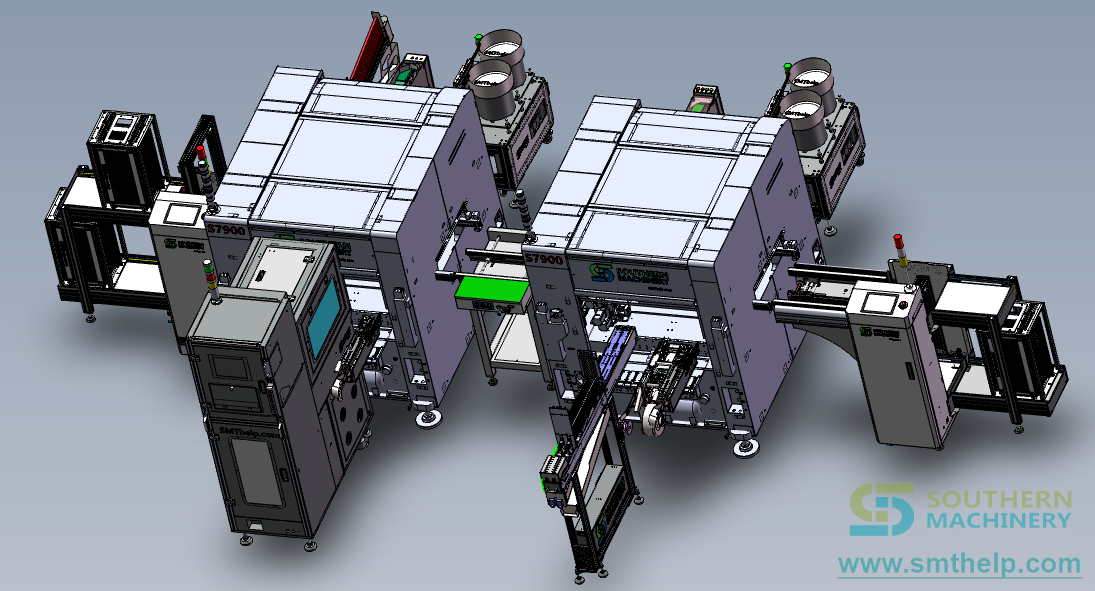
S7900 Odd-Form Insertion Machine for Manual THT Bottlenecks by Southern Machinery
Manual odd-form THT insertion is often where an otherwise efficient PCB assembly line slows down. Operators must pick, orient, insert, and stabilize connectors, terminals, large capacitors, relays, or other non-standard through-hole parts. When the product mix grows, this station can become a bottleneck for labor, quality consistency, and line balance.
The Southern Machinery S7900 odd-form insertion machine targets this exact problem: moving repetitive odd-form THT insertion from manual work to a controlled automated process. Southern Machinery, founded in Shenzhen in 2011, focuses on SMT/THT PCB assembly automation equipment and supports complete line planning across SMT, THT, wave soldering, board handling, inspection, training, spare parts, and global service.
What is this machine used for?
The S7900 automates the insertion of odd-form through-hole components that are difficult to handle with standard SMT placement or simple radial/axial insertion equipment.
Typical use cases include automating manually inserted THT parts in EMS, ODM, industrial control, automotive electronics, medical electronics, appliance control boards, power electronics, and mixed-technology PCB assembly lines. The source material highlights support for components supplied by tape, tube, tray, or bulk feeders, making the machine relevant when one product family uses several different odd-form component packages.
Why manual odd-form insertion becomes expensive
Manual THT insertion looks flexible at first, but it can create hidden operating costs as production volume rises:
- Line speed depends on operator availability and skill.
- Component orientation errors can cause downstream soldering defects.
- Large or irregular components may shift before wave or selective soldering.
- Changeovers and training become harder when the product mix changes.
- Output planning becomes less predictable across shifts.
The source material presents the S7900 as a way to address cost, quality, and throughput together. It includes example claims such as replacing 5-10 manual workers, estimated labor savings of about USD 60,000 annually, and possible ROI in less than 2 years. These should be treated as source-document examples only. Actual payback depends on local labor costs, board design, component mix, feeder configuration, utilization, shift patterns, and final technical confirmation.
Key S7900 capabilities from the source material
The source identifies several buyer-relevant capabilities:
- Odd-form THT component insertion for parts that do not fit normal SMT placement flow.
- Feeder flexibility for tape, tube, tray, or bulk component supply.
- Vision-assisted positioning, described in the source as AI-powered vision.
- Optional lead clinching to help stabilize components before soldering.
- Offline programming and auto-correction features to reduce changeover pressure.
- Line integration support for existing or new PCB assembly lines.
The source also lists speeds up to 4,700 CPH and placement accuracy of +/-0.06 mm. These values should be used as source reference values subject to component testing and final technical confirmation, not as a universal guarantee for every component and board.
How it fits into a complete PCB assembly line
For a mixed SMT/THT factory, the S7900 should not be evaluated as a standalone machine only. It needs to fit the board flow.
A practical line architecture can look like this:
- SMT section: loader, stencil printer, SPI if needed, pick-and-place, reflow oven, and post-reflow AOI.
- THT preparation: buffer or conveyor after SMT, with routing for boards requiring odd-form insertion.
- S7900 odd-form insertion: automated insertion of selected THT components from tape, tube, tray, or bulk feeders.
- Soldering section: wave soldering or selective soldering, depending on board design, keep-out zones, component heat sensitivity, and solder joint access.
- Inspection and test: visual inspection, AOI where suitable, ICT/FCT, traceability, and NG/OK handling.
Southern Machinery can help match the S7900 with board handling, wave/selective soldering, and inspection modules so the automated insertion station does not become isolated from the rest of production.
Typical applications
The S7900 is most relevant when the factory has repeated odd-form THT insertion work and wants better consistency than manual insertion can provide.
Typical application scenarios include:
- Connectors, terminals, relays, sockets, large capacitors, transformers, or other non-standard through-hole components.
- EMS factories moving from manual THT insertion to semi-automatic or fully automatic production.
- High-mix production where different feeder types are needed across product families.
- Automotive electronics or industrial control boards where repeatability and process control matter.
- Power supply, appliance control, lighting, and equipment controller PCBs with mixed SMT and THT components.
Key selection parameters buyers should confirm
Before recommending a final S7900 configuration, Southern Machinery would confirm these points:
- Component drawings and samples: body size, lead diameter, lead pitch, lead length, polarity, orientation, and packaging.
- Feeding format: tape, tube, tray, bulk, or customized feeder requirement.
- PCB information: board size, thickness, panelization, component clearance, insertion force limits, and fixture needs.
- Throughput target: boards per hour or pieces per shift, working hours, shifts per day, and product mix.
- Downstream soldering method: wave soldering or selective soldering, plus whether lead clinching is required.
- Quality requirements: IPC class, traceability, defect target, inspection method, and data connection needs.
- Automation level: standalone machine, inline integration, or full THT line with conveyors, buffers, and inspection.
This information determines whether a standard configuration is enough or whether custom tooling, grippers, nozzles, feeders, or board handling modules are needed.
ROI, quality, and capacity value
The strongest business case for odd-form insertion automation usually comes from three areas.
First, labor reduction. If several operators are inserting the same THT parts every shift, automation can reduce repetitive manual work and make output less dependent on operator skill.
Second, quality consistency. Vision positioning and controlled insertion can reduce orientation mistakes, missed components, unstable components, and variation before soldering.
Third, line balance. If SMT is already fast but THT insertion is slow, the whole factory output is still limited by manual work. Automating odd-form insertion can help the THT section keep pace with the rest of the line.
The source material includes aggressive ROI and labor-saving examples. For a real project, those numbers should be recalculated using your local wage level, annual working hours, current defect costs, current manual headcount, and confirmed cycle time after sample testing.
Why work with Southern Machinery
Southern Machinery has been building SMT/THT automation solutions from Shenzhen since 2011, serving 237+ global customers. The value is not only the S7900 machine itself. The stronger advantage is complete PCB assembly line thinking:
- SMT line equipment and board handling.
- THT radial, axial, and odd-form insertion solutions.
- Wave soldering and selective soldering integration.
- Inspection, traceability, spare parts, training, and global service support.
- Cost-effective configurations for pilot lines, medium-volume EMS, and mass production.
For buyers, this reduces the risk of buying a single machine that does not fit the line rhythm, board design, or soldering process.
FAQ
Can the S7900 replace all manual THT insertion?
Not always. It is best for repeated odd-form components where the component package, board layout, feeder method, and insertion process can be stabilized. Very low-volume prototypes or highly irregular components may still need manual support.
Is the 4,700 CPH speed guaranteed for every component?
No. The source file lists speeds up to 4,700 CPH, but actual output depends on component geometry, feeder type, insertion path, board layout, inspection steps, and line balance. It should be confirmed with samples.
When should I choose odd-form insertion instead of wave soldering only?
Wave soldering solders the leads after components are inserted. It does not solve the manual insertion step. If manual placement of connectors, terminals, or large THT parts is the bottleneck, an odd-form insertion machine should be evaluated before the soldering stage.
Do I need lead clinching?
Lead clinching can help stabilize components before wave soldering or handling, especially when the board moves between stations. The need depends on component weight, lead geometry, board movement, and soldering process.
Can the machine be integrated into an existing line?
The source material states flexible integration support. In practice, Southern Machinery would review board flow, conveyor height, PCB size, upstream/downstream equipment, and required buffers before confirming the inline layout.
What information is needed for a quotation?
Send component drawings or samples, PCB drawings, annual or monthly volume, current manual process details, target output, and preferred automation level. With that, Southern Machinery can propose the closest suitable S7900 configuration and line integration plan.
CTA: get a practical S7900 line review
If manual odd-form THT insertion is slowing your PCB assembly line, share your PCB size, component list, packaging method, and target output. Southern Machinery can review whether the S7900 is the right fit and suggest a practical SMT + THT + soldering + board handling configuration without overbuilding the line.
Comments