
S7900 Odd Form Insertion Machine for THT Automation by Southern Machinery
The S7900 Odd Form Insertion Machine by Southern Machinery helps EMS and ODM factories automate the manual insertion bottleneck for connectors, relays, shields, terminals and other irregular through-hole parts. Designed for flexible feeders, vision alignment, custom nozzles or grippers, and optional lead clinching, it can reduce operator dependency while improving placement consistency. As part of Southern Machinery’s complete SMT, THT, wave soldering, board handling and inspection line capability, the S7900 is suitable for factories that need higher efficiency, cost-effective automation and global service support without overbuilding the line.
Jul 20, 2026 · Updated Jul 20, 2026 · Southern Machinery
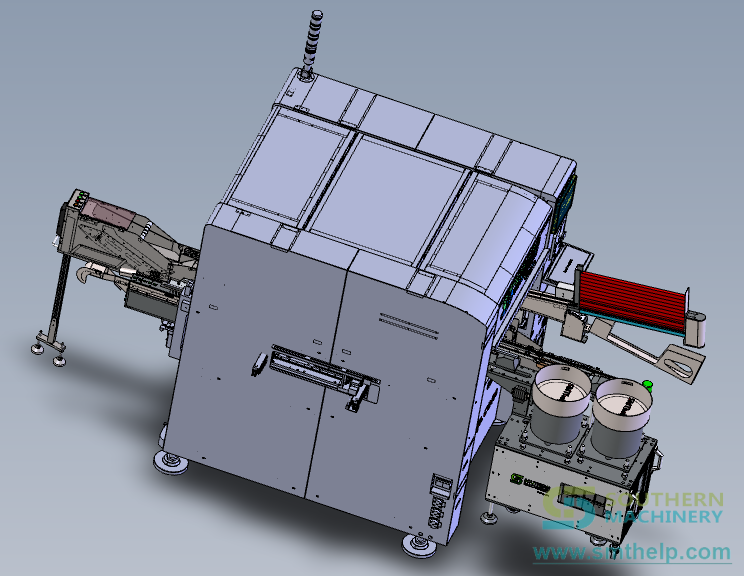
S7900 Odd Form Insertion Machine for THT Automation by Southern Machinery
Odd-form components are often the part of PCB assembly that still depends heavily on manual labor. Standard SMT mounters are excellent for chips, ICs and many packaged parts, but connectors, relays, shields, terminals, sockets and tall or irregular components usually need special handling.
The S7900 Odd Form Insertion Machine by Southern Machinery is designed for this gap. It automates insertion of non-standard through-hole and odd-form parts with custom feeding, vision positioning, dedicated nozzles or grippers, and optional lead bending. For EMS, ODM, automotive electronics, medical electronics and industrial control factories, the goal is simple: reduce manual insertion work, improve repeatability, and connect odd-form assembly into a more stable PCB assembly flow.
Southern Machinery was founded in Shenzhen, China in 2011. We focus on high-efficiency, cost-effective SMT and THT PCB assembly automation equipment, including SMT lines, THT insertion, wave soldering, board handling and inspection solutions for 237+ global customers.
What is this machine used for?
The S7900 is used to automatically pick, position and insert irregular electronic components into PCB holes. These are the parts that are difficult for a standard chip mounter or conventional axial/radial inserter to handle.
Typical components include:
- Connectors and sockets
- Relays and switches
- Shields, brackets and mechanical parts
- Terminals and odd-shaped THT components
- Parts supplied from tape, tube, tray or bowl feeders, depending on the component design
In real production, this machine is useful when one PCB has a few slow manual insertion steps that hold back the whole line. For example, if SMT and wave soldering are already stable but operators still manually insert connectors before soldering, the S7900 can help turn that operation into a controlled automatic process.
Core Capabilities from the Source Product Page
The source product page presents the S7900 as an odd-form insertion platform with these key capabilities:
- High-speed precision insertion: the source page lists placement accuracy of +/-0.06 mm and speed up to 4,700 CPH, depending on configuration and subject to final technical confirmation.
- Flexible component supply: supports different feeding concepts such as tape, tube, tray and bowl feeder arrangements, matched to the component package.
- Vision positioning: uses vision alignment for components and PCB mark points to improve placement consistency.
- Custom nozzles and grippers: tooling can be adapted to the shape, center of gravity and pickup surface of the component.
- Optional lead bending / clinching: the source page describes optional lead bending to help secure parts before soldering.
- Safety and maintenance design: the page highlights safety covers, emergency stops and routine maintenance access.
These figures and functions should be confirmed against the final component sample, PCB data, feeder type and selected machine configuration before purchase.
Why Odd-Form Insertion Becomes a Bottleneck
Odd-form parts create problems because they are not standardized like 0402 resistors or IC packages. A connector may have a plastic body, uneven weight, long pins and limited flat pickup area. A relay may need mechanical gripping instead of vacuum pickup. A terminal may need special forming or orientation control before insertion.
When this process stays manual, factories usually face three problems:
- Labor dependency: output changes with operator skill and attendance.
- Quality variation: tilted parts, missed holes and inconsistent insertion depth can create downstream solder defects.
- Line imbalance: one slow manual station can limit the output of a complete SMT and THT line.
The S7900 addresses this by engineering the feeder, nozzle or gripper, vision and insertion motion around the real component.
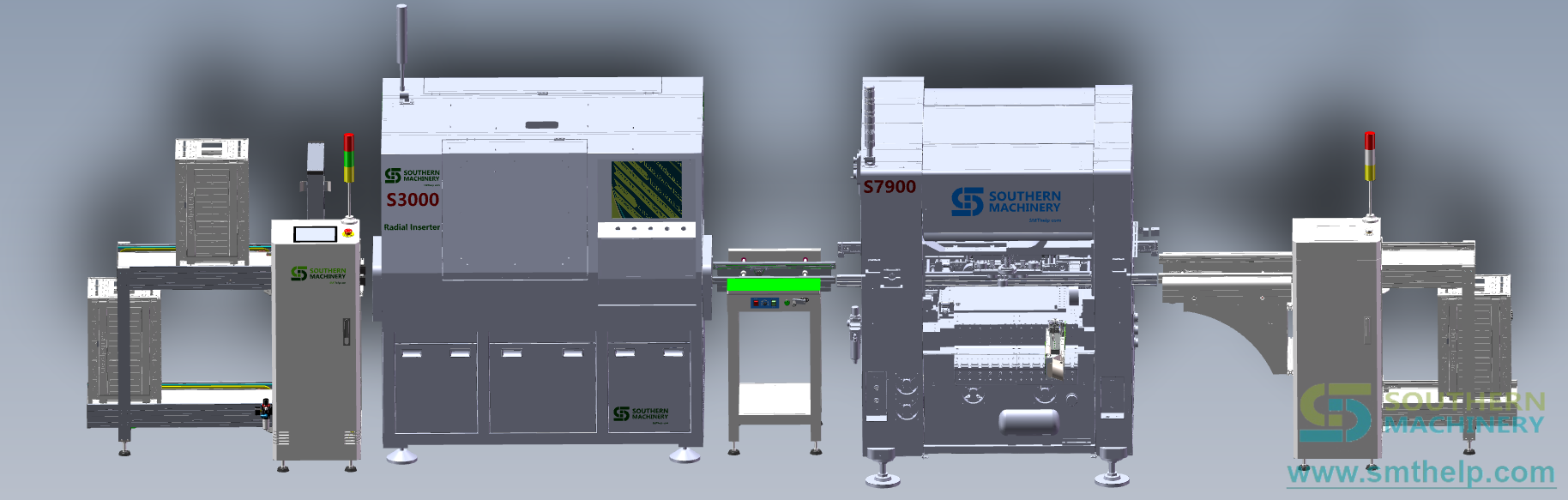
Typical Applications
The S7900 is suitable for products where odd-form THT parts are common and manual insertion is becoming expensive or unstable.
Common application scenarios include:
- Automotive electronics: connectors, relays and terminal components used in control modules and power boards.
- Industrial control: large connectors, switches, sockets and mechanically reinforced components.
- Power supplies and LED drivers: larger THT parts combined with post-SMT soldering.
- Home appliances and consumer electronics: mixed SMT and THT boards with repeatable odd-form components.
- EMS high-mix production: projects where custom feeding and tooling are needed for different customer boards.
For very low volume or constantly changing prototype work, full odd-form automation may be overkill. In that case, Southern Machinery can recommend semi-automatic insertion support, fixtures, conveyors or selective upgrades first. For medium to high repeat volume, the S7900 becomes more attractive because the same insertion program and tooling can be reused shift after shift.
How the S7900 Fits into a Complete PCB Assembly Line
Southern Machinery’s advantage is not only supplying one machine. We can design the complete line around the board, volume and process.
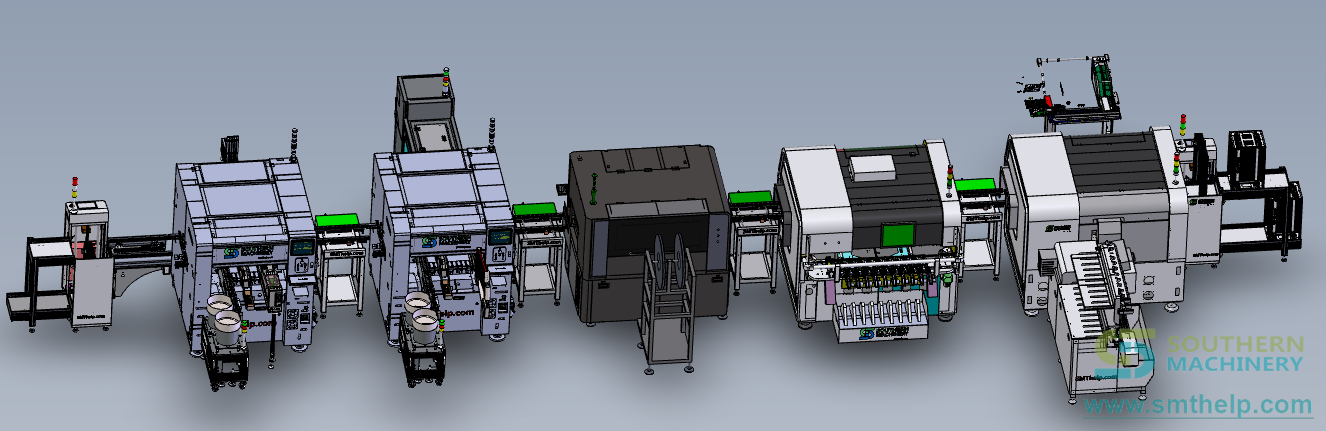
A typical integrated flow can look like this:
- SMT section: magazine loader, automatic stencil printer, SPI if needed, pick-and-place, reflow oven and post-reflow AOI.
- THT preparation: buffer conveyor, PCB loader or transfer conveyor after SMT.
- Odd-form insertion: S7900 inserts connectors, relays, shields or other irregular THT parts.
- Additional THT insertion: axial, radial or terminal insertion machines can be added when the product has high-volume standard THT components.
- Soldering: wave soldering or selective soldering, depending on PCB layout, thermal mass and soldering area.
- Inspection and test: THT AOI, visual inspection, ICT/FCT station and final unloading.

This line architecture is practical because it avoids automating one island while leaving the rest of the process disconnected. Board handling, buffering and inspection must be matched to the insertion cycle time, or the machine will not deliver its full value.
Key Selection Parameters for Buyers
Before selecting the final S7900 configuration, confirm these points:
- PCB size and thickness: maximum and minimum board dimensions, panel layout and support requirements.
- Component list: drawings, samples, photos, package type and insertion direction for each odd-form part.
- Feeding method: tape, tube, tray, bowl feeder or custom feeder, depending on component supply format.
- Insertion accuracy requirement: hole tolerance, pin diameter and acceptable insertion depth variation.
- Cycle time target: boards per hour, parts per board, shifts per day and working days per month.
- Tooling choice: vacuum nozzle, mechanical gripper or hybrid tooling.
- Clinching requirement: whether leads must be bent or secured before wave/selective soldering.
- Traceability needs: barcode scanning, data collection or MES connection if required.
- Downstream soldering process: wave soldering or selective soldering, including fluxing and preheat needs.
Once these are confirmed, Southern Machinery can match the closest catalog configuration and customize tooling where needed.
ROI, Quality and Capacity Value
The source page describes the S7900 as a way to replace multiple manual insertion operators and improve throughput. Those savings are real in many factories, but the exact ROI should be calculated from your own labor cost, product mix, number of odd-form parts, machine utilization and required tooling.
The practical value usually comes from four areas:
- Lower manual labor pressure: one automated insertion process can reduce repetitive manual work.
- More stable quality: vision alignment and controlled insertion reduce variation between operators and shifts.
- Better line balance: odd-form insertion becomes part of the planned flow before soldering.
- Future scalability: if product volume grows, the same platform can be integrated with loaders, buffers, AOI, wave soldering and test stations.
For example, if one product has several connectors that slow the pre-wave-soldering area, automating only the slowest connector operation may already improve the whole line. If the board has many different odd-form parts, the better approach may be a customized feeder and tooling package designed as one project.
Why Work with Southern Machinery
Southern Machinery provides full-line PCB assembly automation, not only standalone machines. For overseas EMS and OEM factories, that matters because the real project risk is usually integration: board flow, feeder design, tooling trial, soldering process and operator training must work together.
Our support scope can include:
- SMT line planning and equipment matching
- THT axial, radial, terminal and odd-form insertion solutions
- Wave soldering and selective soldering process support
- Board handling: loaders, unloaders, conveyors, buffers and inverters
- Inspection options such as SPI and AOI where needed
- Overseas installation guidance, remote support, spare parts and professional training
The result is a high-efficiency, cost-effective line designed around your product instead of a generic machine list.
FAQ
1. Can the S7900 handle every odd-form component?
Not automatically. Each odd-form part should be checked by sample, drawing and supply format. Some parts are suitable for vacuum nozzles, some need mechanical grippers, and some may require a custom feeder or pre-orientation method.
2. Is the listed speed of up to 4,700 CPH guaranteed for all parts?
No. The source page lists up to 4,700 CPH, but actual output depends on component shape, feeder type, PCB layout, insertion path and configuration. Final capacity should be confirmed after technical review.
3. Do we need wave soldering after odd-form insertion?
In many THT flows, yes. Odd-form parts are often inserted before wave soldering or selective soldering. The right soldering choice depends on component spacing, heat sensitivity, board thickness and solder joint accessibility.
4. Can this machine connect with an existing SMT line?
Yes, if the board handling height, direction, PCB size and upstream/downstream flow are matched. Southern Machinery can help design conveyors, buffers, loaders and unloaders to connect the S7900 into an existing line.
5. What information is needed for a quotation?
Please provide PCB size, component photos or drawings, part supply format, parts per board, target output per shift, current process flow and automation budget level. With that, we can recommend the right S7900 configuration and supporting line equipment.
6. Is S7900 suitable for high-mix EMS production?
It can be, especially when the product families share similar component types or tooling concepts. For very frequent product changes, we will evaluate changeover time, feeder setup and tooling cost before recommending the final configuration.
CTA: Get a Practical Line Proposal
If manual odd-form insertion is limiting your PCB assembly output, send Southern Machinery your PCB size, component list, photos, target volume and current line layout. We will review whether the S7900, combined with suitable board handling, wave soldering and inspection equipment, can give you a cost-effective automation path.
Southern Machinery can support you from single-machine automation to a complete SMT + THT + wave soldering + board handling line for smart EMS production.
Comments