
S7900 Odd-Form Insertion Machine: Automate the THT Components Your SMT Line Cannot Handle
How Southern Machinery's S7900 turns manual through-hole insertion into a configurable, vision-guided automation process — with real ROI data from EMS production floors.
Jul 1, 2026 · Updated Jul 1, 2026 · Southern Machinery
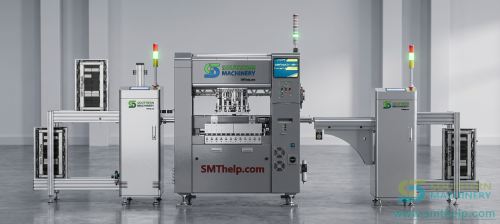
S7900 Odd-Form Insertion Machine: Automate the THT Components Your SMT Line Cannot Handle
How Southern Machinery's S7900 turns manual through-hole insertion into a configurable, vision-guided automation process — with real ROI data from EMS production floors.
---
In electronics manufacturing, most of the conversation centers on SMT: high-speed pick-and-place, fine-pitch placement, and inline inspection. But ask any production manager what happens after the SMT line, and you'll hear the same story — a bottleneck of manual through-hole insertion for odd-form components.
Relays, transformers, large capacitors, connectors, and coils still require skilled operators working shift after shift. The result? Inconsistent output, quality drift, and labor costs that never stabilize.
Southern Machinery designed the S7900 Odd-Form Insertion Machine to close that gap. It's not a single-purpose special machine. It's a flexible automation platform that adapts to your BOM, your component packaging, and your production targets.
---
The Real Problem: Why Odd-Form THT Stays Manual
Odd-form components share one frustrating trait: no two are alike. Body shapes, lead geometries, packaging types, and insertion orientations vary from part to part. A standard axial or radial inserter can't handle them, and a general-purpose robot often requires expensive custom tooling for every new component.
This leaves EMS factories with three uncomfortable options:
| Option | Drawback |
|---|---|
| Manual insertion | Slow, inconsistent, operator-dependent |
| Custom special-purpose machines | High CapEx, long lead time, inflexible |
| General-purpose robots | Complex integration, ongoing programming cost |
The S7900 takes a fourth path: configurable automation. It uses interchangeable feeders, vision-guided alignment, and multi-head insertion to handle diverse components on a single platform.
---
How the S7900 Solves Each Production Pain Point
1. From Manual Labor to Repeatable Cycle Output
Manual insertion output varies with operator skill, fatigue, and shift staffing. The S7900 replaces that variability with a consistent, repeatable process. In one documented example, a relay insertion task that produced 1,000 pieces per hour manually reached 4,700 pieces per hour on the S7900IV — a 4.7× throughput gain.
2. Eliminate Floating Components Before Wave Soldering
Heavy THT components — transformers, large relays — can tilt or lift before wave soldering when leads aren't mechanically secured. The S7900IV-W includes a standard lead clinching unit that bends leads under the PCB, holding components firmly in place during soldering. This single feature reduces both rework rates and soldering defects.
3. Handle Mixed Component Packaging
EMS factories receive odd-form parts in tape, tube, tray, and bulk packaging. The S7900 supports six feeder families:
- Radial tape feeder
- Vertical taping (90°)
- Horizontal tape feeder
- Tube feeder
- Bowl feeder
- Tray feeder
Feeder configuration is matched to your actual BOM — not the other way around.
4. Vision-Guided Precision, Not Blind Force
Forcing a misaligned component damages PCB holes and creates hidden quality risks. The S7900 uses:
- Top mark CCD: aligns the PCB position
- Bottom component CCDs (4 units): verify component orientation before insertion
Placement accuracy reaches ±0.05 mm (CPK≥1.0) on the S7900IV-W model.
5. Fast Changeover for High-Mix Production
Windows-based operation, vision programming, and quick-plug clamp replacement allow operators to switch between product types without calling in an engineer. For high-mix EMS environments, changeover speed directly impacts profitability.
---
S7900IV vs S7900IV-W: Choosing the Right Model
| Specification | S7900IV | S7900IV-W |
|---|---|---|
| Insertion Heads | 4 | 4 |
| Max Component Size | φ30 mm (17×17 mm) | φ50 mm (35×35 mm) |
| Component Height | ≤30 mm | ≤25 mm |
| Speed per Component | 0.7 s | 2 s (with bent feet) |
| Placement Accuracy | ±0.06 mm (CPK≥1.0) | ±0.05 mm (CPK≥1.0) |
| Lead Clinching | Not applicable | Standard |
| PCB Size (L×W) | 70×70 – 410×500 mm | 70×70 – 450×400 mm |
| Conveyor Type | Chain | Belt |
| Machine Size (L×W×H) | 1300×1700×2000 mm | 1550×1900×2100 mm |
| Max Power | 5.4 kW | 6.6 kW |
Choose S7900IV for high-speed insertion without clinching requirements.
Choose S7900IV-W when components must be secured before wave soldering, and for larger component footprints up to 50 mm.
---
ROI: What the Numbers Tell You
Southern Machinery provides ROI modeling as part of quotation, not as generic marketing claims. But here are indicative planning figures from S7900 source documentation:
- 4,700 pieces/hour — example relay output on S7900IV (vs. ~1,000/hour manual)
- 5-worker equivalent — one machine replaces approximately 5 manual insertion operators for the referenced relay case
- Under 2 years — indicative payback period (varies by labor cost, shifts, component mix)
- 5% insertion-rate improvement — documented in S7900IV-W bending-foot scenario
Important: These are planning indicators, not guarantees. Southern Machinery validates ROI case-by-case using your actual labor rates, shift patterns, BOM data, and final machine configuration.
---
Line Integration: Where S7900 Fits
The S7900 is not a standalone island. It integrates into a complete THT line:
PCB Loader → S7900 Odd-Form Insertion → Wave Soldering → PCB UnloaderConveyor direction supports left-to-right or right-to-left flow, and the machine can be paired with magazine loaders, buffers, and downstream soldering equipment for full-line automation.
---
What You Need to Send for Evaluation
To get an accurate quotation and feasibility confirmation, Southern Machinery requests:
- PCB Gerber/CAD data — board dimensions, hole positions, panelization
- BOM (Bill of Materials) — component types, quantities, packaging
- Component drawings and photos — especially for non-standard parts
- Target UPH (units per hour) — your production volume requirement
- Current manual process data — number of workers, defect rates, bottlenecks
- Wave soldering or clinching constraints — any special requirements
Samples are recommended before final confirmation of feeder, gripper, and nozzle design.
---
Key Takeaways for Production and Procurement Teams
- S7900 targets the post-SMT bottleneck: odd-form THT components that SMT placement cannot handle.
- Flexible feeder ecosystem adapts to tape, tube, tray, and bulk packaging — configured per BOM.
- Vision-guided insertion with ±0.05 mm accuracy and CPK≥1.0 capability.
- Lead clinching (S7900IV-W) prevents floating components before wave soldering.
- ROI is validated case-by-case using your labor cost, shifts, volume, and component data — no generic claims.
- Full line integration with upstream loaders and downstream soldering equipment.
---
Next Steps
Ready to evaluate the S7900 for your production line?
- Request a sample review: Send your PCB data, BOM, and component samples to [jasonwu@smthelp.com](mailto:jasonwu@smthelp.com?subject=S7900%20Sample%20Review)
- WhatsApp: Contact Jason directly
- Browse the catalog: Visit the Southern Machinery Product Catalog for the full machine range
---
Published by Southern Machinery — SMT/THT PCB Assembly Automation Lines. Established 2011 in Shenzhen, serving 237+ global EMS, ODM, automotive, and medical electronics manufacturers.
Comments
jasonwu
Jul 1, 2026This S7900 article does a great job describing a very real bottleneck: SMT lines are fast, but odd-form THT insertion still drags overall output and stability down. The use of real production data – such as relay insertion going from around 1,000 pcs/h manually to 4,700 pcs/h on S7900IV, and one machine replacing roughly five manual operators – makes the ROI discussion concrete and credible for both production and purchasing teams. I especially like three aspects: Positioning S7900 as a configurable automation platform rather than a one-off special machine, which fits today’s high-mix, medium-volume EMS environments very well. Clearly explaining when to choose S7900IV versus S7900IV-W, especially for applications that need lead clinching to prevent floating components before wave soldering. Listing supported packaging types, accuracy, and cycle time in detail, so engineers can immediately benchmark against their current manual process. As a next step, adding one or two concrete case studies (for example from automotive electronics or instrumentation) with before/after charts would make the story even stronger. For factories currently evaluating THT automation, this article is a very practical technical and ROI guide – and I strongly recommend following the call-to-action to send your PCB data and BOM for a tailored feasibility and ROI assessment. S7900 Odd-Form Insertion Machine: Automate the THT Components Your SMT Line Cannot Handle