
S7900 Odd-Form Inserter Running Cost by Southern Machinery
Odd-form insertion machine running cost: 4.5-6.6 kW peak vs 2-3.5 kW running power, 0.5-0.65 MPa shop air, clinch cycle time and a cost-per-component model.
Oct 8, 2026 · Updated Oct 8, 2026 · Southern Machinery
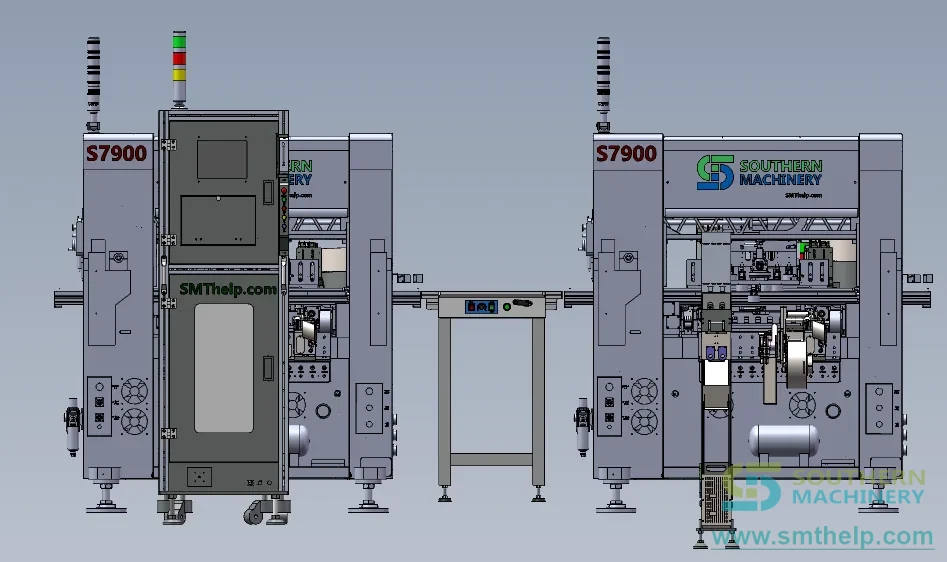
An odd-form insertion machine is rarely expensive because of its motors. It is expensive when the connectors, coils and terminals no SMT head can place queue at a manual bench. The S7900 series from Southern Machinery documents the three utility numbers that decide the machine side of that bill: 4.5–6.6 kW maximum power against 2–3.5 kW running, 0.5–0.65 MPa (ANR) shop air, and a 0.6–2 second cycle per component depending on variant and clinching. The rest of the catalogue — 2 to 6 heads, ±0.05 mm accuracy with CPK ≥ 1.0, up to 20 feeder stations — turns those inputs into a cost per inserted component.
What does an odd-form insertion machine cost to run?
Running cost splits into electricity, shop air and the machine time consumed per component. Only the third is under your control every shift, and it is the one a manual bench cannot match.
Electricity: the peak rating is not the meter reading
Maximum power is documented at 4.5–6.6 kW depending on variant, with 2–3.5 kW while running. Sizing uses the maximum, because preheaters, servo drives and the conveyor can peak together and the drop, breaker and panel have to survive it. Budgeting uses the running figure, which behaves like a meter reading in production — subject to final technical confirmation for your variant.
Shop air: 0.5–0.65 MPa at ANR
The series needs 0.5–0.65 MPa of regulated air at ANR conditions for 2–6 heads that pick, place and, where fitted, clinch. The document states the pressure range, not consumption per cycle, so treat consumption as unconfirmed and measure it or ask Southern Machinery. Practically, the station needs its own filter-regulator at the machine rather than a shared line whose pressure swings when other equipment starts.
Cycle time: 0.6 s on a VI, 2 s on a clinching IV-P
Cycle time is documented at 0.8 s per component on the S7900-II, 0.7 s on the IV, 2 s on the IV-P where clinching is standard, and 0.6 s on the VI and VI-P. Reading 0.6 seconds as free capacity would be careless: output also depends on head count and feeder mix.
How do you calculate the cost per inserted component?
Reduce the machine to units you can price:
energy per hour = running power in kW × your energy price per kWh
cost per inserted component = (energy + air + operator + consumables and spares) ÷ components inserted per hour
Worked example (example only; depends on configuration and subject to final technical confirmation). Take the middle of the documented running range, 3 kW, and an energy price of USD 0.12 per kWh. Energy is USD 0.36 per hour. Taken as a continuous pace, the 0.6-second cycle corresponds to 6,000 components per hour — derived, because real output depends on heads, feeders and clinching. That is roughly USD 0.00006 of energy per component: a rounding error beside the component price, and beside the cost of reworking one floater a manual bench sent to the wave.
What the calculation does not cover
The document states air pressure but not consumption per cycle, and running power but not kWh per board. It publishes no labour rates, spare-part prices or guaranteed payback — the honest boundary of a catalogue-based model. Fill those gaps with your numbers, or have Southern Machinery confirm them.
Which S7900 variant gives the lowest cost per component?
Five configurations are documented, and cycle time is not the only difference:
- S7900-II — 2 heads, 0.8 s per component, ±0.06 mm.
- S7900-IV — 4 heads, 0.7 s per component, ±0.06 mm, insertion force up to 98 N for press-fit parts.
- S7900-IV-P — 4 heads, 2 s per component with automatic lead clinching as standard, ±0.05 mm.
- S7900-VI — 6 heads, 0.6 s per component, ±0.06 mm, maximum PCB weight 2 kg.
- S7900-VI-P — 6 heads, 0.6 s per component, ±0.05 mm, clinching optional.
Accuracy across the series carries CPK ≥ 1.0, checked by one top mark CCD and 2–6 bottom component CCDs.
When the slower variant is the cheaper one
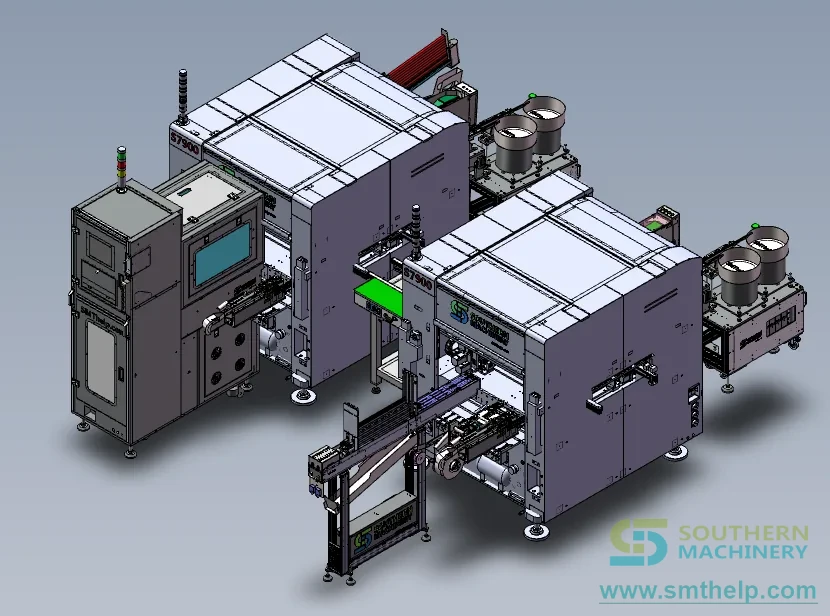
On paper the IV-P looks backwards: 2 seconds per component against 0.7 on the IV. In production the comparison usually inverts, because clinching is what stops hand-inserted leads lifting at the wave, in outward, inner, circular and two-turn bending modes documented for leads under 1.0 mm. A clinched joint removes the rework loop a floater creates — board out of line, reworked, re-inspected, sometimes scrapped — so 1.3 extra seconds inside the machine usually cost less than the throughput lost downstream. It is also why the document lists MES connection as standard and a 1-day spare-part lead time as an uptime feature.
What does an odd-form insertion machine replace on the floor?
Odd-form parts sit outside standard SMT placement: connectors, switches, sockets, transformer coils, ports, capacitors, resistors, ICs and terminals. The documented envelope is a body up to Ø50 mm (35 × 35 mm) and 20–30 mm high depending on variant, with insertion force up to 29.4 N and up to 98 N on the S7900-IV.
- Power adapters and small appliance control boards, where connectors and terminals dominate the through-hole content.
- Automotive electronics, where clinch quality and traceability carry the audit.
- Energy metering and instrument boards, produced in volume with a stable component set.
- 5G communication and power electronics assemblies with heavy terminals and press-fit parts.
Those groups are named in the inline terminal and odd-form production reference (DD-8600) quoted in the same document.
How does the S7900 fit a complete PCB assembly line?
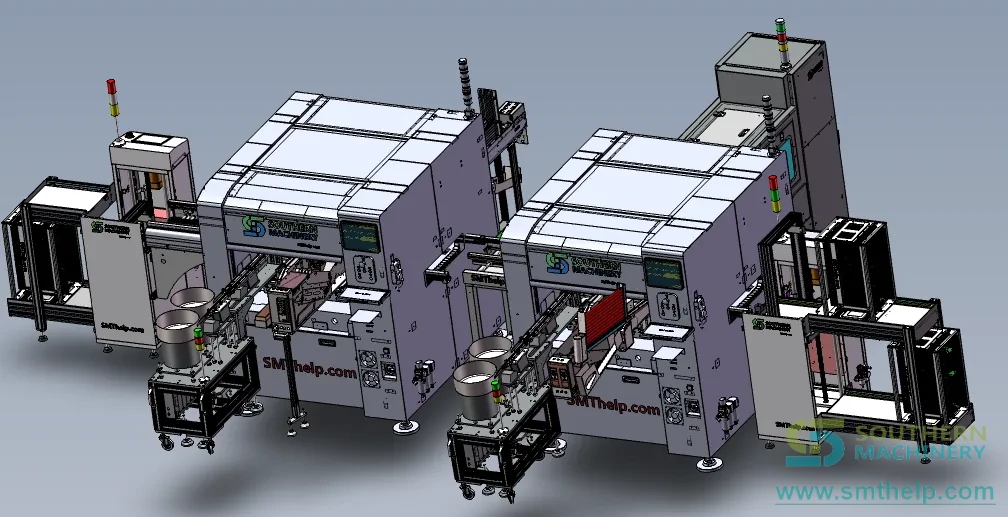
SMT and THT meet at the odd-form station. Placement machines process the fine-pitch SMT content; the S7900 inserts the connectors, coils and terminals no SMT head can present; the board continues to wave or selective soldering. Four documented details keep that sequence running unattended:
- Conveyor — chain or belt, left-to-right or right-to-left, automatically adjusted, line height 750 ± 20 mm.
- Inline flow — supports inline operation with PCB loading and unloading.
- MES connection — standard configuration, so the insertion record travels with the board.
- Feeders — radial and axial tape (including a 90° bending version), tray, tube (including vibration and stacked types) and customised bowl feeders, up to 12–20 stations, mixed on one machine.
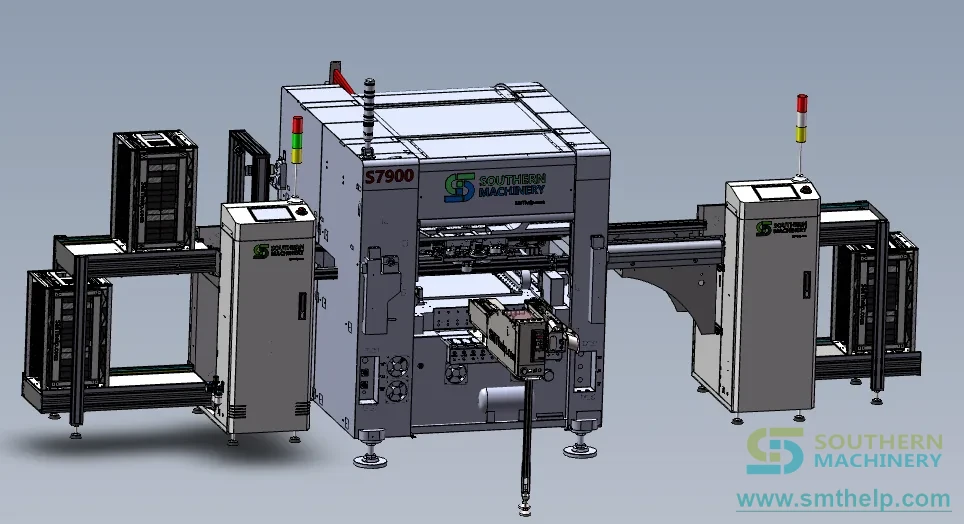
Surrounding modules are described in the Southern Machinery SMT line category, the THT automation category, the board handling range and the PCB assembly category, with model detail at file.autoinsertion.com.
Which specification items should you confirm before you order?
Use these documented values as a baseline; each remains subject to final technical confirmation against your board and component mix.
- PCB — 70 × 70 mm up to 450 × 400 mm; thickness 0.6–2.0 mm; maximum weight 5 kg (2 kg on the VI).
- Component — body up to Ø50 mm (35 × 35 mm); height 20–30 mm by variant; insertion force up to 29.4 N, or 98 N on the IV.
- Accuracy — ±0.05 mm or ±0.06 mm by variant, with CPK ≥ 1.0.
- Air — 0.5–0.65 MPa (ANR); consumption per cycle is not specified in the source, so confirm it with Southern Machinery.
- Power — maximum 4.5–6.6 kW; running 2–3.5 kW; the production reference platform runs on 220 V.
- Footprint — 1050 × 1680 × 1870 mm up to 1550 × 1900 × 2100 mm; 1,250–1,800 kg.
- Vision and clinching — one top mark CCD plus 2–6 bottom component CCDs; clinching standard on the IV-P, optional on the VI-P.
FAQ
How much power does an odd-form insertion machine draw?
The S7900 series is documented at 4.5–6.6 kW maximum depending on variant, with 2–3.5 kW running. Size the supply against the maximum and budget against the running figure.
What air supply does the S7900 need?
0.5–0.65 MPa at ANR conditions for a machine with 2–6 heads and, on the -P variants, a clinching station. Consumption per cycle is not stated in the source, so confirm it if your compressor capacity is tight.
How fast is the S7900 per component?
Documented cycles are 0.8 s on the II, 0.7 s on the IV, 2 s on the IV-P with clinching and 0.6 s on the VI and VI-P. Plan with your own board and feeder mix.
Can it insert components that have no standard feeder?
Yes. Southern Machinery designs customised grippers and nozzles in house, and the feeder set covers radial and axial tape, a 90° bending version, programmable tray, tube including vibration and stacked types, and customised bowl feeders, up to 12–20 stations mixed on one machine.
What happens when a lead has to be clinched?
Automatic lead clinching is standard on the S7900-IV-P and optional on the VI-P, with outward, inner, circular and two-turn bending modes documented for leads under 1.0 mm. Specify it where hand-inserted parts would otherwise float at the wave.
Next step: send your component mix
Running cost is decided by the components you actually insert, so the conversation starts with samples or drawings, board size and monthly volume. Southern Machinery reviews the odd-form parts, designs the gripper where no standard pickup exists, and confirms head count, feeder mix, clinching option and conveyor direction, with quotation typically within 24 hours of technical confirmation. Founded in Shenzhen in 2011 and serving 237+ global customers, Southern Machinery builds SMT, THT, wave soldering, board handling and inspection equipment, supported by global service, spare parts and training. Send your data through the quote request page, read the frequently asked questions, or contact the engineering team.
Comments