
S7900 Odd-Form Inserter Maintenance by Southern Machinery
The S7900 is a multi-head THT odd-form insertion machine for the parts no placement machine will take -- relays, transformers, sockets, screw terminals, large electrolytics, LEDs and jumper wires. Its operation manual specifies a monthly lubrication and alignment routine rather than a daily checklist, and its fault table names the first check for each of eight common stoppages, six of which an operator clears in under a minute. Published figures include 4,700 components an hour maximum on the S7900IV-W against roughly 1,000 an hour by hand, placement accuracy of +/-0.05 mm at CPK >= 1.0, 0.7 s per component without clinching and 2 s with bent feet, 6 feeder stations expandable to 48, and a service package with one-day critical-spare lead time and seven-by-twenty-four support.
Oct 8, 2026 · Updated Oct 8, 2026 · Southern Machinery

The S7900 is a multi-head THT odd-form insertion machine for the parts no placement machine will take — relays, transformers, sockets, screw terminals, large electrolytics, LEDs and jumper wires. Keeping one in production is not a daily chore: the operation manual specifies a monthly lubrication and alignment routine, and its fault table names one first check for each of eight common stoppages. This is S7900 odd-form inserter maintenance planned as uptime.
What does S7900 odd-form inserter maintenance actually require?
Monthly, not daily
The manual specifies a monthly lubrication and cleaning routine rather than a daily checklist: the XY screw and slider, the Z-axis mechanism and the conveyor width adjustment, plus belt, guide-wheel and guarding checks. An odd-form inserter is a rigid cast platform with few consumables, so the load sits in one window a month. The tasks below keep the manual's wording: paraphrasing a maintenance instruction is how a machine gets serviced wrongly.
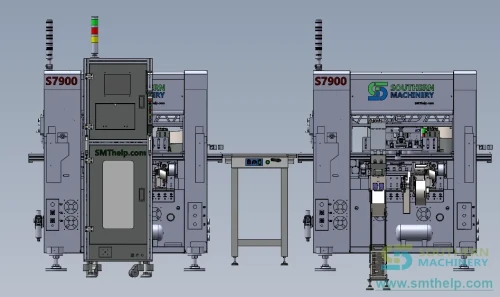
Who owns which task
Lubrication, the belt-and-safety check and returning the machine to production belong to maintenance. The running checks belong to the operator: confirm the safety devices before starting, keep the safety cover closed during automatic operation, and press the emergency stop before working inside.
The monthly schedule the operation manual specifies, task by task
Lubrication
XY screw and slider — clean and re-grease with 2# grease. Z-axis mechanism — remove the insertion head protective cover, then clean and refill with AFC or a special high-speed grease. Conveyor width adjustment and transfer mechanism — 2# grease.
Wear and alignment
Conveyor belt or chain — check for looseness, then clean and service it. Guide wheel — check for wear or sticking, clean it and fill with chain oil. Safety cover and safety grating — check function before returning the machine to production.
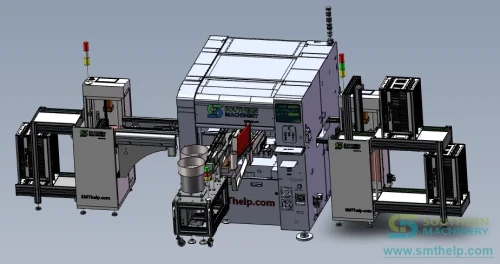
Why monthly is enough
The published maximum speed on the S7900IV-W is 4,700 components an hour against roughly 1,000 an hour by hand, so the insertion cell sets the line's capacity and a stop is measured in boards, not minutes.
Which S7900 faults stop the line, and what does the manual say to check first?
The manual carries its own device failure-handling table, and each row names the first thing to check. Fault handling is for qualified personnel only.
Low pressure alarm — named cause is abnormal total air input; check for a standard 4–6 kg anhydrous source, then the pressure controller.
Every axis alarms after start-up — named cause is a latched emergency switch; check the panel and operating-handle switch and pull it up to reset.
Gripper takes abnormal material, or the feeder is empty — named cause is material shortage; check the feeder supply and pickup position, refill and confirm the pickup test passes.
Mark handling failure — named cause is the PCBA not being in position, or a fuzzy mark; check the board is in place, then click the mark centre.
Machine will not reset — named cause is the machine not being at zero; run it back to zero before production.
Axis command position exceeds the limit — named cause is the X-Y limit sensor signal or an abnormal drive; check the signal, then the drive and motor.
Machine stops with the safety door open — the door was opened during operation; close it and reset, and never defeat the interlock.
Machine stops on the safety grating — a foreign body or an operator is in the guarded area; confirm both are clear, then press reset.
What the fault table says about planning
Six of the eight rows are cleared by an operator in under a minute, which is why the schedule can stay monthly. The two needing maintenance attention are the air-supply and limit-sensor rows, and routine care keeps both predictable.
Which S7900 parts wear, and what should be on your shelf?
The bill of materials is the spares plan
The published bill of materials reads: screws and guides by THK, servo motors by Panasonic, bearings by NSK, sensors and cylinders by Panasonic, SMC or Airtac, cable chain by igus, host computer by Advantech and cameras by Hikvision. Every one of those names sells in most industrial markets, so a bearing or a sensor is a local purchase, not an air-freight.
The three parts to confirm first
Ask for the wear-part list with prices, and confirm a local source for the cable chain, the linear guides and the servo drives — the three items that fail most often. That check is the difference between a two-day stoppage and a two-week one.
What the service package covers
Free installation and on-site training, seven-by-twenty-four worldwide support, one-day lead time on critical spares and one-month turnaround on custom solutions. Warranty terms and quotation lead times are not specified in the source document — contact Southern Machinery to confirm.
How S7900 maintenance fits a complete PCB assembly line
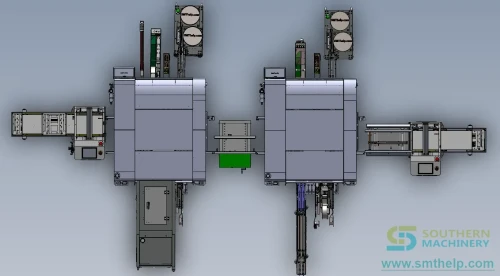
The machine carries two SMEMA ports and runs in line with axial and radial inserters and automatic loaders, with conveyor height published at 900 ± 20 mm on the S7900IV and 750 ± 20 mm on the S7900IV-W, and MES parameters set by IP, port and device number. Pair it with board handling, a matched feeder set and the wider PCB assembly automation range, and the monthly window becomes the only planned stop.
What does an S7900 maintenance programme cost per year?
The formula
Planned maintenance cost = (monthly task hours × 12 × loaded maintenance rate) + annual spare-parts spend + (unplanned stoppage hours × line cost per hour).
Only the third term is worth attacking, and the monthly schedule pushes it toward zero. The published business case for the machine — one S7900 replacing five manual operators, roughly USD 60,000 of labour released a year, payback under two years — is quoted as published.
A worked example (example / depends on configuration / subject to final technical confirmation)
Inputs of four monthly maintenance hours at USD 35, USD 1,200 of annual wear parts and one stoppage hour a month on a line costed at USD 400 an hour: planned maintenance 4 × 12 × 35 = USD 1,680; spares USD 1,200; stoppage 12 × 400 = USD 4,800; total ≈ USD 7,680 a year. Machine values are quoted from the S7900 operation manual, the S7900IV / IV-W specification table and the S7900 odd-form solution deck, and the arithmetic is derived and is an example only.
Key S7900 parameters to confirm before you order
Feeders — 6 stations standard, expandable to 48, with tape, tube, tray and bowl running simultaneously.
Heads and speed — 4 heads published for both variants, offered from 2 to 8; 0.7 s per component without clinching, 2 s with bent feet.
Accuracy — ±0.06 mm at CPK ≥ 1.0 on the S7900IV; ±0.05 mm at CPK ≥ 1.0 on the S7900IV-W.
Board and component — boards of 70 × 70 to 410 × 500 mm on the S7900IV and up to 450 × 400 mm on the S7900IV-W, 0.6 – 2.0 mm thick; component envelope L5 × W5 × H6 mm up to L40 × W40 × H45 mm including the lead.
Variant — S7900IV (chain conveyor, no clinching) or S7900IV-W (belt conveyor, lead clinching standard); it decides board weight, conveyor height and clinching.
Utilities — a standard 4–6 kg anhydrous air source; electrical figures of 2 kW, 5.4 kW and 6.6 kW appear across the documents and need confirming against your variant.
FAQ
How often does an S7900 need maintenance?
Monthly. The manual specifies lubrication of the XY screw and slider, the Z-axis mechanism and the conveyor width adjustment and transfer mechanism, plus belt-or-chain, guide-wheel and guarding checks.
What grease does the S7900 manual specify?
2# grease on the XY screw and slider, the conveyor width adjustment and the transfer mechanism; AFC or a special high-speed grease on the Z-axis mechanism after removing the head cover; chain oil on the guide wheel.
Can an operator clear faults without maintenance?
Six of the eight rows in the manual's fault table are cleared by an operator: emergency switch, feeder material shortage, mark handling on a PCB not fully in place, a machine not at zero, and a safety stop. The interlock is never to be defeated.
What spare parts should an S7900 owner stock?
Start from the published wear-part list and prices, then confirm a local source for the cable chain, the linear guides and the servo drives. The bill of materials uses THK guides, NSK bearings, Panasonic motors, igus cable chain and Hikvision cameras.
Plan your S7900 maintenance before the machine lands
Send us a populated board and a sample of each odd-form component in the packaging it arrives in. We will confirm the feeder mix, the lead bend form, the variant and a realistic throughput; the source documents sit in the machine catalogue.
Southern Machinery has built SMT and THT assembly automation in Shenzhen since 2011 and supports 237+ customers worldwide. Request a quotation, read the FAQ, or contact the team with your component list.
Comments