
S7020T Terminal Inserter Site Readiness — Southern Machinery
S7020T terminal inserter site readiness: size the 220 V single-phase circuit for 2.0 kW, deliver 0.6 MPa of air, and plan 1200-1500 kg of floor loading before the machine ships.
Oct 8, 2026 · Updated Oct 8, 2026 · Southern Machinery
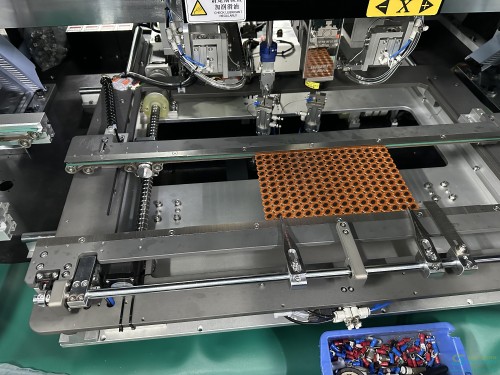
The S7020T is a vision-corrected THT terminal insertion machine from Southern Machinery for tact switches, strip connectors, copper inserts and axial braided terminals, stated at 0.6 seconds per point for tact switches. Site readiness for a terminal insertion machine comes down to four services: single-phase 220 V power, compressed air at 5–6 kgf/cm², a conditioned floor inside 5–25 °C, and a footprint of 1700 × 1300 mm to 2160 × 1330 mm depending on head count. These are the numbers the S7020T manual and its family solution sheet publish — including the rows where they disagree.
What does the S7020T need from your floor before installation?
The manual lists three pre-start checks — power supply, the air pressure gauge on the left of the machine, and a working area clear of foreign objects — so those three pass on day one.
The published installation numbers, side by side
- Power: AC220 V ±10 V single phase, 50/60 Hz — 1.6 kVA in the manual, 2 kVA in the solution sheet, 2.0 kVA in the presentation, against a stated 2.0 kW maximum.
- Air: 5–6 kgf/cm² in the specification table, 0.4–0.6 MPa at start-up, 0.5–0.6 MPa in daily maintenance; consumption around 0.6 m³/min.
- Floor size: 2160 × 1330 × 1530 mm in the manual, or 1700 × 1300 × 1600 mm for a two-head configuration.
- Weight: 1500 kg in the manual, 1200 kg in the solution sheet.
- Environment: 5–25 °C and 20–95% RH in the manual, 30–70% RH in the solution sheet.
- Noise 70 dB; line interface RS-232C, with MES connection stated.
Why size the power circuit for 2.0 kW instead of 1.6 kVA?
Three documents give three electrical answers and one of them is a maximum. The published rule is to size the supply for the higher figure until the electrical drawing for your configuration confirms it, because guessing low costs a second electrician visit, re-run cable and idle machine time. Confirm a 220 V single-phase feed at the intended position.
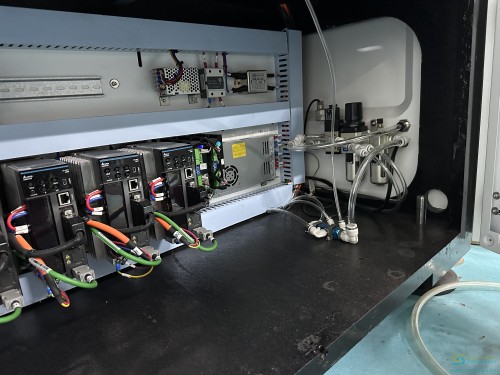
The machine also carries a dedicated industrial PC. The manual states the computer is for this machine only, with no other software and no untrusted USB media, and requires a shutdown order — exit the application, exit Windows, then cut the power — with a 10–20 second wait after a power failure before restarting. On a site with generator changeover, that belongs in the commissioning procedure.
What air supply and environment does the S7020T require?
The manual gives the air figure three ways and resolves it with one instruction: supply 0.6 MPa and regulate down at the machine. Consumption is around 0.6 m³/min. Air also appears in the fault table as a cause of a machine that will not start, alongside power supply, the safety sensor and a latched emergency stop.
For environment, the manual specifies 5–25 °C and 20–95% RH, out of direct sunlight and away from condensation, splashing water, oil and chemical liquids; the solution sheet is narrower at 30–70% RH, the safer assumption for a conditioned shop floor.
Utilities checklist for your facilities team
- A dedicated 220 V single-phase circuit sized to the largest published figure, plus the electrical drawing for your configuration.
- An air drop delivering 0.6 MPa at the machine, regulated at the machine, with a 0.6 m³/min allowance.
- A conditioned area inside 5–25 °C and, conservatively, 30–70% RH.
- A clear working area free of foreign objects, per the manual's third pre-start check.
- A lifting plan based on the heavier published weight, and a serial or network run for the RS-232C interface.
How much floor space and floor loading should you plan for?
Head count moves the footprint. Insertion heads are optional from one to four, and the two published dimensions belong to different configurations. Ask for the outline drawing for the configuration on your quotation — with your head count and feeding arrangement on it — and plan the floor from that drawing, using the heavier 1500 kg for rigging until it arrives.
Board size sets the handling around the machine: 80 × 80 mm minimum to 380 × 280 mm maximum, with manual board load or automatic PCB load and unload, which changes the conveyor interfaces on both sides.
How does the S7020T connect into a complete PCB assembly line?
The inserter is normally one station inside a THT line: boards arrive from a loader, pass through axial and radial insertion, and reach this machine for the parts a placement machine cannot handle, before wave soldering and inspection. Feeding decides the layout — bulk tact switches, connectors and copper inserts run through a bowl feeder and track, while axial braided terminals run on a 52 mm tape feeder. Handling decides the rest — board flow direction and conveyor interfaces decide whether the machine sits inline, and RS-232C lets it report to your MES. Layout equipment: PCB assembly equipment, board handling systems, feeder systems.
What does an unready site cost, and how do you number it?
The published payback model counts operator hours released only, and excludes yield improvement, rework reduction and floor space — so the real payback is shorter than the calculation.
manual insertion hours per month = terminals per board x seconds per insertion (manual) x boards per month / 3600
machine hours for same output   = terminals per board x 0.6 s per point (tact switch) x boards per month / 3600
operator hours released         = manual insertion hours - machine hours
labour cost released per year   = operator hours released per month x loaded hourly cost x 12
payback (months)                = machine investment / labour cost released per year x 12
Worked example — example only, depends on configuration and subject to final technical confirmation: 8 insertion points per board, 25,000 boards a month and 3 seconds of manual time per terminal give about 167 manual hours a month against about 33 machine hours at the stated 0.6 s per point — roughly 133 operator hours, or 0.8 of a full-time operator. The manual-bench time is an assumption for illustration; no price, lead time or guarantee is implied.
Uptime is the second, less visible term: the fault table attributes a machine that will not start to power supply, air supply, a safety sensor, a latched emergency stop or other causes — three of those sit on the facility side. Southern Machinery has built SMT and THT assembly equipment since 2011 from Shenzhen, and supports lines worldwide with spare parts, retrofit, training and overhaul.
Key selection parameters to confirm before you order
- Head count: 1 to 4 insertion heads, optional — more heads means more terminal types per pass and a longer machine.
- Feeding: bowl feeder with track for bulk tact switches, connectors and copper inserts, or a tape feeder for axial braided terminals on 52 mm tape.
- Clinch form: inward, outward or N form, settled on a sample board; load and unload manual or automatic.
- Board range: 80 × 80 mm minimum, 380 × 280 mm maximum; terminal thickness 0.5–1.2 mm, vertical error ≤ 0.8°, insertion hole 0.5 ± 0.1 mm larger than the foot, component spacing ≥ 2 mm.
- Insertion performance: 0.6 s per point tact switches, 0.55 s connectors and copper inserts, 1 s axial braided, up to 2 insertions per second at 5.08 mm pitch; vision correction 0.015 mm, repeat positioning 0.05 mm.
- Quality: IPC-9704 stress test within ±400 µε per insertion; force detection is optional and the documented recommendation is to specify it.
- Wear parts to price at quotation: clinching mould, press cover, tracks and belts.
- Programming: online visual programming with an Excel data path, a stated five-minute new-board program using the camera, 17-inch colour LCD.
Frequently asked questions
What power supply does the S7020T need?
AC220 V ±10 V single phase at 50/60 Hz: 1.6 kVA in the manual with a 2.0 kW maximum, 2 kVA in the solution sheet, 2.0 kVA in the presentation. Size the circuit for the higher figure until the electrical drawing confirms it.
What air pressure and consumption should the compressor plan for?
5–6 kgf/cm² at the machine, roughly 0.5–0.6 MPa, with consumption around 0.6 m³/min. Supply 0.6 MPa and regulate down at the machine.
How much floor space and floor loading do I need to allow?
2160 × 1330 × 1530 mm and 1500 kg in the manual; 1700 × 1300 × 1600 mm and 1200 kg for a two-head configuration. Confirm the outline drawing for your head count and use the heavier weight until then.
What environment does the machine require?
5–25 °C and 20–95% RH in the manual, 30–70% RH in the solution sheet; plan the tighter range, away from sunlight, condensation, water, oil and chemicals.
Can the S7020T run in line with our existing THT equipment?
Manual board load and automatic PCB load and unload are both listed, and this family runs in line with a loader alongside axial and radial inserters. Whether your line can take it depends on conveyor interfaces and board flow direction.
Does the machine need its own computer and a shutdown routine?
Yes. The manual states the PC is for this machine only, with no other software and no untrusted USB media; shutdown is application, then Windows, then power, with 10–20 seconds before restarting after a power failure.
Plan the site before you plan the shipment
Send us your board, a sample of every terminal type with its packaging, and the available power, air and floor area. We will confirm the head count, feed path, clinch form and a realistic throughput — and tell you which of our own documents still need confirming. Start with a quote request, review the FAQ, or contact the team. Catalogues: file.autoinsertion.com; photographs: ph.smthelp.com.

Comments