
S4000 Axial Insertion Machine for Power Supply & LED Lighting PCB Assembly | Southern Machinery
Southern Machinery S4000 axial inserter automates resistors, diodes and jumper wires on power supply and LED lighting PCBs — up to 20,000 CPH, MES-ready.
Aug 19, 2026 · Updated Aug 19, 2026 · Southern Machinery
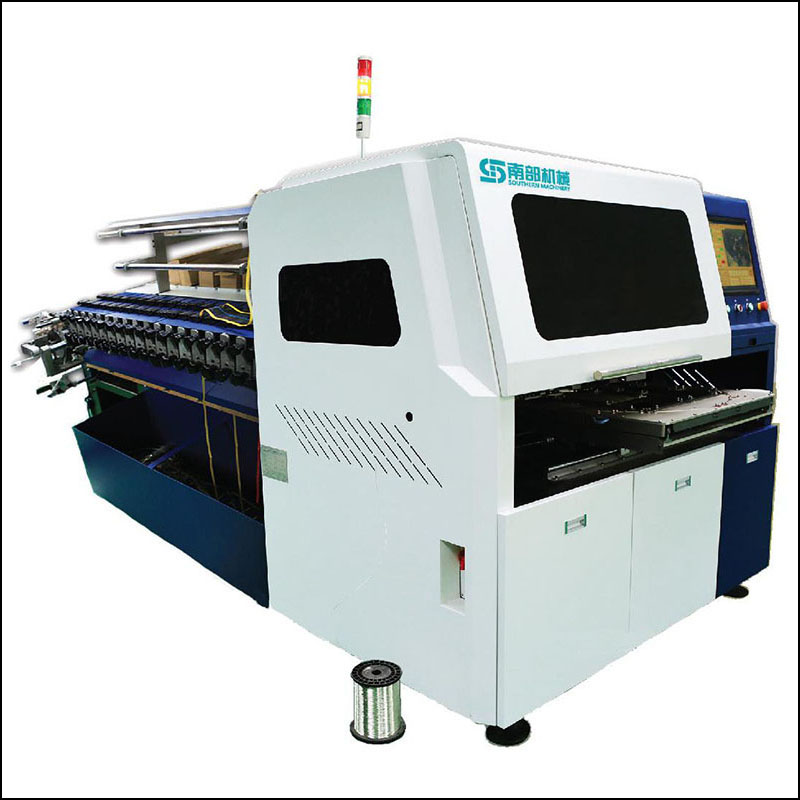
S4000 Axial Insertion Machine for Power Supply & LED Lighting PCB Assembly | Southern Machinery
Axial components — resistors, diodes and jumper wires — are the backbone of power supply, LED driver and energy-saving lighting PCBs. In most factories they are still inserted by hand, which is exactly why those same factories struggle with labor cost, rework and throughput when order volumes climb. Southern Machinery's S4000 Axial Insertion Machine automates this step: it feeds taped axial parts, forms the leads, inserts them, and clinches them on the far side of the board — at a rated speed of up to 20,000 CPH, with a typical actual production speed of approximately 10,000 CPH in real line conditions.
Southern Machinery, founded in Shenzhen, China in 2011, designs and manufactures SMT and THT PCB assembly automation equipment and has served 237+ customers worldwide. The S4000 is one of the company's core THT platforms, complemented by radial inserters (S-3010B, S3000), odd-form inserters (S7040, S7000), Wave Soldering machines (S-WS450, S-WS350B), board handling systems, and inspection equipment — a complete THT line from one supplier.
What is this machine used for?
What is the S4000 axial insertion machine used for?
The S4000 is used to automatically insert axial-lead components — components with two leads exiting opposite ends of the body — into through-hole PCBs. Typical parts are tape-packed resistors, diodes and jumper wires. The machine replaces the manual work cell where operators pick each component, bend the leads, push it through the PCB, and cut or clinch the leads underneath.
Which components can it handle?
Per Southern Machinery's published specification, the S4000 supports:
- Tape-packed resistors, diodes and jumper wires
- Axial lead diameters from 0.3 to 0.8 mm
- Component lead spans from 5 to 20 mm
How fast is it?
The published rating is up to 20,000 CPH (rated insertion speed), with a typical actual production speed of approximately 10,000 CPH when running a mixed board in production.
How does it fit into a line?
The S4000 can be configured with 5 to 60 Feeder stations, uses full servo-driven motion control, runs on a Windows-based industrial PC with EtherCAT bus motion control, supports automatic PCB loading, and is compatible with MES production management systems — so it can be placed inline between board loading and Wave Soldering.
Why Power Supply & LED Lighting Manufacturers Automate Axial Insertion
The Manual Insertion Cost Problem
Power supply boards — adapters, chargers, ballasts, LED drivers, street-lamp power supplies — carry a high density of axial resistors and diodes. At volume, manual insertion has three measurable costs:
- Labor cost per board. Every axial part is a hand operation. On a 40-component board, that is 40 touches per board multiplied by shift volume.
- Quality variance. Hand-inserted parts vary in insertion depth, lead forming and clinch quality, which shows up later as rework after Wave Soldering or as field failures on vibration-prone products such as LED drivers mounted inside luminaires.
- Training and turnover. Manual insertion stations are sensitive to operator skill; any staff change lowers output and raises defect rates.
The S4000 removes the human variable. Because the whole feed–form–insert–clinch sequence is mechanically executed under programmable control, the same board program produces the same result shift after shift.
Typical Application Scenarios
- LED driver and lighting power supply production — axial resistors and diodes on driver boards for LED tubes, panels and street lamps; high mix of ratings with long-run repeat orders.
- Energy-saving lighting and ballast manufacturing — ballast PCBs with multiple axial capacitors/resistors per board; automation stabilizes output without adding headcount.
- Household appliance control boards — air conditioners, induction cookers, microwave ovens, electric kettles; mixed SMT/THT boards where axial parts sit alongside SMT components.
- EMS and ODM production — multi-project factories that need quick program changeover between different boards, with MES traceability for each program.
- General electronics and instruments — power sections of meters, controllers and small appliances that still use through-hole axial parts for reliability and current rating.
How the S4000 Fits into a Complete PCB Assembly Line
A full THT line around the S4000 typically looks like this:
PCB Loader (e.g. magazine loader)
  → S4000 Axial Insertion Machine (resistors, diodes, jumpers)
  → Radial / Odd-Form Insertion (capacitors, connectors, relays)
  → Wave Soldering Machine (lead-free dual wave)
  → Inline Lead Cutter / Post-solder handling
  → Board Handling & Inspection (AOI, counters, conveyors)
Because Southern Machinery supplies the whole chain — insertion machines, Wave Soldering, board handling, cleaning and inspection — the line can be engineered as one system rather than a collection of mismatched brands. The S4000's MES compatibility and EtherCAT bus control also make it straightforward to add to an existing SMT/THT line without a separate control island.
Key Selection Parameters to Confirm Before Buying
The following parameters are what Southern Machinery's engineers need to define a correct S4000 configuration. Confirm these against your actual board set and component range:
- Component types and package format — tape-packed axial resistors, diodes, jumper wires; lead diameter must fall in the 0.3–0.8 mm range; lead span between 5 and 20 mm.
- Feeder station count — the S4000 supports modular configurations from 5 to 60 stations; choose based on the number of different axial values per board and changeover frequency.
- PCB size and transport — board dimensions, thickness and edge clearance for the automatic PCB loading system.
- Throughput target — rated up to 20,000 CPH, typical actual ~10,000 CPH; your required output determines line balance and whether one or two machines are needed.
- Control and MES integration — Windows-based industrial PC, EtherCAT bus motion control, and MES compatibility; confirm data export format with your factory system.
- Downstream process — Wave Soldering parameters (lead length after clinch) affect clinch settings; agree on clinch requirements before commissioning.
- Line layout — floor space, conveyor height and interface protocol with existing loaders/unloaders and Reflow Oven lines.
ROI, Quality and Throughput Considerations
- Labor replacement. One S4000 axial insertion machine replaces a manual insertion work cell — in Southern Machinery's application data, a single axial inserter can replace the work of many hand-insertion operators per shift.
- Scrap and rework reduction. Precise forming, insertion and clinching reduce missed insertions and bent leads, lowering post-Wave Soldering rework and the e-waste that comes from scrapped boards.
- Consistent quality for reliability-critical boards. LED drivers and power supplies sold into lighting and appliance markets face warranty pressure; repeatable clinch quality matters on boards exposed to heat and vibration.
- Capacity without headcount growth. When volume grows, adding shift hours on an automated machine costs less than recruiting and training more hand-insertion operators.
- Traceability. MES-compatible data capture supports the documentation that EMS and ODM customers increasingly request for production records.
FAQ
What components can the S4000 axial insertion machine insert?
The S4000 inserts tape-packed axial-lead components — resistors, diodes and jumper wires — with lead diameters from 0.3 to 0.8 mm and lead spans from 5 to 20 mm.
How fast is the S4000 axial insertion machine?
Southern Machinery rates the S4000 at up to 20,000 CPH insertion speed, with a typical actual production speed of approximately 10,000 CPH in production.
Is the S4000 suitable for an inline THT line?
Yes. It supports automatic PCB loading, EtherCAT bus motion control and MES compatibility, and can be placed between a PCB loader and a Wave Soldering machine in a full THT line.
How many Feeder stations can the S4000 have?
The S4000 is modular, with configurations from 5 to 60 Feeder stations, depending on the number of different axial values in your boards.
Does Southern Machinery provide the rest of the THT line?
Yes. Southern Machinery supplies radial and odd-form insertion machines, Wave Soldering machines, board handling equipment, cleaning and inspection systems, spare parts and repair services — complete SMT/THT line solutions.
Where is Southern Machinery based?
Southern Machinery is based in Shenzhen, China, founded in 2011, and has served 237+ customers worldwide with SMT/THT PCB assembly automation equipment and support.
Get a Configuration Recommendation
Every power supply or LED lighting board set is different — Feeder count, line layout and downstream soldering parameters all affect the right S4000 configuration. Contact Southern Machinery to review your board list and get a concrete machine and line proposal.
- Contact: jasonwu@smthelp.com | +86 13602562576
- Product catalogs & manuals: https://file.autoinsertion.com
- Machine photos: https://ph.smthelp.com
- Website: https://www.smthelp.com
Southern Machinery — Your Smart EMS Factory Partner.
Comments