
Automate THT Assembly with the S-4000 Axial Insertion Machine from Southern Machinery
The S-4000 Axial Insertion Machine from Southern Machinery helps EMS and OEM factories reduce manual THT insertion, improve repeatability, and integrate axial component placement into a more stable PCB assembly line. Des
Jul 3, 2026 · Updated Jul 3, 2026 · Southern Machinery

Automate THT Assembly with the S-4000 Axial Insertion Machine from Southern Machinery
Manual insertion of axial components can become a hidden bottleneck in an otherwise automated PCB assembly factory. SMT may run smoothly, reflow may be stable, and wave soldering may have enough capacity, but axial resistors, diodes, jumpers, and similar THT parts still depend on manual labor in many EMS lines.
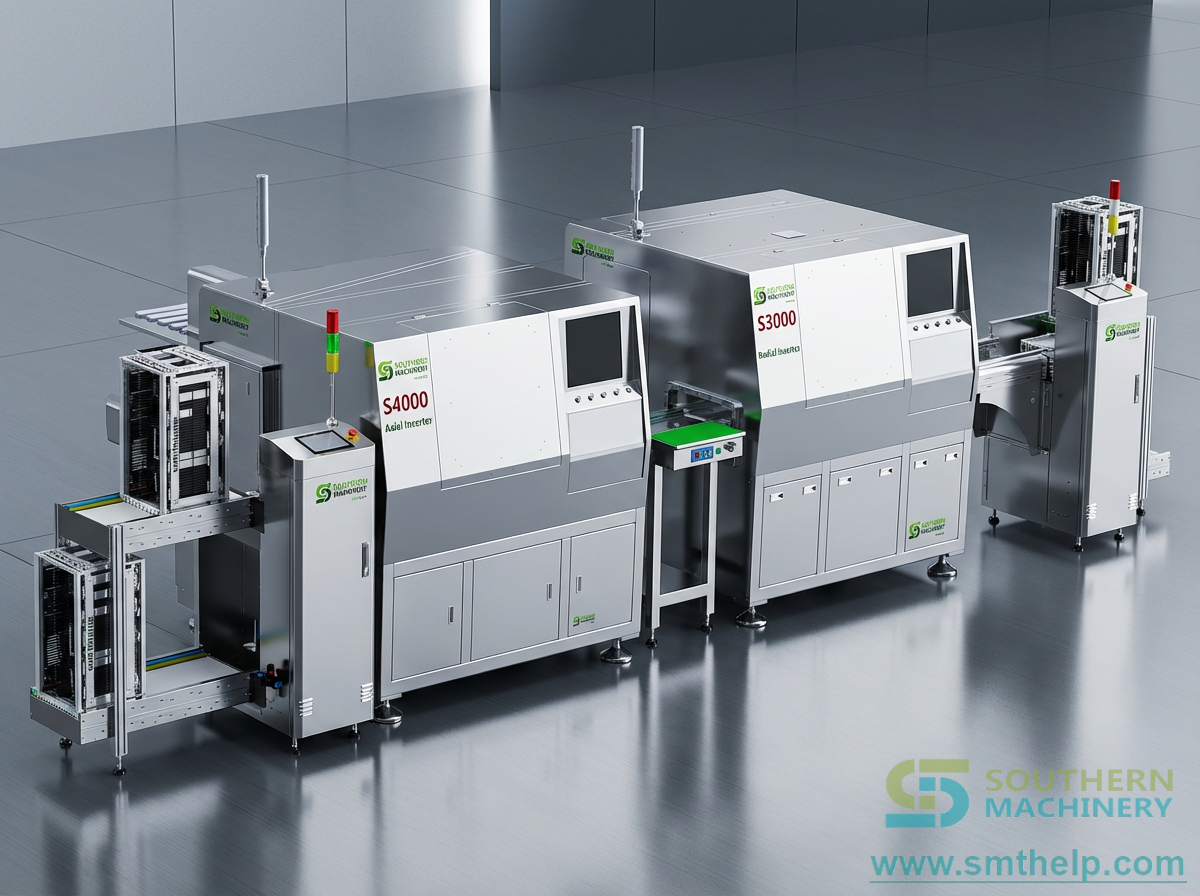
The S-4000 Axial Insertion Machine from Southern Machinery is designed to transform this process into a repeatable, automated THT workflow. According to the product specifications, the machine supports high-speed axial insertion, PCB loader integration, configurable feeding, lead clinching, and smart factory connectivity.
Southern Machinery, founded in Shenzhen in 2011, provides SMT and THT PCB assembly automation equipment for global EMS, ODM, automotive electronics, medical electronics, industrial control, and power electronics manufacturers. Our value extends beyond a single machine to a complete line approach: SMT, THT insertion, wave soldering, board handling, inspection, spare parts support, and professional training.
What Is This Machine Used For?
The S-4000 automatically inserts axial leaded components into printed circuit boards during the THT stage of PCB assembly.
Typical axial components include:
- Axial resistors
- Axial diodes
- Jumper wires or similar taped axial parts
- Other compatible axial components within the confirmed body size and lead pitch range
In a real factory, this machine is useful when the product still requires through-hole axial parts but manual insertion is too slow, inconsistent, or difficult to scale. For example, a power supply line may already use SMT placement for chips and capacitors while axial resistors are still inserted by operators before wave soldering. The S-4000 helps convert that manual station into an automated, controlled insertion process.
Why Axial Insertion Automation Matters
THT automation is often justified by three practical issues: labor stability, quality repeatability, and line balance.
Manual insertion can work for prototype or very low-volume production. But as output rises, the same manual process introduces variation in insertion angle, lead forming, missing parts, wrong orientation, and operator fatigue. These small issues create rework before wave soldering or defects after soldering.
The product specifications position the S-4000 around three core benefits:
- Higher insertion speed: up to 20,000 CPH, depending on configuration and final technical confirmation.
- Repeatable insertion and clinching: designed to control component position and lead forming more consistently than manual work.
- Smart factory integration: SMEMA communication, optional MES connectivity, and production data logging.
This makes the machine relevant for factories that want to reduce manual dependence without redesigning every product to SMT.
Key Specifications from the Source Page
The following data comes from the product documentation. Final selection should always be confirmed against the actual PCB, component drawings, feeder configuration, and factory layout.
| Parameter | Source specification |
|---|---:|
| Insertion speed | Up to 20,000 CPH, depending on configuration |
| PCB size range | 50 x 50 mm to 460 x 460 mm, customizable |
| Component body length | 3.0 mm to 20.0 mm |
| Component body diameter | 1.6 mm to 6.0 mm |
| Lead pitch | 10.0 mm to 25.0 mm, 2.5 mm step |
| Insertion accuracy | +/-0.1 mm |
| Clinching type | Full clinch / half clinch, IPC-A-610 compliant as stated |
| Feeder capacity | Up to 60 feeders, expandable |
| Power supply | AC 220V, 50-60Hz, single phase |
| Air supply | 0.5-0.7 MPa, 150 L/min |
| Machine dimensions | 1,200 mm L x 1,450 mm W x 1,500 mm H |
| Weight | Approx. 850 kg |

Typical Application Scenarios
Power Electronics and LED Drivers
Power boards often combine SMT parts with axial resistors, diodes, transformers, connectors, and other THT components. If axial parts are inserted manually, the THT area can slow down the entire line. The S-4000 helps stabilize the axial component stage before wave soldering.
Automotive and Industrial Control Boards
Automotive and industrial electronics prioritize repeatability, traceability, and controlled process flow. Automated axial insertion supports more consistent lead forming and reduces operator-to-operator variation.
EMS Factories with Mixed SMT and THT Work
Many EMS factories cannot eliminate THT parts because customers require through-hole strength, high current capability, or legacy product designs. In such cases, automation should focus on the repeatable, high-volume THT parts first. Axial insertion is often a good starting point.
How the S-4000 Fits into a Complete PCB Assembly Line
Southern Machinery evaluates the entire process, not just one station. A practical line can look like this:
SMT Section
- Magazine loader or PCB loader
- Automatic stencil printer
- SPI if solder paste quality control is required
- Pick-and-place machine for SMT components
- Reflow oven
- Post-reflow AOI if required by the quality target
THT Insertion Section
- Board buffer or loader after SMT
- S-4000 axial insertion machine for compatible axial parts
- Radial insertion or odd-form insertion if the product also uses radial capacitors, connectors, terminals, relays, or other special components
- Manual assist station only for components that are not economical to automate
Soldering and Inspection Section
- Wave soldering or selective soldering, depending on PCB design and component clearance
- Cooling conveyor and board handling
- THT AOI or visual inspection
- ICT/FCT test station if required
- Unloader, buffer, or OK/NG sorting

For a buyer, this line-level thinking is critical. A fast insertion machine alone will not solve the problem if the board loader, feeder preparation, wave soldering capacity, or inspection station cannot keep up.
Selection Checklist for Buyers
Before finalizing the S-4000 configuration, confirm these points:
- PCB size range, thickness, panelization, and maximum board weight
- Axial component body length, diameter, lead pitch, and tape packaging
- Number of axial part types per product and expected changeover frequency
- Required insertion direction, polarity handling, and lead clinching style
- Monthly output target, shifts per day, and working days per month
- Whether radial insertion, odd-form insertion, or manual assist stations are also needed
- Wave soldering or selective soldering process after insertion
- MES, barcode, traceability, and production data requirements
- Available floor space, compressed air, power, and board handling direction
If your board has several axial parts but frequent product changes, feeder setup and changeover workflow may be just as important as peak CPH. If your production is high-volume and stable, feeder capacity and line balance become the key decision points.
ROI, Quality, and Capacity Value
The product page presents the S-4000 as a way to reduce dependence on a manual insertion team and improve output consistency. In practical terms, the value usually comes from:
- Fewer operators required for repetitive axial insertion work
- More stable insertion angle and lead forming
- Less fatigue-related variation during long production runs
- Better line balance before wave soldering
- Easier standardization for multi-shift production
- Data and connectivity options for smart factory control
Any ROI calculation should be based on your actual labor cost, product mix, shifts, takt time, reject rate, and machine configuration. For an accurate payback estimate, compare the current manual process against the proposed automated flow using real production data.
Why Work with Southern Machinery
Southern Machinery is a Shenzhen-based manufacturer founded in 2011. We support more than standalone equipment supply; we help customers plan complete PCB assembly automation lines, including:
- SMT line equipment
- THT axial, radial, and odd-form insertion
- Wave soldering and selective soldering
- Board handling conveyors, loaders, unloaders, buffers, and inverters
- Inspection and traceability options
- Spare parts support, training, and remote service
For global EMS and OEM factories, this one-stop approach reduces integration risk. The goal is a high-efficiency and cost-effective line that fits the product, not an oversized machine that looks good on paper but doesn't match the actual production mix.
FAQ
1. Can the S-4000 replace all manual THT insertion?
Not always. It is designed for compatible axial leaded components. If your board also uses radial capacitors, connectors, relays, terminals, transformers, or odd-form parts, you may need radial insertion, odd-form insertion, or a manual assist station as part of the complete line.
2. Is 20,000 CPH guaranteed for every product?
No. The product page lists up to 20,000 CPH, but real output depends on PCB layout, component mix, feeder setup, insertion sequence, board handling, and downtime. Final capacity should be confirmed through a line configuration review.
3. What PCB size can the machine handle?
The product page lists 50 x 50 mm to 460 x 460 mm, with customization available. The final usable range should be checked against PCB thickness, panelization, fixture needs, and line direction.
4. Can it connect with other equipment in the line?
The product page mentions SMEMA communication, optional MES connectivity, and production data logging. For a real project, Southern Machinery would confirm the exact interface requirements with your factory system.
5. Should I use wave soldering or selective soldering after axial insertion?
It depends on PCB design, thermal mass, component clearance, masking, production volume, and quality requirements. High-volume THT boards often use wave soldering, while more selective or mixed boards may need selective soldering.
6. What information is needed for a quotation?
Please share PCB size, product photos, BOM or axial component list, monthly output target, shift schedule, current manual process, and whether you need SMT, radial insertion, odd-form insertion, wave soldering, inspection, or board handling equipment.
CTA: Build a Practical THT Automation Plan
If axial component insertion is slowing down your PCB assembly line, Southern Machinery can help review your product and propose a practical automation path.
Send us your PCB size, axial component list, production target, and current process. We can match the closest S-4000 configuration and, if needed, design the surrounding SMT, THT, wave soldering, board handling, and inspection equipment as one complete line.
Comments