
S-4000 Axial Insertion Machine for THT Automation by Southern Machinery
For EMS and ODM factories still inserting axial components by hand, the S-4000 Axial Insertion Machine by Southern Machinery offers a practical path to more stable THT production. According to the source landing page, th
Jul 4, 2026 · Updated Jul 4, 2026 · Southern Machinery

S-4000 Axial Insertion Machine for THT Automation by Southern Machinery
Manual axial component insertion is still common in power electronics, industrial control boards, lighting products, automotive electronics, and mixed-technology PCB assembly. It works for low volumes, but it becomes a real bottleneck when the same resistor, diode, jumper, fuse, or other axial component must be inserted across thousands of boards.
The S-4000 Axial Insertion Machine by Southern Machinery is designed to automate axial component insertion in smart EMS factories. The source landing page presents it as a high-speed THT automation solution with PCB loader integration, 3D engineering review, video process references, and resource links for catalog, operation manual, and manual-to-auto insertion ROI study.
Southern Machinery, founded in Shenzhen, China in 2011, focuses on high-efficiency, cost-effective SMT/THT PCB assembly automation equipment. This includes SMT lines, THT insertion, wave soldering, board handling, inspection options, feeder/nozzle customization, training, spare parts support, and global service for 237+ customers.
What is this machine used for?
The S-4000 is used to automate the insertion of axial leaded components into PCBs during the THT section of a PCB assembly line.
In simple terms, it replaces repetitive manual insertion work for components supplied in axial tape format. The machine is especially relevant when a factory has stable product families, repeated axial parts, and enough volume to justify automatic feeding, cutting, forming, insertion, and downstream soldering integration.
Typical axial component examples include:
- Axial resistors
- Diodes
- Jumpers
- Small fuses
- Other two-lead axial components, depending on final feeder and forming confirmation
Final component compatibility should be checked against the actual component body, lead diameter, tape format, pitch, forming requirement, PCB hole size, and insertion direction.
Where it fits in a complete PCB assembly line
The S-4000 is not just a standalone machine. For a production buyer, the important question is how it connects to the full process.
A practical line flow can look like this:
- Upstream SMT process: stencil printing, pick-and-place, reflow, and AOI if the board has SMT components.
- PCB loader or buffer: prepares boards for the THT insertion section.
- S-4000 axial insertion: inserts axial components automatically with the required forming and insertion process.
- Radial or odd-form insertion if needed: added when the board also has radial capacitors, connectors, terminals, or other non-axial THT parts.
- Manual assist station: used only for parts that do not justify automation.
- Wave soldering or selective soldering: selected according to board design, component clearance, thermal mass, and soldering quality target.
- THT AOI / visual inspection / ICT or FCT: added according to quality requirements.
- Board handling: loaders, conveyors, buffers, unloaders, NG/OK sorting, and traceability options.
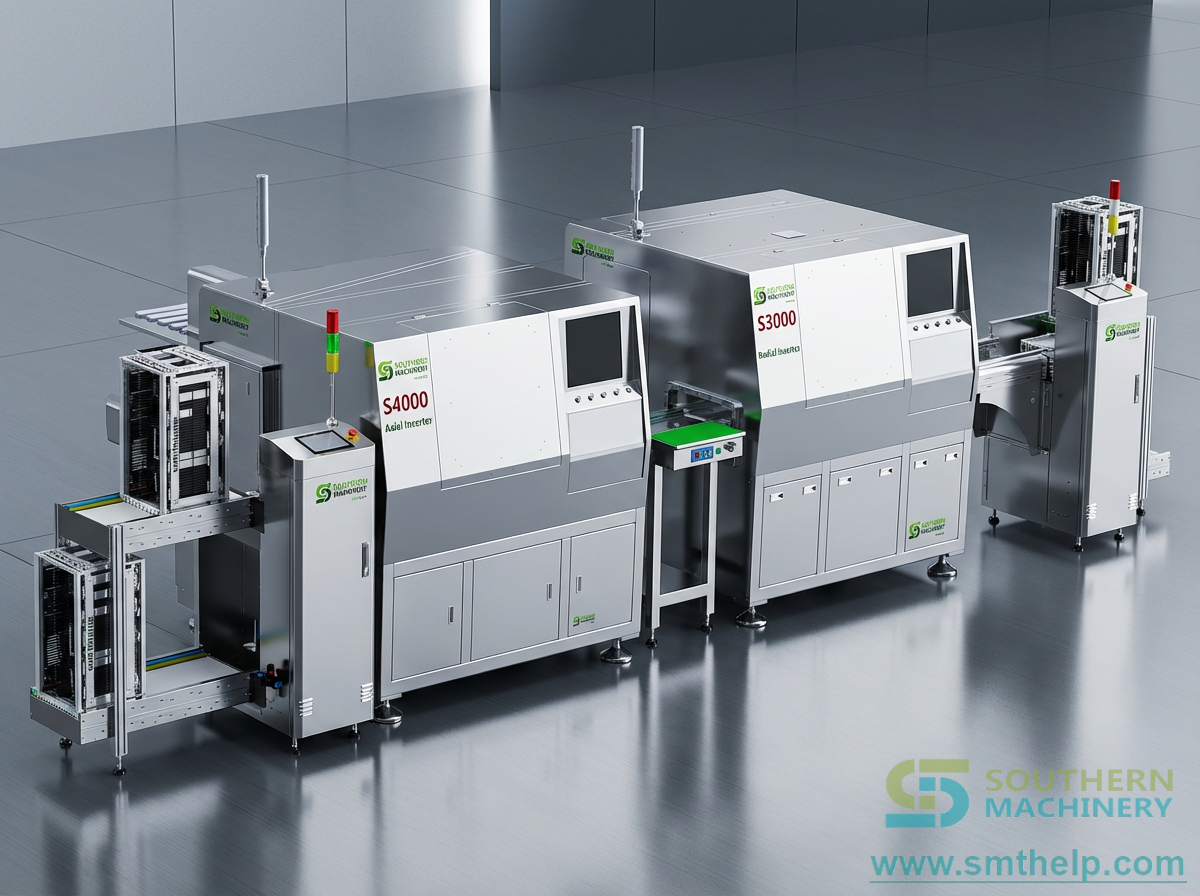
For factories already running manual THT insertion, this is often the biggest improvement: the axial insertion step becomes repeatable, easier to balance, and easier to connect with wave soldering.
Why EMS factories consider axial insertion automation
1. Manual insertion is difficult to scale
Manual THT work depends heavily on operator skill, shift discipline, component picking accuracy, and fatigue. Even when the workers are experienced, output can vary between operators and shifts.
The source page positions the S-4000 as a way to replace repetitive manual work with stable automated insertion. Any labor-saving or ROI number should be treated as configuration-dependent and confirmed with the real board, component count, shift pattern, and current labor cost.
2. Repeatability matters before soldering
Wave soldering and selective soldering cannot fully fix poor insertion quality. If components are misinserted, tilted, reversed, missing, or poorly formed, defects move downstream.
Automating the axial insertion step can help stabilize:
- Component orientation
- Lead forming consistency
- Insertion position
- Board-to-board repeatability
- Operator-independent process control
3. The THT section can be connected to smart factory workflows
The source page highlights MES / Industry 4.0 connectivity, remote monitoring, and smart factory readiness. The exact connectivity scope should be confirmed during technical configuration, but the direction is clear: THT insertion should not remain an isolated manual island when the SMT side is already automated.
Key buyer questions before selecting the S-4000 configuration
Before quoting or finalizing a line, Southern Machinery would confirm these points:
PCB and panel information
- Maximum and minimum PCB size
- Board thickness
- Panelization method
- Hole diameter and tolerance
- Component insertion side
- Clearance around axial components
Axial component details
- Component type and body size
- Lead diameter and lead length
- Tape format and reel condition
- Required pitch and forming style
- Polarity requirement, if applicable
- Number of axial components per board
Production target
- Boards per hour, per shift, or per month
- Working days per month
- Hours per shift and number of shifts
- Target utilization rate
- Future product or volume growth
Downstream process
- Wave soldering or selective soldering
- Fixture requirement
- Preheat and thermal mass concerns
- Inspection method after soldering
- Traceability and MES needs
Technical resources mentioned in the source page
The source page includes several useful engineering resources for buyer evaluation:
- Interactive 3D model for engineering review
- Video references showing axial insertion operation and line integration
- S-4000 machine catalog link
- Operation manual link
- Manual-to-auto insertion ROI analysis link
These resources are useful during early project discussion because they help manufacturing engineers check footprint, line access, feeder layout, operator workflow, and maintenance approach before committing to a final configuration.

ROI, quality, and capacity value
A realistic automation decision should not rely on one marketing number. For THT axial insertion, the business case normally comes from several combined savings:
- Fewer operators assigned to repetitive axial insertion
- More stable output per shift
- Lower risk of missed or wrong insertion
- Less rework before soldering
- Easier line balancing with downstream soldering
- Better process visibility when connected to traceability or MES systems
The source page states that one S-4000 can replace multiple experienced operators and run continuously. That should be treated as an application example, not a universal guarantee. The real result depends on the number of axial parts per board, component supply format, current manual process, operator cost, required takt time, and final automation scope.
When the S-4000 is a good fit
The S-4000 is most suitable when:
- Axial components repeat across many boards
- Manual axial insertion is a bottleneck
- Product families have stable THT layouts
- The factory wants to connect THT insertion with wave soldering
- Quality variation from manual work is causing rework or inspection pressure
- The buyer wants a scalable THT automation roadmap instead of a single isolated machine
It may be overkill for very low-volume, prototype-only, or constantly changing builds where manual insertion remains more flexible and economical.
How Southern Machinery would build the full solution
Southern Machinery can configure the S-4000 as part of a complete PCB assembly automation project, not only as a single machine purchase.
A typical THT-focused proposal may include:
- S-4000 axial insertion machine
- PCB loader and conveyor connection
- Radial insertion machine if radial components are also used
- Odd-form insertion or manual assist stations for connectors and special parts
- Wave soldering or selective soldering according to board design
- THT inspection station
- Board handling, buffering, and unloading
- Spare parts, training, installation guidance, and remote support
For mixed SMT + THT factories, we can also connect this with upstream SMT equipment, including printer, pick-and-place, reflow oven, AOI, board handling, and traceability options.

FAQ
Is the S-4000 only for axial components?
Yes, the source document presents the S-4000 as an axial insertion machine. If your PCB also has radial capacitors, connectors, transformers, terminals, or other odd-form THT parts, Southern Machinery can review whether radial insertion, odd-form insertion, manual assist, or custom feeding is needed.
Can it connect with a PCB loader?
Yes. The source page specifically shows the S-4000 with loader-related images and mentions PCB loader integration. Final conveyor height, board size range, flow direction, and buffer design should be confirmed during line layout.
Does it support smart factory or MES integration?
The source page positions the machine as smart-factory ready with MES / Industry 4.0 connectivity and remote monitoring. The exact data interface and traceability scope should be confirmed before quoting.
Can it replace manual operators?
It can reduce repetitive manual axial insertion work, but the real labor saving depends on your component count, product mix, working hours, current manual process, and line balance. Southern Machinery can calculate a practical ROI estimate after reviewing your PCB and production target.
What information is needed for a quotation?
Please prepare PCB size, board thickness, axial component list, photos or drawings, insertion quantity per board, output target, downstream soldering method, and preferred automation level. With this, we can match the closest Southern Machinery configuration.
Should I choose wave soldering or selective soldering after axial insertion?
For many THT boards, wave soldering is efficient and cost-effective. Selective soldering may be better when there are SMT components close to THT joints, high-mix production, or areas that cannot be exposed to a full solder wave. The decision depends on PCB design and quality requirements.
CTA: send your axial component list for line matching
If axial insertion is slowing down your THT process, send Southern Machinery your PCB size, axial component list, target output, and current manual workflow. We can help you decide whether the S-4000 should be used as a standalone upgrade or as part of a complete SMT + THT + soldering + board handling line.
A practical configuration review is usually more useful than a generic machine quote. The right answer depends on your board, components, soldering process, labor cost, and future production plan.
Comments