
S380A PCB Separator Router Machine by Southern Machinery
The S380A PCB Separator Router Machine by Southern Machinery helps EMS, ODM, automotive, medical, and industrial electronics factories move from manual or high-stress depaneling to automated, vision-guided PCB routing. With CCD visual programming, double Y-axis table work, high-speed spindle routing, and configuration-dependent tool management, it supports stable quality, labor reduction, and smoother integration into complete SMT, THT, wave soldering, inspection, and board handling lines.
Jul 20, 2026 · Updated Jul 20, 2026 · Southern Machinery
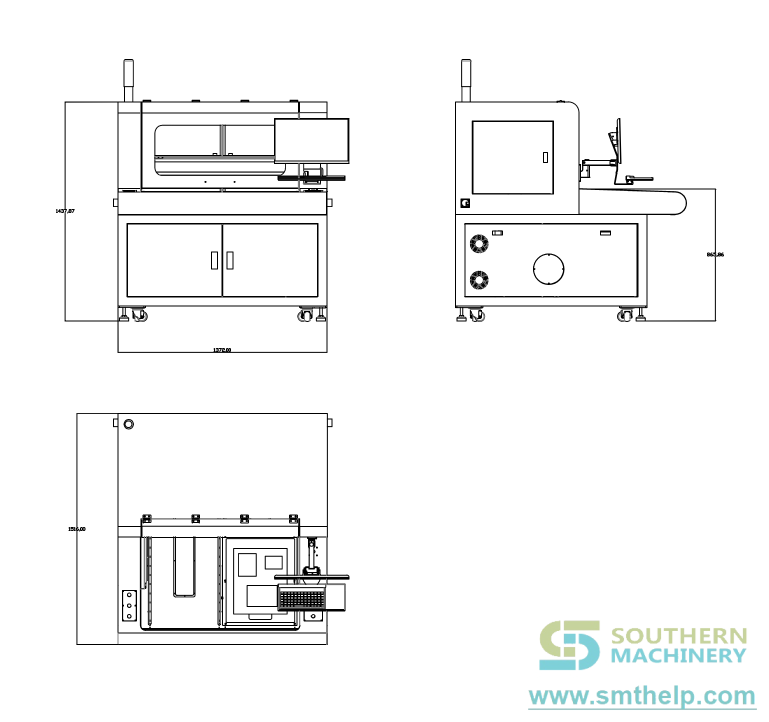
S380A PCB Separator Router Machine by Southern Machinery
For EMS, ODM, automotive electronics, medical electronics, and industrial control factories, depaneling is often a quiet bottleneck. The SMT line may place and solder accurately, but if boards are separated with too much mechanical stress, solder joints, nearby components, and final product reliability can suffer. The S380A PCB Separator Router Machine by Southern Machinery is designed for automated, vision-guided PCB depaneling with low-stress routing, simplified programming, and double-table operation.
Southern Machinery, founded in Shenzhen in 2011, focuses on cost-effective SMT and THT PCB assembly automation equipment. For factories planning a complete line, we can connect depaneling with upstream SMT, THT insertion, wave soldering, board handling, inspection, and test processes instead of treating it as a standalone machine.
What is this machine used for?
The S380A is used to separate PCB panels into individual boards after assembly, especially when the panel has complex shapes, dense components, stamp holes, V-slots, or designs that are not ideal for manual breaking or simple V-cut separation.
In practical terms, it helps factories move from operator-dependent depaneling to a more controlled process. The goal is not only faster separation; it is also lower cutting stress, fewer damaged boards, easier programming, and more stable quality for products where hidden mechanical damage can become a real field risk.
Why factories look beyond manual or basic V-cut depaneling
Manual board breaking and older depaneling methods can still work for simple, low-value boards. But they become a weak point when your products use thin PCBs, components close to the cutting edge, high-density layouts, or boards for automotive, medical, power electronics, and industrial controls.
Typical risks include:
- Mechanical stress near solder joints and components
- Micro-cracks or hidden damage that inspection may not catch immediately
- Slow changeover when operators need to handle different panel designs
- Unstable output when quality depends too heavily on manual skill
- Limited ability to handle arcs, circles, L-shaped boards, U-shaped boards, stamp-hole panels, and V-slot models
The S380A addresses these issues with visual programming, high-speed spindle routing, double Y-axis table work, and tool monitoring functions described in the source product document.
Core S380A capabilities
Full-vision programming
The source document describes the S380A as a full-vision curve splitter with CCD visual programming. Technicians can draw straight lines and arcs on the PCB image to create the cutting path. This is useful when a factory handles many product types and wants to reduce editing and debugging time during changeover.
Low-stress high-speed routing
The S380A uses a high-speed spindle listed at 20,000-60,000 rpm. Routing is suitable for PCB boards of many shapes and helps reduce the mechanical stress associated with manual breaking or unsuitable cutting methods.
Double Y-axis table operation
The machine uses two independent Y axes, Y1 and Y2. This allows one side to process while the operator or automation prepares the next PCB, or it can support two different products depending on fixture and production setup. For medium-volume and high-mix factories, this matters because idle time often costs more than the cutting cycle itself.
Tool management functions
The document lists automatic tool change on the Q380A configuration, broken tool detection, and automatic tool height correction after tool change. These functions help reduce downtime and avoid quality problems caused by tool wear or tool failure. Final availability should be confirmed against the selected configuration.
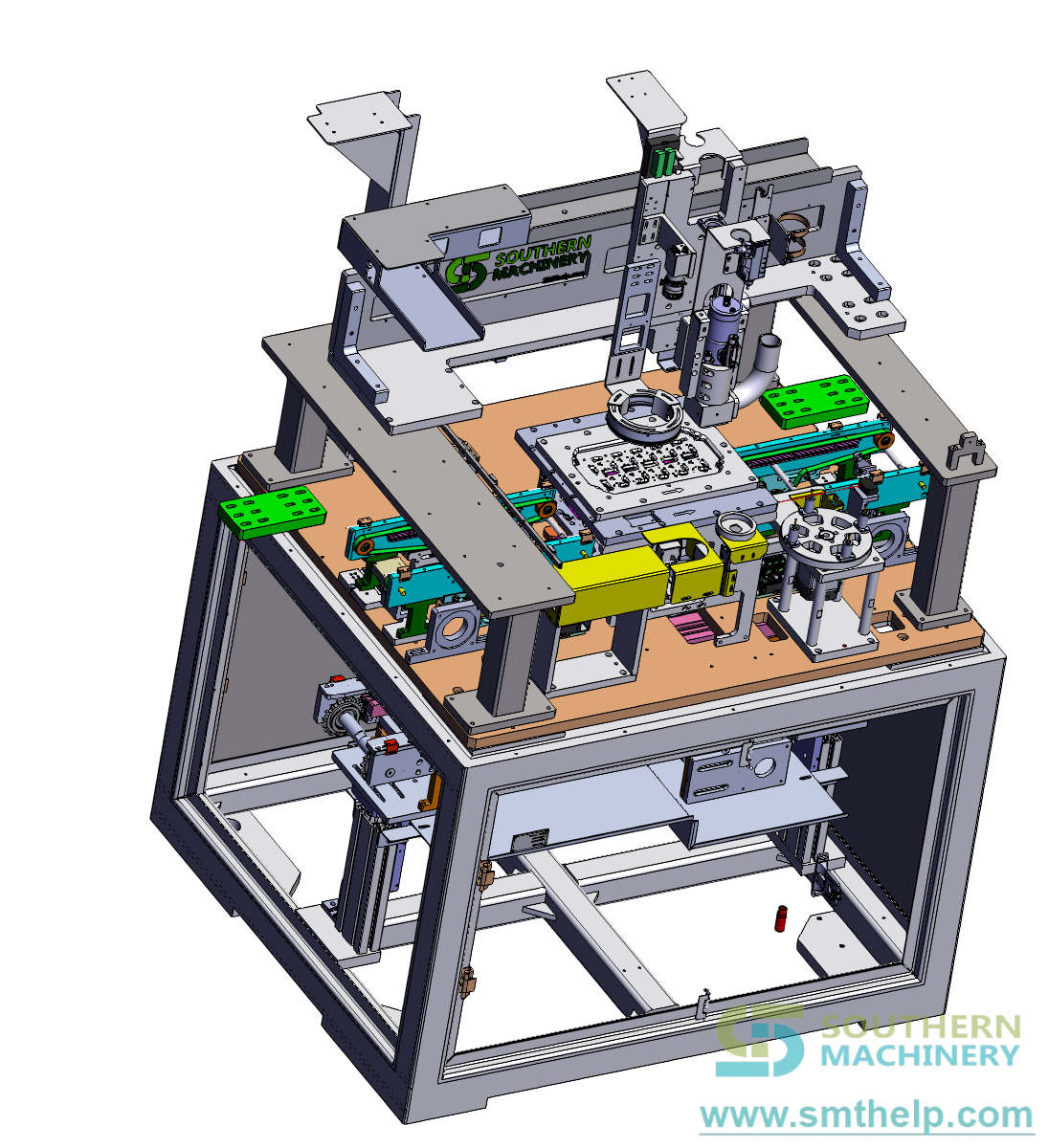
Key selection parameters from the source document
Use these figures as the starting point for technical evaluation. Final configuration should be confirmed based on your PCB drawing, panel design, fixture, tooling, dust collection setup, and site utilities.
| Item | Source document value |
|---|---:|
| Machine repetition accuracy | +/-0.01 mm |
| Cutting accuracy | +/-0.02 mm |
| Cutting speed | 5-100 mm/s adjustable |
| Effective cutting size | 350 x 550 mm |
| Machinable working stroke | L350 x W330 mm |
| PCB thickness range | 0.3-3 mm |
| Milling cutter size | 0.8-3.0 mm |
| Separator power supply | AC220V 50/60Hz, 1 HP, 5 kW |
| Dust collector power supply | AC380V 50/60Hz, 3 HP, 3 kW |
| Host size / weight | L1230 x W1180 x H1350 mm / 800 kg |
| Dust collector size / weight | 665 x 635 x 1610 mm / 155 kg |
| Gas supply requirement | >4.5 kg/cm2 |
| Recommended ambient temperature | 10-30 C |
| Relative humidity | 35-80% |
| Minimum site dimensions | L2500 x W2500 x H2500 mm |
| Dust collection mode | Lower standard, top optional |
Typical application scenarios
High-mix EMS production
If your factory changes products often, visual programming and double-table work can reduce setup friction. A typical example is an EMS line building several industrial control boards in the same week, each with different panel outlines and component clearance zones.
Automotive and medical electronics
These products often need controlled stress and stable repeatability. The value of the S380A is strongest when reliability requirements make manual board breaking too risky, even if manual work appears cheaper at first glance.
Dense SMT boards with edge-near components
For compact consumer electronics, power modules, LED control boards, and controller PCBs, components may sit close to the routing path. A controlled spindle routing process gives process engineers more room to manage quality.
Complex panel shapes
The source document lists support for straight lines, arcs, circles, L-shaped boards, U-shaped boards, stamp-hole boards, and V-slot models. That flexibility is important when product designers cannot use a simple straight-line separation strategy.
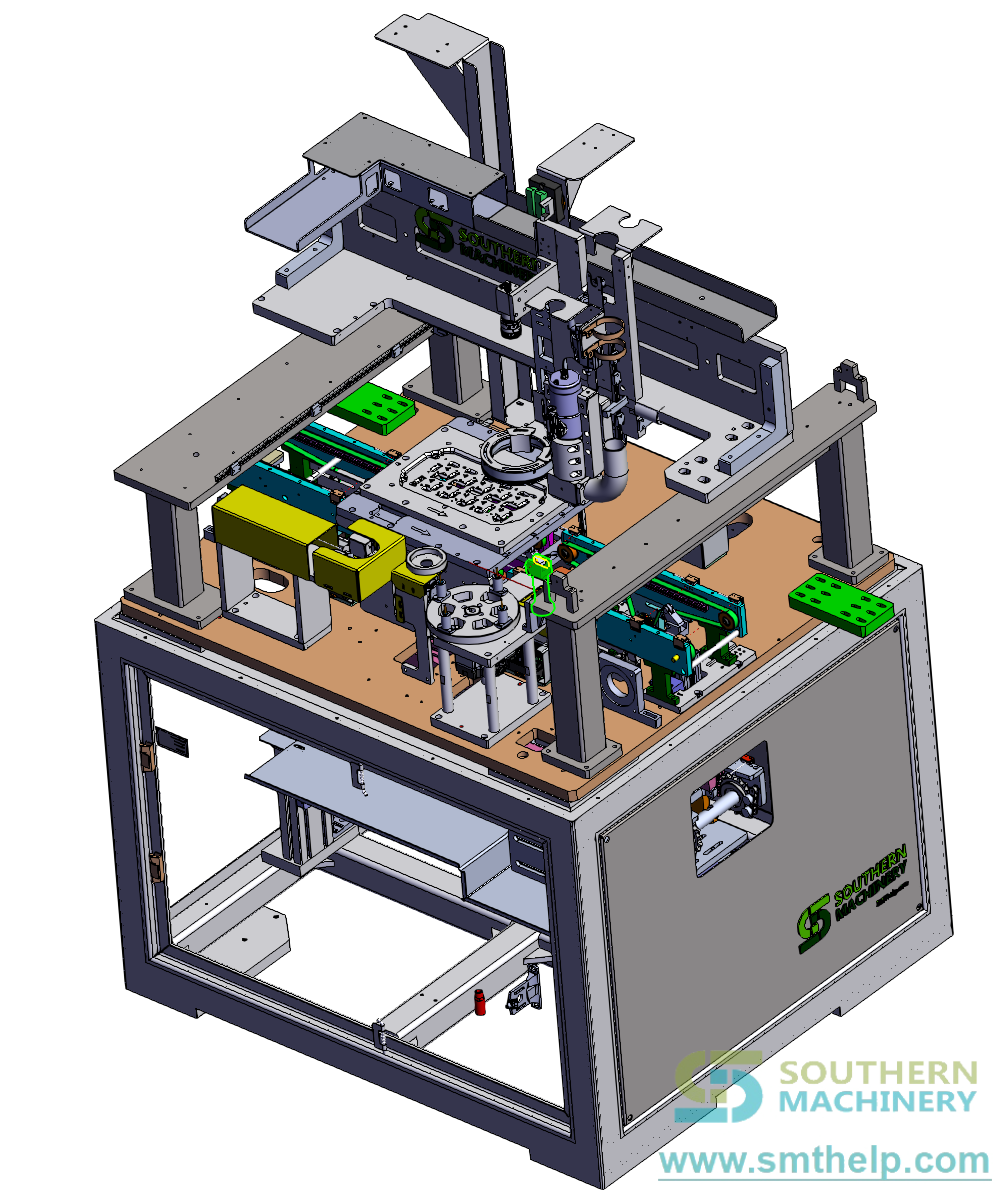
How it connects into a complete PCB assembly line
A depaneling machine should be selected as part of the full factory flow, not as an isolated machine.
SMT line connection
A typical SMT flow is: magazine loader, conveyor, automatic stencil printer, SPI if needed, pick-and-place, reflow oven, post-reflow AOI, buffer, then depaneling depending on whether the product is separated before or after downstream testing.
For high-quality production, the S380A can sit after SMT inspection or after functional test, depending on whether test fixtures require panels or single boards.
THT and wave soldering connection
For mixed SMT + THT products, the board may continue after SMT into manual insertion, automatic insertion, selective soldering, or wave soldering. Depaneling usually comes after soldering and inspection, when the product is ready to become individual PCBs or modules.
Southern Machinery can support the wider line layout: THT insertion equipment, wave soldering, selective soldering, PCB loaders, unloaders, buffers, conveyors, PCB inverters, inspection stations, and process handoff points.
Dust collection and fixture planning
PCB routing creates dust, so dust collector configuration and fixture design are part of the project. The source document lists lower dust collection as standard and top dust collection as optional. We would confirm this based on board material, panel routing path, and factory cleanliness requirements.
ROI, quality, and capacity value
The strongest ROI argument for an automated PCB router is usually a combination of labor reduction, lower scrap, fewer rework events, and more stable output. Exact ROI depends on your board value, labor cost, panel design, defect history, and daily output, so it should be calculated from your actual factory data.
For example, if a factory currently uses manual breaking on high-value boards and sees edge damage or intermittent solder joint failures, the cost of one quality escape can be much higher than the visible labor cost. In that case, controlled low-stress depaneling is a process insurance decision as much as an automation decision.
For lower-volume, simple boards, a fully automated router may be more than you need. In that case, Southern Machinery can also review whether a simpler separator, semi-automatic option, or outsourced fixture strategy is more cost-effective.
Buyer checklist before selecting the S380A
Before final model confirmation, prepare these details:
- PCB panel size and single board outline
- Board thickness and material
- Component clearance near the cutting path
- Panel connection type: tabs, stamp holes, V-slots, or mixed design
- Required output per shift
- Whether boards arrive as panels after SMT, after THT, after wave soldering, or after test
- Dust collection preference and factory cleanliness requirements
- Need for automatic tool change, broken tool detection, and top dust collection
- Fixture quantity needed for current and future products
- Traceability or MES data requirements, if any
Why work with Southern Machinery
Southern Machinery has manufactured SMT and THT PCB assembly automation equipment from Shenzhen since 2011 and serves 237+ global customers. The practical advantage is line-level thinking: we do not only quote one machine, we help match the depaneling process with SMT placement, reflow, THT insertion, wave soldering, board handling, inspection, and final test.
That matters when your factory wants high efficiency at a cost-effective investment level. You get a configuration designed around your actual PCB, output target, labor structure, and future expansion plan, with global service, spare parts support, and professional training available for overseas buyers.
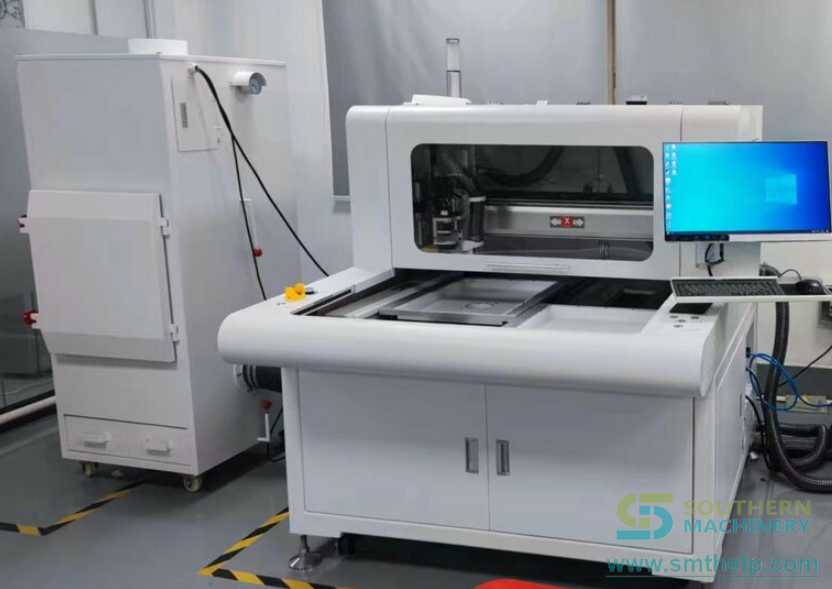
FAQ
Is the S380A only for SMT boards?
No. It can be used in SMT-only lines or mixed SMT + THT assembly flows. The right position depends on your soldering, inspection, and test process.
Can it handle complex board shapes?
Yes, the source document lists straight lines, arcs, circles, L-shaped boards, U-shaped boards, stamp-hole boards, and V-slot models. We still need your panel drawing to confirm fixture and routing feasibility.
What accuracy should we use for planning?
The source document lists machine repetition accuracy of +/-0.01 mm and cutting accuracy of +/-0.02 mm. Final confirmation should be made with your board sample, fixture design, and process acceptance criteria.
Do we need a dust collector?
Yes. PCB routing creates dust. The source document includes a separate dust collector and notes lower dust collection as standard, with top dust collection optional.
Is automatic tool change included?
The source document mentions automatic tool change on the Q380A configuration. We should confirm the selected configuration before quotation.
What information is needed for a quotation?
Please send the PCB panel drawing, board thickness, target output per shift, component clearance near the cutting path, preferred automation level, and whether depaneling happens before or after test.
CTA: send your PCB panel drawing
If you are reviewing PCB depaneling for a new SMT/THT line or upgrading an existing manual process, send Southern Machinery your PCB panel drawing, board thickness, production volume, and current separation method. We will match the right PCB separator configuration and show how it fits into a complete PCB assembly automation line.
Comments