
S3010A Radial Insertion Machine: Training, Troubleshooting & Restart Protocols for PCB Assembly Lines
A practical guide to the S3010A radial insertion machine — covering common failure modes, restart procedures, and integration tips for THT PCB assembly lines.
Aug 12, 2026 · Updated Aug 12, 2026 · Southern Machinery
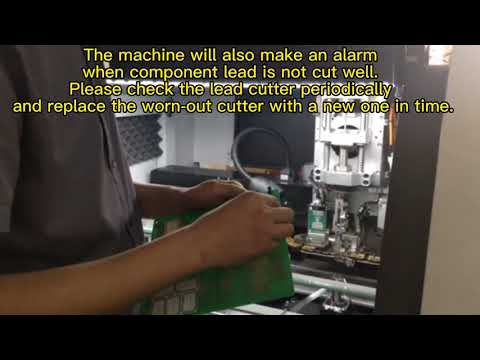
What Is the S3010A Radial Insertion Machine?
The S3010A is a radial lead component insertion machine designed for through-hole (THT) PCB assembly. It automates the insertion of radial components — such as capacitors, resistors, and inductors with two axial leads — into printed circuit boards, replacing manual placement and reducing insertion defects.
The S3010A handles a wide range of radial component body styles and lead spans, making it a versatile solution for production lines serving power electronics, consumer appliances, LED drivers, and automotive PCB assemblies.
---
Typical Application Scenarios
The S3010A fits into several production contexts:
- High-volume consumer electronics — air conditioners, washing machine control boards, microwave and induction cooker PCBs where radial components dominate BOMs
- Power supply manufacturing — vehicle power supplies, LED drivers, and energy-saving power supplies requiring consistent lead insertion and clinching
- LED lighting control boards — stable, repeatable insertion for components subject to thermal cycling
- General electronics — instruments, spare parts, and watches where batch sizes range from medium to high
---
Integrating the S3010A into a THT Assembly Line
A typical THT line flow with the S3010A looks like:
- Wave pre-heating zone — PCB enters pre-heating
- S3010A radial insertion — components inserted and lead clinched in one pass
- Odd-form insertion (if needed) — separate odd-form or mixed-lead machines for non-standard parts
- Wave soldering — solder joint formation
- Cleaning and inspection — post-solder cleaning and AOI
Key integration considerations:
- Ensure consistent lead cut length and clinching force settings match your PCB thickness and hole tolerance
- Calibrate component detection sensors to avoid mis-insertion on marginal lead spans
- Configure feeder indexing for your specific component pitch and body diameter range
- Allow sufficient lead clinch clearance at the outfeed edge to prevent board handling jams
---
Common Technical Failures and Restart Procedures
Based on the S3010A training curriculum, these are the most frequently encountered failure modes:
1. Component Misdetection
Symptom: Machine reports no component at insertion head despite feeder advancing.
Cause: Dust or flux residue on optical sensor, incorrect sensor threshold setting.
Restart: Clean sensor with IPA, recalibrate detection sensitivity, run test insertion cycle.
2. Lead Clinch Failure
Symptom: Leads not bent adequately after insertion; boards show potential pushback.
Cause: Worn clinch tool, incorrect clinch pressure setting for lead gauge.
Restart: Inspect and replace clinch tool if worn, reset pressure to PCB-specific parameter.
3. Feeder Indexing Error
Symptom: Component not presented at correct height; insertion head strikes component body.
Cause: Feeder wear, incorrect step pitch for the component's lead span.
Restart: Verify feeder pitch setting matches component spec, lubricate feeder rails, re-run calibration.
4. Board Clamping Slip
Symptom: PCB shifts during insertion; misaligned holes result.
Cause: Worn or contaminated clamp pads, insufficient clamping pressure.
Restart: Replace clamp pads, adjust clamping force to suit PCB thickness.
5. Insertion Speed Degradation
Symptom: Cycle time increases without load change.
Cause: Lubrication points not serviced, linear guide wear.
Restart: Perform scheduled lubrication, inspect linear guides and replace if play is detected.
---
Key Selection Criteria for Radial Insertion Equipment
When evaluating any radial insertion machine for your line, these are the verifiable factors:
| Criterion | What to Verify |
|-----------|---------------|
| Component range | Minimum/maximum body diameter, lead span range supported |
| Insertion rate | Components per hour (varies by component type and setup) |
| Lead cut length | Adjustable range and repeatability |
| Clinching | Force and angle adjustable, compatible with PCB thickness range |
| Feeder capacity | Number of stations, component changeover time |
| PCBA compatibility | PCB size range, hole diameter tolerance |
| Service footprint | Floor space, floor loading, accessibility for maintenance |
| Spare parts lead time | Availability of consumables (clinch tools, sensors, feeders) |
---
Why Automation Matters for Radial Insertion
Manual radial insertion is slow, ergonomically demanding, and produces inconsistent clinch quality. A dedicated machine like the S3010A:
- Reduces labor dependency — one operator can supervise multiple insertion points
- Improves first-pass yield — automated detection prevents mis-insertion before it reaches soldering
- Stabilizes solder joint quality — consistent lead protrusion and clinch geometry reduces solder defects
- Supports ESG compliance — reduced manual handling aligns with workplace safety goals
---
Frequently Asked Questions
What types of components can the S3010A insert?
Radial lead components with two axial leads — including electrolytic capacitors, film capacitors, resistors, inductors, and diodes. Body diameters typically range from 3mm to 12mm depending on feeder configuration.
What is the typical throughput of the S3010A?
Throughput depends on component type, board layout, and operator proficiency. Consult Southern Machinery's applications team with your BOM for a line capacity assessment.
Can the S3010A handle mixed lead spans on the same board?
Yes — by configuring feeder positions for each component type and sequencing the insertion program accordingly.
What maintenance is required daily?
Daily: visual inspection of lead sensors, verification of clinch tool condition, and confirmation of feeder cleanliness. Weekly: lubricate linear guides and verify calibration against a test board.
Does Southern Machinery offer installation and training?
Yes. Southern Machinery provides on-site installation, commissioning, operator training, and ongoing spare parts and technical support.
What PCB thickness range does the S3010A support?
The machine accommodates a range of PCB thicknesses through adjustable clamping force. Confirm your specific PCB thickness and hole diameter with Southern Machinery's applications team.
---
About Southern Machinery
Shenzhen Southern Machinery Sales And Service Co., Ltd has specialized in SMT and THT PCB assembly automation since 2011, serving 237+ clients across power electronics, LED lighting, consumer appliances, and automotive electronics worldwide.
The S3010A is part of a full line covering SMT placement, radial and odd-form insertion, wave soldering, board handling, and inspection — backed by spare parts, training, and field service support.
Ready to upgrade your radial insertion process?
Contact Kevin Yang at Southern Machinery:
📧 kevin@smthelp.com | 📞 +86 13602562576
🌐 https://www.smthelp.com
Comments