
S3010A Radial Insertion Machine for THT Automation by Southern Machinery
The S3010A Radial Insertion Machine from Southern Machinery is built for EMS and OEM factories looking to reduce manual through-hole insertion, stabilize radial component placement, and connect THT automation into a comp
Jul 3, 2026 · Updated Jul 3, 2026 · Southern Machinery
S3010A Radial Insertion Machine for THT Automation by Southern Machinery
For EMS, ODM, automotive electronics, medical electronics, and industrial control manufacturers, radial through-hole components are often one of the slowest manual steps in a mixed SMT and THT assembly line. The S3010A Radial Insertion Machine by Southern Machinery is designed for factories that want to automate radial component insertion, reduce operator dependence, and keep THT assembly in step with modern PCB assembly line speeds.
Southern Machinery, founded in Shenzhen in 2011, focuses on high-efficiency, cost-effective SMT/THT PCB assembly automation equipment. Our scope covers SMT lines, THT insertion, wave soldering, board handling, inspection, training, spare parts support, and complete line integration for electronics factories worldwide.
What is this machine used for?
The S3010A automatically inserts radial taped through-hole components into PCBs. Typical components include radial capacitors, LEDs, varistors, and similar two-lead parts supplied in tape format.
In practical factory terms, this machine is used when manual insertion creates bottlenecks, inconsistent insertion quality, or high labor dependence before wave soldering. Instead of assigning multiple operators to repetitive radial component insertion, the S3010A becomes a controlled insertion process within the THT section of a PCB assembly line.
Key Product Details From the Source Document
The local product page lists the following S3010A specifications. Final equipment configuration should still be confirmed against the actual PCB, component drawings, and production target.
| Item | Source Document Detail |
|---|---|
| Product type | S3010A Radial Insertion Machine |
| Stated real insertion rate | 12,000 CPH |
| Stated maximum speed | Up to 22,000 CPH |
| Stated reliability | Less than 1000 PPM |
| Component span | 2.5 mm to 10.0 mm |
| Maximum component height | 22 mm without derating |
| Maximum PCB size | 450 mm x 450 mm |
| Programming | Visual operating system with Gerber file import |
| Line integration | Automatic PCB loading and unloading can be integrated |
The source page also lists a very tight positioning accuracy value. Because that figure should be checked against the final machine specification sheet before any external technical commitment, this blog treats accuracy as a technical item requiring final confirmation rather than a guaranteed public claim.
Typical Application Scenarios
The S3010A is most useful where radial components appear repeatedly across medium- or high-volume boards.
Common applications include:
- LED driver and lighting control boards with radial capacitors, LEDs, and protection components.
- Power supplies and adapters where radial capacitors and varistors are inserted before wave soldering.
- Industrial control PCBs that combine SMT components with durable through-hole parts.
- Automotive electronics subassemblies where repeatability, traceability, and stable process control matter.
- Mixed-technology EMS production where manual THT insertion limits overall line output.
For low-volume, high-mix products, a manual assist station may still be sufficient. But once the same radial components appear in repeat orders, automatic insertion usually becomes easier to justify.
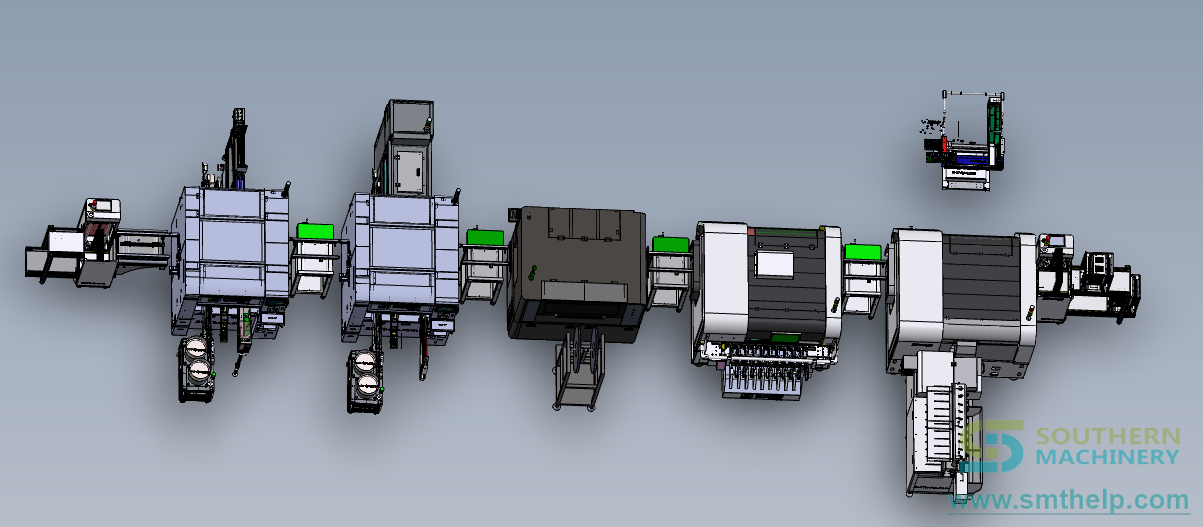
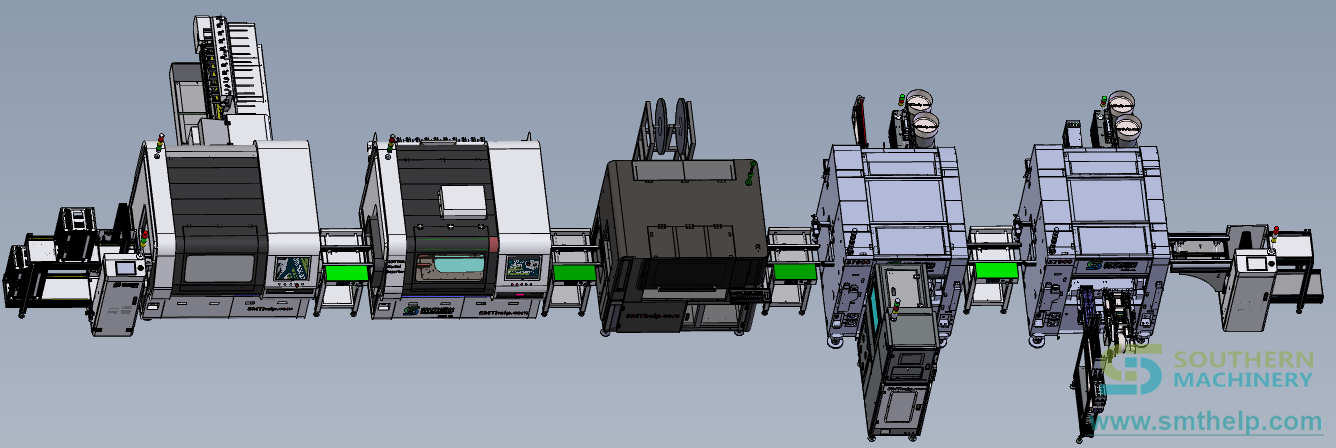
How the S3010A Fits Into a Complete PCB Assembly Line
Southern Machinery does not see the radial inserter as an isolated machine. Its value is greater when matched to the full line flow.
A typical mixed SMT/THT configuration can be:
- SMT section: loader, stencil printer, pick-and-place, reflow oven, and optional SPI/AOI.
- THT preparation: PCB buffer, barcode scan if traceability is required, and radial component preparation.
- S3010A radial insertion: automated insertion of radial taped components into the PCB.
- Other THT insertion: axial insertion, odd-form insertion, terminal insertion, or manual assist for low-volume special parts.
- Wave soldering or selective soldering: selected according to board design, thermal mass, and component restrictions.
- Inspection and test: THT AOI, visual inspection, ICT/FCT, and OK/NG handling if needed.

Why This Setup Improves Factory ROI
The ROI case is not just about speed. The more important value is process stability.
Manual radial insertion can be inconsistent when operators handle long shifts, mixed batches, similar-looking parts, or boards with dense THT areas. An automatic radial insertion machine helps standardize insertion depth, location, sequence, and handling method.
For a factory, that can mean:
- Fewer operators on repetitive insertion work.
- More stable output before wave soldering.
- Lower risk of wrong-part or missing-part insertion when the feeder setup and program are controlled.
- Better use of skilled workers for process control, inspection, and line improvement.
- Easier expansion from one radial insertion process to a broader THT automation line.
Any ROI example must be calculated from your actual labor cost, board cycle time, component count, workdays, and shift pattern. Southern Machinery can help estimate this after reviewing the PCB and target output.
Key Selection Parameters Before Buying
Before selecting the final S3010A configuration, buyers should confirm these points:
- PCB size and panel design: maximum length, width, thickness, warpage, and edge clearance.
- Radial component list: body size, lead pitch/span, lead diameter, height, polarity, and tape packaging.
- Insertion volume: boards per day or month, shifts per day, and expected utilization.
- Product mix: whether the machine will run one stable product or frequent changeovers.
- Downstream process: wave soldering, selective soldering, pallet use, and preheat requirements.
- Inspection needs: whether THT AOI, barcode traceability, or MES data connection is required.
- Factory layout: inline loader/unloader, buffer, conveyor height, and available floor space.
These details matter more than a generic machine brochure. A radial insertion machine that is well matched to the component package and board design will run more smoothly than one chosen only by headline speed.
Southern Machinery Integration Value
Southern Machinery can support the S3010A as part of a broader PCB assembly automation project, not just as a standalone machine purchase.
Our team can help match:
- SMT equipment for front-end assembly.
- Radial, axial, odd-form, and terminal insertion solutions for the THT section.
- Wave soldering or selective soldering according to the board design.
- Board handling equipment such as loaders, unloaders, buffers, inverters, and conveyors.
- Inspection and traceability options for quality control.
- Overseas installation guidance, operator training, remote support, spare parts, and long-term service.
This is especially important for smart EMS factories that want one coordinated solution instead of separate machines that do not communicate well on the line.
FAQ
Is the S3010A only for one PCB product?
No. It can be used for different PCB programs, but real efficiency depends on how often you change products and whether the radial component packages are compatible with the feeder and insertion setup.
Can it replace all manual THT insertion?
Not always. It targets radial taped components. If your board also has transformers, connectors, terminals, heatsinks, or odd-form parts, you may need axial insertion, odd-form insertion, terminal insertion, or manual assist stations as part of the same THT line.
Does the machine need to be inline?
The source page shows automatic PCB loading and unloading as an integration option. Whether you should choose inline handling depends on volume, factory layout, and budget. Low-volume production may start simpler; medium- and high-volume production usually benefits from inline handling.
Should I add wave soldering after radial insertion?
For many through-hole assemblies, yes. Radial insertion is usually followed by wave soldering or selective soldering. The right soldering process depends on board design, thermal mass, solderability, component restrictions, and quality requirements.
What information is needed for a final quotation?
Please provide PCB size, component list, radial component tape details, target output, current bottleneck, automation level, and whether you need wave soldering, AOI, or traceability. With that data, Southern Machinery can match the closest configuration and avoid overbuilding the line.
CTA: Send Your PCB and Radial Component Details
If radial component insertion is slowing your THT process, send us your PCB size, target volume, radial component list, and a few product photos. Southern Machinery can review whether the S3010A fits your application and suggest a complete SMT/THT line configuration, including board handling, wave soldering, inspection, spare parts, and training support.
Comments