
Radial Auto Insertion by Southern Machinery: Full-Spectrum Component Coverage for THT Assembly
The S3010A radial insertion machine automates the full spectrum of vertical tape-packed radial through-hole components — electrolytic and film capacitors, transistors, LEDs, key switches, resistors, connectors, and fuse blocks — in a single pass across lead pitches from 2.5 mm to 10 mm. For EMS providers and OEMs building power supplies, home appliances, LED lighting, and vehicle electronics, it retires manual radial insertion, cuts bent-lead and polarity defects, and lifts THT throughput to 18,000 components per hour. This guide covers application scenarios, line integration, selection parameters, and ROI so your procurement and manufacturing teams can evaluate it against manual insertion and Tier-1 alternatives.
Sep 14, 2026 · Updated Sep 14, 2026 · Southern Machinery
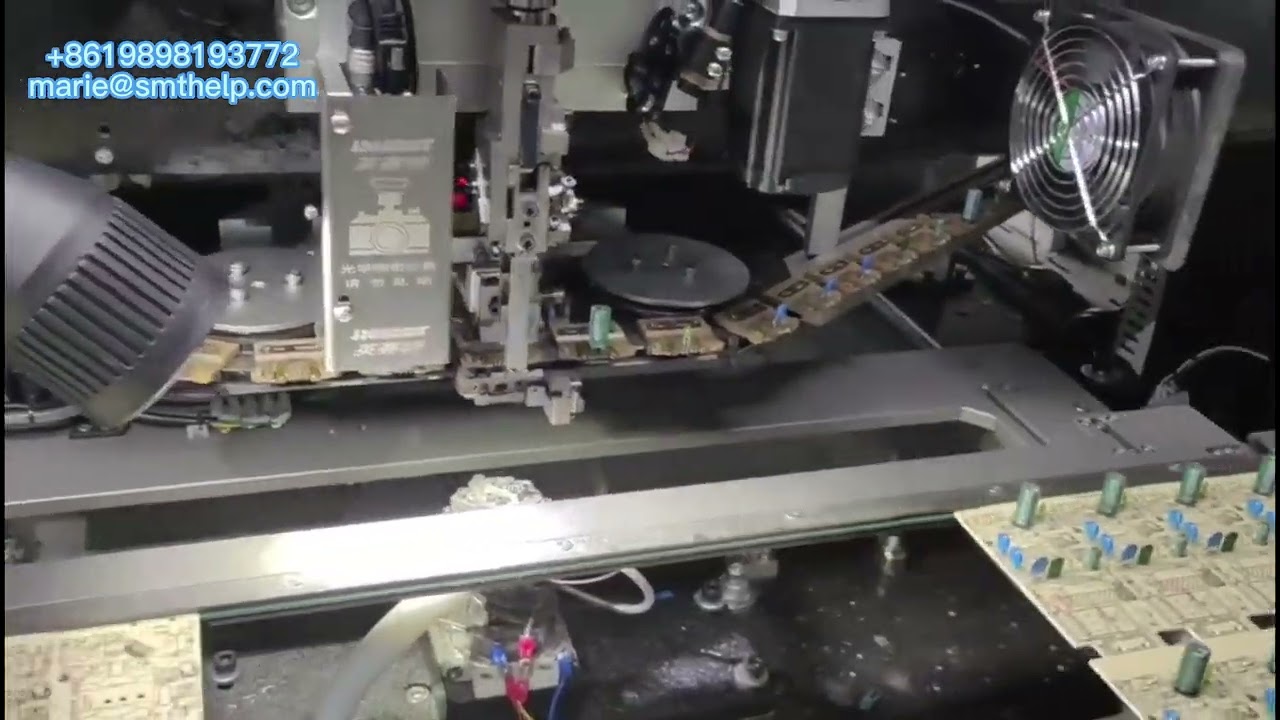
Radial Auto Insertion by Southern Machinery: Full-Spectrum Component Coverage for THT Assembly
Watch in Action: S3010A Radial Insertion machine for Smart EMS factory PCB assembly
What Is This Machine Used For?
The S3010A is a radial insertion machine that automatically places vertical tape-packed radial through-hole components onto PCBs. Where a manual operator would pick, orient, and clinch each part by hand, the S3010A feeds taped radial components from a 10-station feeder, positions the board, and inserts each part with a servo-driven insertion head that clinches the leads to hold the component before soldering.
Which components can it insert? A radial component has both leads exiting the same side of the body, parallel to each other. The S3010A handles the full spectrum of vertical tape-packed radial parts:
- Electrolytic and film capacitors
- Transistors
- LEDs
- Key switches
- Resistors
- Connectors
- Fuse blocks
What makes it "full-spectrum"? A single S3010A accepts multiple lead pitches — 2.5 mm, 5.0 mm, 7.5 mm, and 10.0 mm — in single-, dual-, triple-, or quad-span configurations. One machine covers the entire radial portion of a mixed BOM rather than requiring a dedicated machine per component family.
How fast is it? The machine is rated for up to 18,000 components per hour (PCS/H). Southern Machinery's own demo shows the S3010A inserting 33 components into a PCB in 16 seconds — a concrete reference for cycle-time planning.
How does it maintain accuracy? A servo-driven insertion head with an "N"-type clinch base inserts and clinches each lead, while machine-vision coordinate correction and calibration keep placement aligned with the board's hole pattern. Insertion direction is programmable through 0°–360° in 1° increments.
Typical Application Scenarios
Radial through-hole parts remain essential in boards that carry higher power, higher voltage, or mechanical-mounting requirements. The S3010A is deployed across the industries Southern Machinery serves:
Power supplies and chargers — Switch-mode power supplies, adapters, and mobile-charger boards carry large numbers of radial electrolytic capacitors and power transistors that are impractical to hand-insert at scale.
Home appliances — Washing-machine, air-conditioner, and induction-cooker control boards use radial capacitors, relays, and connectors in through-hole form. Southern Machinery has delivered axial-and-radial insertion lines for washing-machine control PCB assembly.
LED lighting and displays — LED driver boards and traffic-signal controllers combine radial LEDs, capacitors, and connectors in high mix. Radial insertion removes the manual bottleneck in these high-volume, repetitive placements.
Vehicle electronics — Car audio, vehicle power supplies, and EV control modules require the mechanical robustness of clinched through-hole joints. Radial insertion provides that clinching while holding automotive-grade accuracy.
How It Integrates Into a Complete PCB Assembly Line
A radial insertion machine is one station in a full THT line. A typical Southern Machinery line flows:
- Axial insertion (S4000) for taped axial components
- Radial insertion (S3010A) for the radial component spectrum
- Odd-form / terminal insertion (S7000, S-7000T) for connectors, relays, and terminals
- Wave Soldering (S-WS450 / S-WS350B) to solder all inserted leads
- Lead cutting / cleaning / inspection to finish the assembly
The S3010A accepts boards from 50×50 mm up to 400×400 mm and 0.79–2.36 mm thick, so it pairs with standard loader/unloader board handling for inline operation. Its machine-vision coordinate correction lets it work in a mixed-model line where board variants change frequently. Because the machine clinches each lead to a controlled 1.5–2.2 mm length at 10°–35°, boards move to Wave Soldering with leads held in place — reducing the floating, leaning, and tombstoning that plague manual insertion.
Key Selection Parameters
When your team evaluates a radial insertion machine, confirm these parameters against your BOM and board mix:
- Component spectrum — Which radial part types (capacitor, transistor, LED, connector, fuse block) and body sizes must the machine accept?
- Lead pitch / span — What lead spans (2.5 / 5.0 / 7.5 / 10.0 mm and wider XL variants) does your BOM require? Verify single-, dual-, triple-, and quad-span support.
- Feeder capacity — How many distinct taped radial components must be loaded simultaneously (the S3010A uses a 10-station feeder)?
- Insertion accuracy and clinch — What clinch length/angle and hole-pattern accuracy do your reliability specs demand?
- Vision / polarity verification — Do you need machine-vision coordinate correction and polarity checking to prevent reversed electrolytics and LEDs?
- Board envelope — Confirm PCB size (50×50–400×400 mm) and thickness (0.79–2.36 mm) fit your panel designs.
- Changeover speed — How fast must you switch between component types and spans for high-mix production?
ROI, Quality & Throughput Considerations
Throughput. At up to 18,000 PCS/H, a single S3010A replaces multiple manual operators. Southern Machinery's demo — 33 components in 16 seconds — illustrates the compounding effect of eliminating per-part hand placement, orientation, and clinching.
Quality. Manual radial insertion is a leading source of bent leads, reversed polarity, and floating components. Machine-vision coordinate correction, controlled clinching, and programmable insertion direction remove these variables, cutting rework at Wave Soldering and improving first-pass yield.
Labor economics. Southern Machinery positions its THT equipment at a fraction of Tier-1 pricing, with Shenzhen-direct support, spare parts, and training. For Tier-2 and Tier-3 EMS providers and OEM in-house lines, that shortens payback while delivering the same insertion capability. Recovered operator time is redeployed to Feeder loading, AOI, and changeovers rather than repetitive insertion.
FAQ
What is the difference between radial and axial insertion?
Axial components have one lead exiting each end of the body (like a resistor on a taped reel); radial components have both leads exiting the same side. The S3010A handles radial parts; Southern Machinery's S4000 handles axial.
Which components can the S3010A insert?
Capacitors, transistors, LEDs, key switches, resistors, connectors, and fuse blocks — all in vertical tape-packed form.
How fast is the S3010A?
Up to 18,000 PCS/H; Southern Machinery's demo shows 33 components inserted into one PCB in 16 seconds.
What board sizes does it accept?
From 50×50 mm up to 400×400 mm, and 0.79–2.36 mm thick.
Does it support multiple lead pitches?
Yes — 2.5 mm, 5.0 mm, 7.5 mm, and 10.0 mm lead spans in single-, dual-, triple-, and quad-span configurations.
Can it detect incorrect polarity?
The machine's vision system provides coordinate correction and calibration to keep placement accurate; confirm your polarity-verification and error-detection requirements with Southern Machinery's engineering team.
Contact Southern Machinery
Founded in 2011 in Shenzhen, China, Southern Machinery has delivered SMT and THT PCB assembly automation to 237+ global customers. We provide full-line solutions — SMT, THT, Wave Soldering, board handling, and inspection — plus spare parts, retrofit kits, training, and overhaul.
What is manual radial insertion currently costing you in defects and rework? If you are hand-placing capacitors, transistors, or LEDs, a short conversation can map the payback from automating that station. What throughput would your line need to clear its current THT bottleneck?
- Email: jasonwu@smthelp.com
- Phone / WhatsApp: +86 13602562576
- Website: https://www.smthelp.com
- File portal: https://file.autoinsertion.com
- Image library: https://ph.smthelp.com
Comments