
S300AS Desktop PCB Router for PCB Depaneling by Southern Machinery
The S300AS Desktop PCB Router by Southern Machinery is designed for EMS, ODM, automotive electronics, medical electronics and industrial control manufacturers that need cleaner PCB depaneling with less manual variability. Based on the source document, it combines a dual-table alternating cycle, 800W high-speed milling spindle, programmable tool paths and a rigid aluminum die-cast frame to support small to medium-batch production. Example throughput is stated as about 120 boards per hour, depending on panel design, routing path, fixture and final technical confirmation.
Jul 23, 2026 · Updated Jul 23, 2026 · Southern Machinery
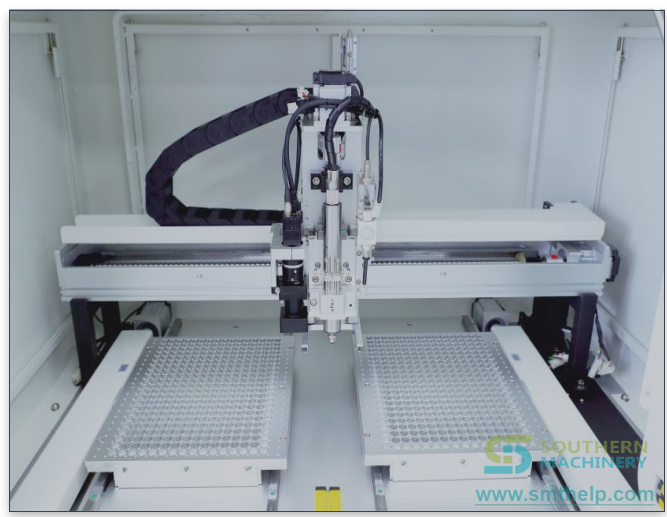
S300AS Desktop PCB Router for PCB Depaneling by Southern Machinery
For EMS and OEM production teams, PCB depaneling is a quality gate, not just a finishing step. A rough edge, over-cut, missed cut or stressed component can turn a completed SMT/THT assembly into rework or scrap. The S300AS Desktop PCB Router from Southern Machinery is positioned in the source document as an offline, high-precision PCB routing solution for small to medium-batch production and specialized applications where repeatability matters.
Southern Machinery was founded in Shenzhen, China in 2011 and serves 237+ global customers with SMT/THT PCB assembly automation equipment. For buyers building or upgrading an assembly line, Southern Machinery can support SMT, THT insertion, wave soldering, board handling, inspection options, spare parts support and professional training.
What is this machine used for?
The S300AS Desktop PCB Router is used to separate routed PCB panels into individual boards after assembly. Instead of relying on hand tools or inconsistent manual separation, the machine follows programmed cutting paths to reduce uneven surfaces, over-cutting, missed cuts and inconsistent planes.
In practical factory language, it is for manufacturers that need clean, repeatable depaneling of assembled PCB panels while protecting components and board edges.
Source-Derived Machine Profile
The selected source document describes the S300AS as a desktop PCB router for high-precision depaneling. Although it is called desktop, the listed size and feature set position it as a professional production tool rather than a hobby or simple prototype router.
Key source-stated features include:
- Dual table alternating cycle for continuous operation.
- 800W high-speed precision milling cutter.
- Cutting accuracy and repeatability stated as +/-0.02 mm.
- Aluminum die-cast frame for rigidity, precision and thermal stability.
- Microcontroller plus handheld programmer control.
- Teach programming and graphic import support.
- Path options including points, lines, arcs, full circles, curves, polylines, helices and ellipses.
- Conditional rotation, dual MARK alignment, array replication, DXF/PLT import with automatic path optimization and breakpoint execution.
- Program storage stated as 100+ files and 8,000 instructions per file in the feature section, with 1000 sets listed in the specification section.
- Shinano Electric motor system, YAKO driver, HIWIN linear guide and TBI lead screw or synchronous belt transmission as listed in the source document.
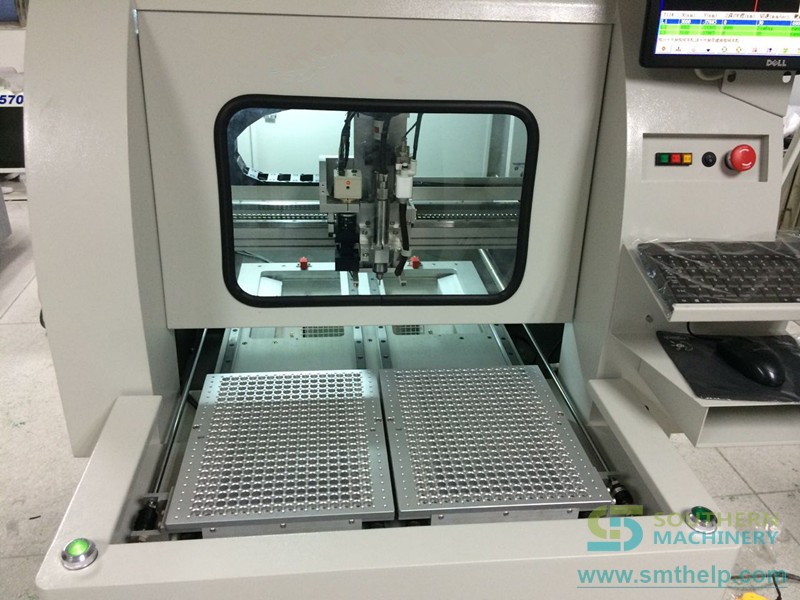
- Sheet-metal environmental protective cover.
- AC110-220V full-voltage power input.
- RS232 external control interface.
Typical Applications
The S300AS is a fit for factories that need controlled depaneling but do not require a fully inline routing cell.
Typical application scenarios include:
- EMS lines producing mixed PCB models in small to medium batches.
- ODM pilot production where routing paths change often.
- Automotive electronics where clean board edges and stable process control are important.
- Medical electronics and industrial control assemblies where manual stress on components must be reduced.
- R&D and prototyping labs that need repeatable routing for complex board outlines.
- Factories moving away from manual cutting because of burrs, uneven surfaces or inconsistent quality.
How It Connects To A Complete PCB Assembly Line
The S300AS is best treated as an offline depaneling station after SMT/THT assembly and soldering. A typical production flow can be:
- SMT placement and reflow for surface-mount components.
- THT insertion, odd-form insertion or manual insertion where required.
- Wave soldering or selective soldering depending on board design.
- AOI, functional inspection or visual quality checks.
- Offline S300AS routing to separate PCB panels.
- Final inspection, cleaning if required, packing and traceability closeout.
For factories planning a broader upgrade, Southern Machinery can help match PCB loaders, unloaders, conveyors, THT insertion equipment, wave soldering and board handling modules around the routing process. The practical integration question is not only whether the router can cut the panel, but whether the fixture, routing path, inspection process and line takt time work together.
Key Selection Parameters For Buyers
Before quoting or approving an S300AS project, manufacturing engineering teams should confirm these points:
- Panel size and routing outline.
- Tab design, remaining material and cutter access.
- Component clearance near the routing path.
- Required edge quality and acceptable burr level.
- Expected daily panel volume and target takt time.
- Fixture design and whether bakelite fixtures are suitable for the application.
- Whether DXF/PLT import and path optimization match the engineering workflow.
- Required program storage and changeover frequency.
- Dust, cover and operator safety requirements.
- Whether RS232 external control is enough for the factory's offline workflow.
- Incoming power standard: AC110-220V is listed in the source document.
- Confirmation of the source-stated cutting range: 600 x 400 x 400 x 100 mm, which should be technically clarified before purchase because the notation is not self-explanatory.
Source-Stated Technical Snapshot
The following values are taken from the selected local source document. They should be treated as configuration-dependent and subject to final technical confirmation.
| Item | Source-stated value |
|---|---|
| Equipment dimensions | 1350 x 800 x 1900 mm |
| Cutting range | 600 x 400 x 400 x 100 mm, notation requires confirmation |
| Spindle power | 800W |
| Movement speed | 0-500 mm/sec |
| Repeatability / cutting accuracy | +/-0.02 mm |
| Maximum load | 10 kg |
| Control method | Microcontroller + handheld controller |
| Motor system | Shinano Electric, Japan |
| Driver | YAKO |
| Linear guide | HIWIN Taiwan |
| Transmission | Synchronous belt / TBI lead screw, Taiwan |
| Fixture material | Bakelite for specific purpose |
| Environmental cover | Sheet-metal protective cover |
| Power input | Full voltage AC110-220V |
| External interface | RS232 |
| Example panel processing time | Approximately 30 seconds per panel |
| Example throughput | About 120 boards per hour |
ROI, Quality And Capacity Value
The strongest value case is labor stability plus quality consistency. The source document states that automated operation provides stable, repeatable results and reduces common manual problems such as uneven surfaces, over-cutting, missed cuts and inconsistent planes.
For ROI review, buyers should model the S300AS against current manual depaneling cost, rework rate, scrap risk, operator skill dependency, panel mix and expected board volume. The source document gives example productivity of about 30 seconds per panel and about 120 boards per hour, but actual output depends on board size, routing path length, fixture design, panel loading behavior and process confirmation.
A realistic investment case is strongest when:
- Operators spend significant time separating panels manually.
- Product mix requires frequent but controllable program changes.
- Burrs or edge damage create downstream inspection or assembly issues.
- The factory wants offline automation without committing to a full inline router cell.
- Quality teams need more repeatable separation for high-value PCB assemblies.
FAQ
Is the S300AS an inline router?
The source document positions it as a desktop/offline PCB router. It can support production workflows, but it is not described as a fully inline cell with automatic loading, unloading, MES connection or advanced CCD vision.
What is the main advantage over manual PCB separation?
The main advantage is repeatability. The source document specifically points to improved cutting consistency and reduced issues such as rough edges, over-cutting, missed cuts and inconsistent planes.
What production volume does the source document suggest?
The source document gives an example of approximately 30 seconds per panel and about 120 boards per hour. These are example values and must be confirmed against the final PCB panel, routing path and fixture.
Can it handle complex board shapes?
The document lists programming support for points, lines, arcs, circles, curves, polylines, helices and ellipses, plus DXF/PLT import and automatic path optimization. Final suitability depends on the PCB design and cutter access.
What should be confirmed before purchase?
Confirm panel size, routing path, component clearance, fixture design, expected throughput, dust and safety requirements, program import workflow, power input and the exact interpretation of the listed cutting range.
Can Southern Machinery support a complete assembly solution?
Yes. Southern Machinery focuses on SMT/THT PCB assembly automation equipment and can support full-line planning around SMT, THT insertion, wave soldering, board handling, inspection options, spare parts and professional training.
CTA: Send Your PCB Panel For Technical Review
If you are evaluating a cleaner and more repeatable depaneling process, send Southern Machinery your PCB panel drawing, routed tab design, target takt time, component clearance constraints and current separation pain points. The engineering team can review whether the S300AS Desktop PCB Router is suitable, what fixture approach is needed and how it should fit into your complete PCB assembly workflow.
Comments