
S-3000 Radial Insertion Machine for THT Automation by Southern Machinery
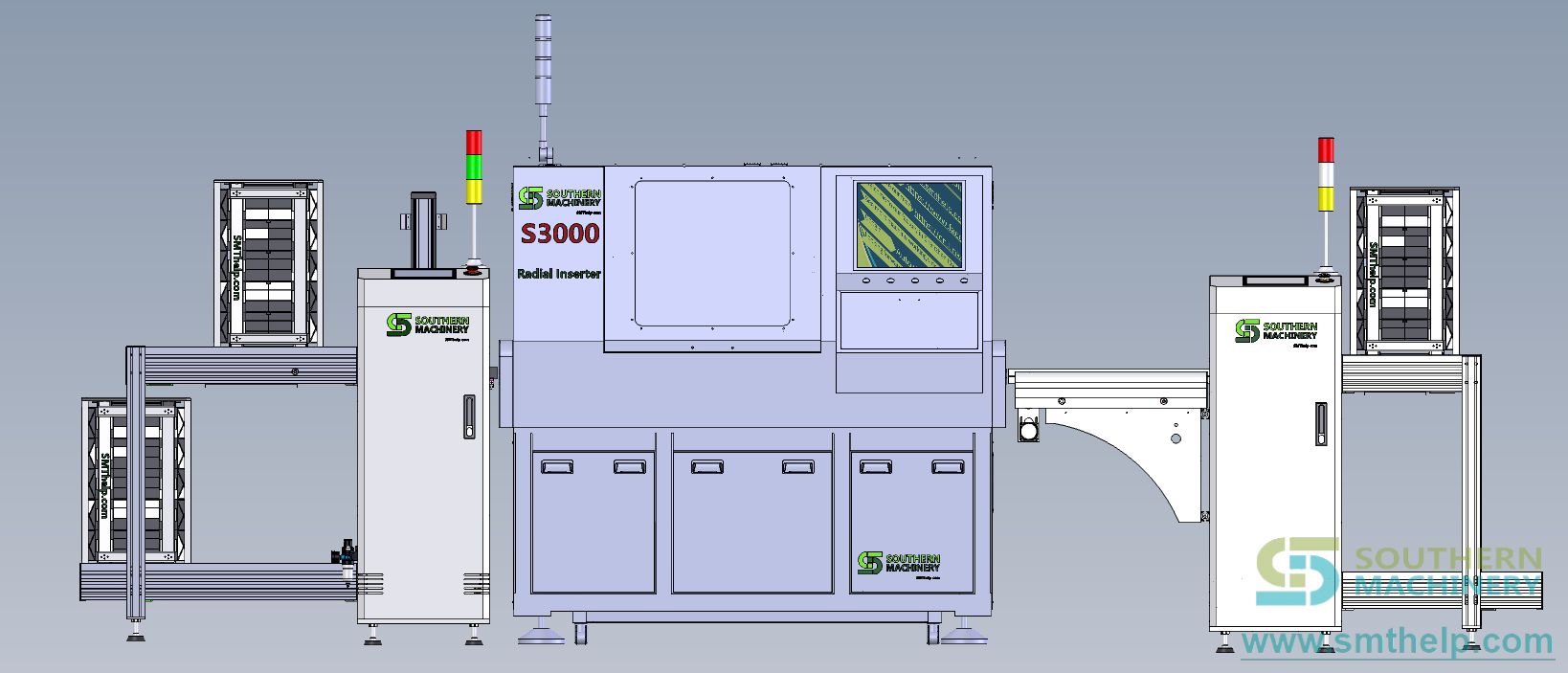
The S-3000 Radial Insertion Machine by Southern Machinery helps EMS and electronics manufacturers move radial THT component insertion from manual, operator-dependent work to a controlled automation process. Designed for taped radial components and inline-ready PCB handling, it supports stable feeding, repeatable insertion, loader integration, and smoother connection to wave soldering or selective soldering processes. For factories building power supplies, LED boards, industrial controls, appliance electronics, and other mixed SMT/THT products, the S-3000 can reduce manual touchpoints, improve process consistency, and keep through-hole assembly better aligned with upstream SMT output.
Jul 19, 2026 · Updated Jul 19, 2026 · Southern Machinery

S-3000 Radial Insertion Machine for THT Automation by Southern Machinery
For many EMS factories, SMT is already automated, but through-hole technology (THT) still depends on operators manually inserting radial components. That works for small batches. Once volume, shift-to-shift consistency, and quality targets increase, manual insertion becomes a bottleneck.
Southern Machinery's S-3000 Radial Insertion Machine is designed to make radial THT insertion more stable, repeatable, and easier to connect into a smart PCB assembly line. It is especially useful when your boards use taped radial components such as common capacitors, resistors, LEDs, and similar leaded parts.
What is this machine used for?
The S-3000 is used to automatically insert radial taped components into PCB holes during the THT stage of PCB assembly. Instead of relying on operators to pick, orient, and insert each component by hand, the machine uses a configured feeder layout, controlled insertion motion, and inline board handling options to make the process more predictable.
In simple terms: it turns radial insertion from a manual workcell into a controlled production station.
Typical use cases include:
- Power supply boards with many radial capacitors or resistors
- LED driver and lighting electronics
- Industrial control boards with repeated radial THT parts
- Home appliance control boards
- Automotive and energy electronics where stable insertion quality matters
- EMS production lines where SMT output is faster than manual THT insertion
Why radial insertion becomes the bottleneck
Manual radial insertion depends heavily on operator skill and attention. Two operators can produce different results on the same board, especially across long shifts or when component mix changes. Common problems include tilted parts, missed insertions, wrong orientation, inconsistent insertion depth, and slower output when the BOM has many radial components.
The S-3000 is positioned for factories that want fewer touchpoints per board, steadier cycle behavior, and better alignment between SMT and downstream soldering. The source product page describes the goal clearly: stable feeding, repeatable insertion, scalable inline material handling, and reduced dependence on manual work.
That does not mean every factory needs full automation. If you build prototypes or very small batches, manual insertion may still be the most flexible choice. But when the same radial parts appear across repeat orders, automation starts to make practical sense.
Recommended line position
The S-3000 fits into the THT section after SMT assembly and before soldering. A typical complete line can look like this:
- SMT line: loader, stencil printer, pick-and-place, reflow oven, and optional AOI.
- Buffer or conveyor transfer into the THT area.
- S-3000 radial insertion machine for taped radial components.
- Optional odd-form insertion station if the board also has connectors, transformers, relays, or special components.
- Wave soldering or selective soldering, depending on board design and component mix.
- THT AOI, visual inspection, ICT/FCT, and unloading.

For Southern Machinery, this complete-line thinking is important. We are not only matching a single machine. We look at the full PCB assembly flow: SMT, THT insertion, wave soldering, board handling, inspection, training, and spare parts support.
Key configuration points from the source document
The source page presents the S-3000 as a production-oriented radial insertion platform. The following values should be treated as typical examples and must be confirmed against your PCB drawing, BOM, and final machine configuration.
| Selection item | Typical range or capability from source material | Why it matters |
|---|---:|---|
| Insertion throughput | Up to about 18,000 components/hour, program and part dependent | Helps reduce manual insertion bottlenecks and keep THT closer to SMT output. |
| Component format | Radial taped components, including common capacitor and resistor packages | Standardized feeding reduces missed or tilted insertion risk. |
| Lead pitch / span | Typical compatibility around 2.5-10 mm, subject to BOM confirmation | Determines whether your main radial parts can run on the selected setup. |
| PCB size | Approx. 50 x 50 mm minimum and up to about 450 x 350 mm maximum, configuration dependent | Confirms whether your panels fit the handling system. |
| PCB thickness | Around 0.8-3.2 mm typical | Affects board support, stability, and insertion reliability. |
| Placement repeatability | Typically within +/-0.1 mm, application dependent | Supports more consistent downstream solder quality. |
| Feeder capacity | Configurable, with common 5-12 feeder layouts and 10-feeder setups shown in the source | Reduces feeder swaps for common EMS BOM mixes. |
| Utilities | AC 220V and compressed air around 0.5-0.7 MPa typical | Helps factory teams plan installation requirements. |
These are not universal guarantees. They are selection references. Final confirmation should be based on sample components, board files, required takt time, and line layout.
How it improves quality and output
The biggest value is process stability. When radial insertion is automated, the factory can reduce variation between operators and shifts. Controlled feeding and insertion also help make downstream soldering more predictable, because component position and lead insertion are more consistent before wave soldering or selective soldering.
From an ROI point of view, the source material points to three practical levers:
- Fewer operators needed for repetitive radial insertion work
- Less rework caused by missed, tilted, or inconsistent insertions
- Higher and more predictable output when THT no longer delays the rest of the line
Southern Machinery keeps ROI discussion realistic. Payback depends on labor cost, component count per board, working hours, product mix, and the number of feeders required. For example, a board with dozens of repeated radial capacitors across two shifts has a much stronger automation case than a low-volume mixed board with only a few radial parts.
Buyer checklist before selecting the S-3000
Before we recommend the exact configuration, please confirm these points:
- PCB size range, thickness, and panel format
- Radial component list from your BOM, including lead pitch and body size
- Monthly or shift output target
- Number of radial components per board
- Current insertion method and main pain point
- Whether the line needs loader, conveyor, buffer, barcode, or MES connection
- Downstream process: wave soldering or selective soldering
- Required inspection level, such as visual check, THT AOI, ICT, or FCT
With these inputs, Southern Machinery can match the closest S-3000 configuration and confirm feeder quantity, board handling, and line layout.
Example application scenario
A medium-volume EMS factory builds power electronics boards after SMT reflow. The SMT line can finish boards quickly, but the THT area slows down because operators manually insert repeated radial capacitors. Adding the S-3000 lets the factory automate that repeated radial insertion step, then move boards by conveyor toward wave soldering. Operators can focus on material preparation, inspection, and special components instead of repetitive insertion.
This is where the S-3000 fits best: repeated radial components, clear volume demand, and a need to reduce manual variability.
Why Southern Machinery
Southern Machinery was founded in Shenzhen in 2011 and focuses on high-efficiency, cost-effective SMT and THT PCB assembly automation equipment. We support EMS, ODM, automotive electronics, medical electronics, industrial control, and smart factory projects with equipment covering SMT lines, THT insertion, wave soldering, board handling, and inspection options.
Our value is not only machine supply. We help design the complete production flow, provide installation guidance, operator training, spare parts support, and remote technical service. For overseas buyers, that full-line integration and service structure reduces project risk.
FAQ
Can the S-3000 handle every through-hole component?
No. It is for radial taped components. If your board includes odd-form parts such as large connectors, transformers, relays, or special terminals, we may recommend an additional odd-form insertion solution or manual assist station.
Is the listed throughput guaranteed?
No. The source page gives a typical example of up to about 18,000 components/hour, but actual output depends on component type, feeder setup, PCB layout, program, and handling configuration. Final speed should be confirmed after reviewing your BOM and board data.
Can it connect with wave soldering?
Yes. The S-3000 can be planned as part of a THT line before wave soldering or selective soldering. The right choice depends on component layout, bottom-side clearance, thermal mass, and quality requirements.
Do I need inline loader and conveyor integration?
For stable medium or high-volume production, yes, inline handling is usually worth it. For lower volume or high-mix production, a simpler configuration may be more cost-effective.
What information is needed for quotation?
Please send PCB size, BOM, radial component photos or drawings, required output per shift, insertion process flow, and any traceability or inspection requirements.
CTA
If your THT area is slowing down SMT output, send Southern Machinery your PCB drawing, BOM, target volume, and current insertion process. We will review whether the S-3000 Radial Insertion Machine is the right fit and propose a cost-effective complete line covering radial insertion, odd-form needs, soldering, board handling, and inspection.
Comments