
S-3000 Radial Insertion Machine for THT Automation by Southern Machinery
The S-3000 Radial Insertion Machine from Southern Machinery helps EMS and OEM factories shift radial through-hole insertion from manual labor to a more repeatable, automated process. Built for radial taped components and
Jul 3, 2026 · Updated Jul 3, 2026 · Southern Machinery

S-3000 Radial Insertion Machine for THT Automation by Southern Machinery
Manual radial component insertion can look flexible at low volume, but it becomes expensive as product volume, shift count, and quality requirements grow. The S-3000 Radial Insertion Machine from Southern Machinery is designed to help EMS and OEM factories shift radial through-hole insertion from a manual, operator-dependent process to a controlled, automated step.
Southern Machinery, founded in Shenzhen in 2011, specializes in SMT and THT PCB assembly automation equipment. For factories building power supplies, LED drivers, industrial control boards, automotive electronics, and other mixed-technology PCB assemblies, the S-3000 can be configured as a standalone radial insertion station or as part of a complete line that includes SMT, THT, wave soldering, board handling, inspection, and traceability support.
What is this machine used for?
The S-3000 automatically inserts radial taped through-hole components into PCBs. Typical parts include radial capacitors, resistors, and similar leaded components supplied in tape format. Instead of relying on manual operators to pick, orient, insert, and repeat the same motions all shift, the machine feeds the component, positions it, inserts it into the PCB, and supports a more repeatable THT workflow.
In practical terms, the machine is most valuable when your THT area is the bottleneck. If SMT placement and reflow are already stable but radial insertion still depends on several operators and visual checks, the S-3000 offers a path to higher output, fewer insertion errors, and more consistent takt time.
Why EMS factories automate radial insertion
Radial THT work is often treated as a labor problem, but the bigger issue is process variation. Different operators insert at different speeds. Fatigue affects shift performance. Part orientation, lead handling, and insertion depth can vary. Those small differences add up to rework, soldering defects, and unpredictable line balance.
The S-3000 is designed to reduce that variation. The manufacturer describes it as a way to move from manual insertion toward repeatable, IPC-aligned quality and higher throughput. Exact output depends on the program, board design, component format, feeder configuration, and changeover practices, but the business goal is clear: reduce reliance on manual labor while making THT output more predictable.
Typical applications
The S-3000 fits factories with significant radial through-hole content, especially where the same component families appear across many products.
Common use cases include:
- LED driver and power supply boards with radial capacitors and resistors.
- Industrial control PCB assemblies where stable THT quality matters.
- Automotive electronics subassemblies that require repeatable insertion before soldering.
- Appliance, charger, lighting, and mixed SMT/THT products with high manual insertion loads.
- EMS production where radial insertion is a bottleneck after SMT placement and reflow.
For high-mix factories, the key question is not just speed. It is whether the feeder setup, BOM grouping, and changeover workflow can support your product mix without creating a new bottleneck.
How it connects to a complete PCB assembly line
The S-3000 should not be evaluated as an isolated machine. In a real factory, it belongs inside a complete PCB assembly flow.
A typical mixed-technology line can be arranged like this:
- SMT section: loader, stencil printer, pick-and-place, reflow oven, and optional SPI/AOI.
- THT radial insertion: S-3000 with suitable radial feeders and loader/unloader options.
- Additional THT insertion: odd-form insertion, axial insertion, or manual assist for parts that are not suitable for radial tape feeding.
- Soldering: wave soldering or selective soldering, depending on board design, masking needs, and product mix.
- Inspection and test: post-solder inspection, AOI or visual inspection, ICT/FCT where required.
- Board handling: conveyors, buffers, loaders, unloaders, NG/OK sorting, and optional traceability integration.

Southern Machinery supports this full-line view. The practical advantage is integration: radial insertion, odd-form insertion, wave soldering, board handling, and inspection can be planned together instead of purchased as disconnected stations.
Key selection parameters
Before choosing the final S-3000 configuration, a manufacturing engineer should confirm these items:
| Selection item | What to confirm | Why it matters |
| --- | --- | --- |
| Radial BOM | Part type, body size, lead pitch/span, tape format | Determines feeder suitability and insertion setup |
| PCB size and thickness | Panel dimensions, thickness, hole quality, tooling constraints | Affects board handling, stability, and fixture needs |
| Feeder count | Number of radial part types per product or family | Influences changeover time and uptime |
| Output target | Boards per shift, insertion points per board, shifts per day | Converts machine CPH into real line capacity |
| Upstream/downstream flow | SMT output, manual stations, wave/selective soldering capacity | Prevents the bottleneck from simply shifting downstream |
| Quality target | IPC class, defect limits, traceability needs | Defines inspection, recipe control, and documentation level |
| Automation level | Standalone, loader/unloader, conveyor-ready inline setup | Impacts labor savings and line balance |
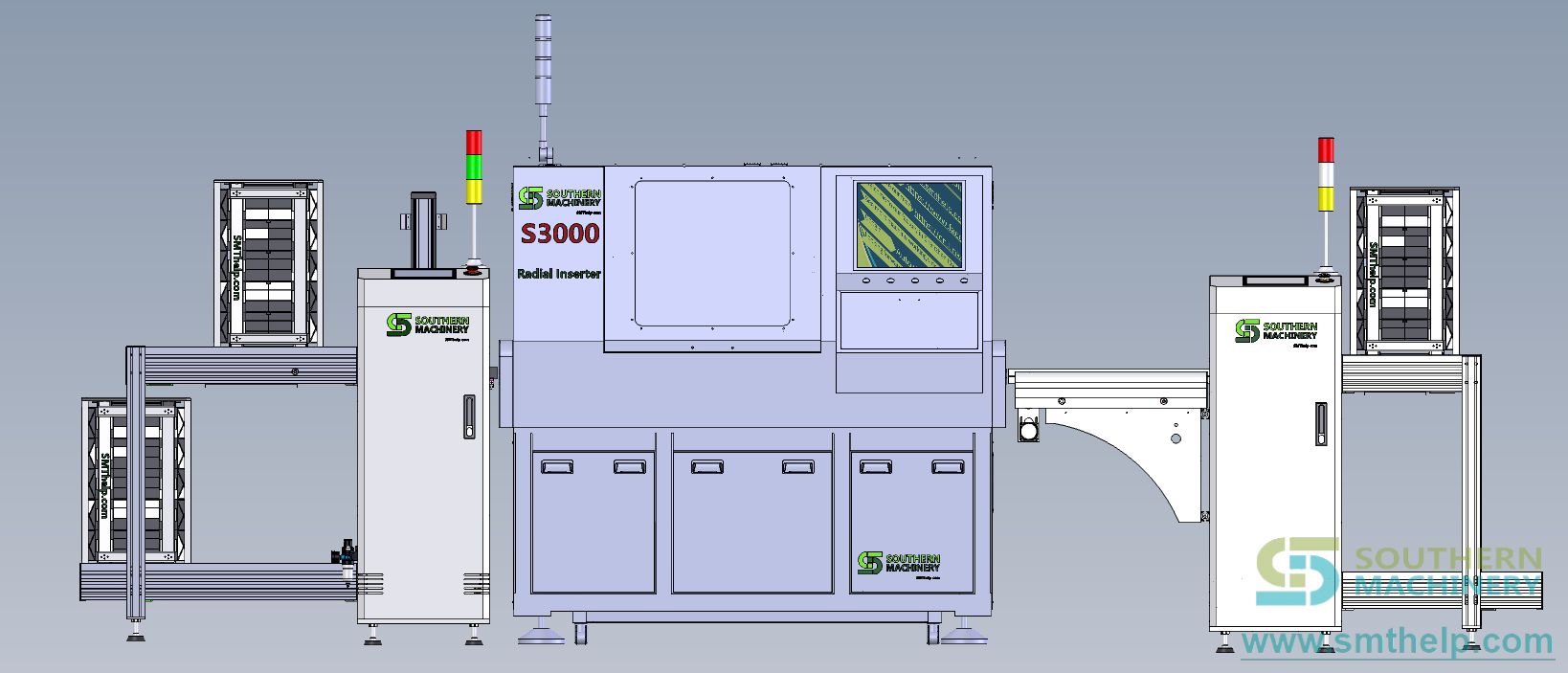
The manufacturer highlights production-oriented features such as handling radial taped components, loader/unloader options, conveyor-ready integration, configurable feeder capacity, and configurations supporting up to 10 feeders. Example specifications include up to approximately 18,000 components per hour, PCB sizes from 50 x 50 mm to 450 x 350 mm, PCB thickness from 0.8 to 3.2 mm, and repeatability within ±0.1 mm. These values are configuration- and application-dependent and should be confirmed against your specific PCB drawings and BOM.
ROI, quality, and capacity value
The ROI case for radial insertion automation usually comes from three areas.
First, labor reduction. A manual insertion cell may require several operators per shift to maintain output. Automation can reduce the number of manual touchpoints and make labor planning easier. The exact payback depends on your local labor cost, shift pattern, part count per board, and machine configuration.
Second, quality stability. Manual insertion defects often come from fatigue, inconsistent orientation, missed parts, or uneven insertion depth. A controlled insertion process helps reduce variation before soldering. That can reduce rework loops and help downstream soldering behave more predictably.
Third, line balance. If your SMT line is already producing faster than THT can insert parts, the factory is paying for upstream capacity that cannot be fully used. A radial insertion machine helps THT keep pace with SMT and prepares the line for more consistent wave soldering or selective soldering.
For example, a power supply factory running two shifts may find that manual insertion is acceptable for pilot builds but becomes unstable once daily output increases. In that case, the S-3000 is not just a labor-saving machine; it becomes a line-balance tool.
When S-3000 is the right fit
The S-3000 is a strong candidate when:
- Radial components are a repeated part of your BOM.
- Manual insertion consumes too many operators or creates quality variation.
- You need a more stable process before wave soldering or selective soldering.
- Your SMT section is faster than your current THT area.
- You want an automation path that can later connect with loaders, conveyors, odd-form insertion, inspection, and traceability.
It may be overkill if your radial content is very low, your build volume is small, or your component mix changes so often that feeder setup would dominate production time. In those cases, Southern Machinery can help compare semi-automatic, manual-assist, or selective automation options before recommending a full radial insertion cell.
FAQ
1. Can the S-3000 replace all manual THT insertion?
Not always. It is designed for radial taped through-hole components. Connectors, transformers, relays, heatsinks, and irregular parts may need odd-form insertion, manual assist, or a different automation method.
2. What information is needed for a reliable recommendation?
The most important inputs are PCB size and thickness, radial component list, lead pitch/span, tape format, insertion points per board, monthly volume, shift pattern, and current bottleneck.
3. Is the quoted insertion speed guaranteed for every product?
No. Any CPH figure should be treated as program- and part-dependent. Real output depends on the BOM, board layout, feeder configuration, changeover frequency, and downstream soldering capacity.
4. Can it be connected with wave soldering?
Yes. In many mixed SMT/THT lines, radial insertion happens before wave soldering or selective soldering. The right choice depends on the board design, component clearance, masking requirements, and quality target.
5. Can Southern Machinery provide a complete line, not just the insertion machine?
Yes. Southern Machinery can support SMT, THT insertion, wave soldering, board handling, inspection, and related automation as a complete PCB assembly solution. This is useful when you want one integrated flow instead of isolated machines.
6. What should a buyer check before ordering?
Confirm your BOM, PCB drawings, target output, factory layout, utilities, feeder requirements, inspection needs, and future expansion plan. Final machine configuration should be confirmed against real production data.
Talk to Southern Machinery
If radial insertion is becoming a labor, quality, or capacity bottleneck in your factory, send Southern Machinery your PCB drawings, radial BOM, target output, and current process flow. We can help match the S-3000 configuration to your real product mix and show how it connects with SMT, THT, wave soldering, board handling, inspection, spare parts support, and professional training.
Southern Machinery has served 237+ global customers and focuses on high-efficiency, cost-effective PCB assembly automation from Shenzhen. The right next step is simple: confirm the board, the BOM, and the daily output target, then build the line around the bottleneck instead of guessing from a catalog page.
Comments