
S-3000 Radial Insertion Machine Inline THT Line Guide by Southern Machinery
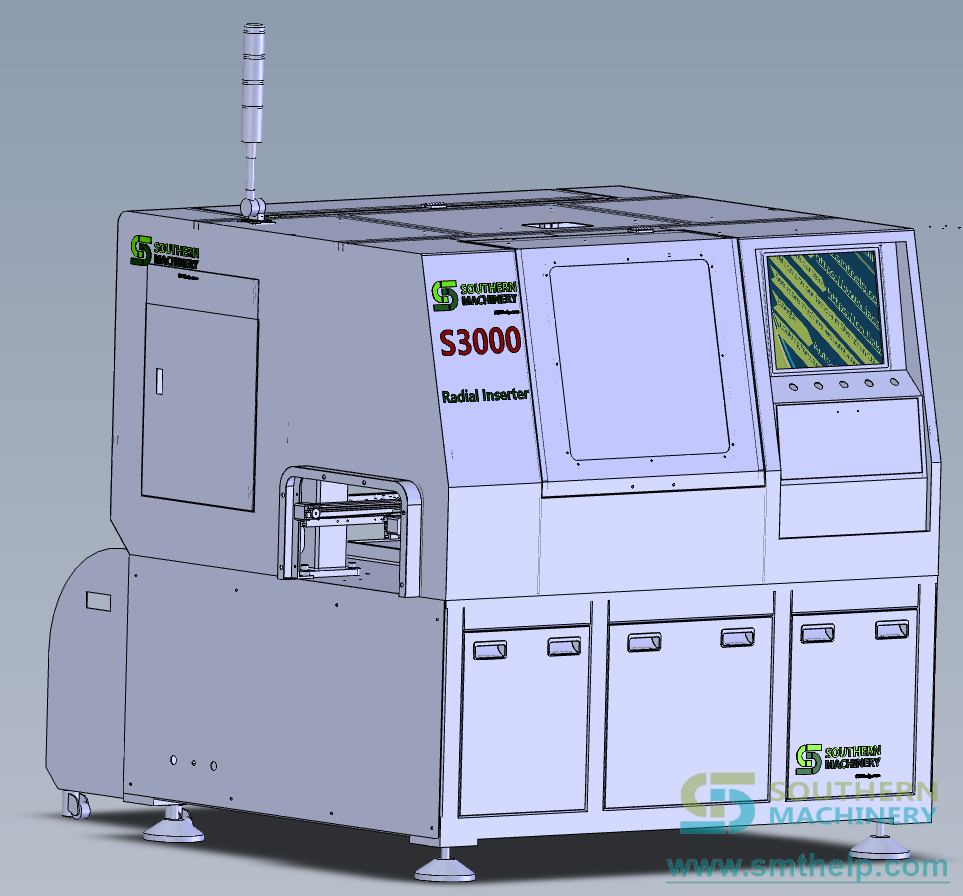
The S-3000 Radial Insertion Machine by Southern Machinery helps EMS, ODM, automotive electronics, industrial control, and appliance electronics factories automate repeated radial THT component insertion. Built for radial taped components and inline-ready board handling, it supports stable feeding, repeatable insertion, and smoother transfer toward wave soldering or selective soldering. This guide explains where the S-3000 fits in a complete PCB assembly line, what parameters buyers should confirm, and how radial insertion automation can reduce manual touchpoints while improving process consistency.
Jul 19, 2026 · Updated Jul 19, 2026 · Southern Machinery

S-3000 Radial Insertion Machine Inline THT Line Guide by Southern Machinery
Many factories already run an efficient SMT line, but their through-hole technology (THT) process still depends on operators manually inserting radial components. That gap creates a practical problem: SMT can move fast, while radial insertion becomes the place where boards wait.
Southern Machinery's S-3000 Radial Insertion Machine is built for this situation. It automates insertion of radial taped components and can be planned as part of a complete THT automation section with loaders, conveyors, odd-form insertion, wave soldering or selective soldering, and inspection.
What is this machine used for?
The S-3000 is used to automatically insert radial taped components into PCB holes during through-hole assembly. Typical parts include common radial capacitors, resistors, LEDs, and similar leaded components supplied in tape format.
In plain language, the machine replaces repetitive hand insertion for suitable radial parts. It uses configured feeders, controlled insertion motion, and inline board handling options to make the THT process more repeatable.
This is most useful when the same radial components appear across repeat production orders. For prototype or very low-volume work, manual insertion may still be more flexible. For medium and higher-volume EMS production, automated radial insertion can reduce labor dependence and make output easier to plan.
Where the S-3000 fits in a complete PCB assembly line
A practical line architecture can be arranged like this:
- SMT section: magazine loader, stencil printer, pick-and-place, reflow oven, and optional AOI.
- Transfer and buffering: conveyors or buffers to move boards from SMT into THT.
- S-3000 radial insertion: automated insertion of taped radial components.
- Odd-form or manual assist: for connectors, transformers, terminals, or special components that are not radial taped parts.
- Soldering: wave soldering or selective soldering, depending on board design and component layout.
- Inspection and test: visual check, THT AOI, ICT, FCT, and unloading as required.
Southern Machinery focuses on this full-line view. The right question is not only “which insertion machine?” It is also “how do boards enter, how many feeders are needed, what happens to odd-form parts, and how will the inserted board move to soldering?”

Key configuration parameters to confirm
The source product page describes the S-3000 as a production-oriented radial insertion platform. The values below are useful planning references, but they are typical and subject to final technical confirmation after reviewing your PCB, BOM, and required takt time.
| Parameter | Typical source-based reference | What buyers should check |
|---|---:|---|
| Insertion throughput | Up to about 18,000 components/hour, depending on program and part | Confirm parts per board and required boards per hour. |
| Component format | Radial taped components | Check whether your parts are suitable for radial tape feeding. |
| Lead pitch / span | Around 2.5-10 mm typical compatibility | Confirm every high-volume radial part from the BOM. |
| PCB size | About 50 x 50 mm minimum and up to about 450 x 350 mm maximum | Check panel size, tooling holes, and board support needs. |
| PCB thickness | Around 0.8-3.2 mm typical | Confirm stability during insertion and downstream soldering. |
| Repeatability | Typically within +/-0.1 mm, application dependent | Validate against hole tolerance and quality target. |
| Feeder capacity | Configurable, commonly 5-12 feeders; 10-feeder layouts are shown in the source | Match feeder quantity to the repeated radial parts in your BOM. |
| Utilities | AC 220V and compressed air around 0.5-0.7 MPa typical | Confirm factory power and air preparation. |
The most important step is BOM review. If 80 percent of your radial insertion workload comes from a few repeated taped parts, the automation case is usually much stronger than a board with many rarely used special components.
Application scenarios
The S-3000 is a strong fit for products where repeated radial components slow down the THT area:
- Power supply and LED driver boards
- Industrial control PCBs
- Home appliance control boards
- Energy electronics and charging-related boards
- Automotive electronics with repeat radial THT parts
- EMS high-mix lines where several products share similar radial components
A simple example: an EMS factory runs SMT for power boards, then operators manually insert many radial capacitors before wave soldering. SMT output is steady, but THT output changes by operator and shift. Adding the S-3000 can move the repeated radial work into a controlled station, while operators focus on material preparation, odd-form parts, and inspection.
ROI, quality, and capacity value
The S-3000's business value comes from three practical areas.
First, it reduces repetitive manual insertion work. That can lower dependence on operator availability and training time.
Second, it improves process consistency. Stable feeding and controlled insertion help reduce variation in insertion depth and component position before soldering.
Third, it improves line balance. If radial insertion is the reason boards wait between SMT and wave soldering, automation can help the THT section keep pace with the rest of the factory.
Southern Machinery does not treat ROI as a fixed promise. Payback depends on labor cost, shifts per day, radial component count, board volume, feeder configuration, rework level, and final automation scope. We recommend calculating ROI from your actual board data instead of using a generic number.
How Southern Machinery would size the solution
Before recommending the exact S-3000 configuration, we would confirm four groups of information:
- Product and PCB: board size, thickness, panelization, and hole layout.
- Component list: radial taped component types, lead pitch, body size, and quantity per board.
- Capacity target: boards per shift, shifts per day, working days per month, and future growth plan.
- Line integration: loader, conveyor, buffer, downstream wave soldering or selective soldering, inspection, barcode, and MES requirements.
Once this is clear, Southern Machinery can match the closest machine configuration from our catalog and design the surrounding board handling, soldering, and inspection flow.
Why Southern Machinery
Southern Machinery was founded in Shenzhen in 2011 and focuses on high-efficiency, cost-effective SMT and THT PCB assembly automation equipment. We support 237+ global customers with solutions covering SMT lines, THT insertion, wave soldering, board handling, and inspection options.
For overseas EMS and manufacturing teams, the key value is integrated delivery: machine selection, line layout, installation guidance, professional training, remote support, spare parts support, and long-term service. A radial inserter is more useful when it is connected to the right complete process.
FAQ
Can the S-3000 insert all through-hole components?
No. It is for radial taped components. For connectors, transformers, terminals, relays, or other odd-form parts, Southern Machinery may recommend odd-form insertion or a manual assist station.
Should I choose wave soldering or selective soldering after insertion?
It depends on board layout, bottom-side components, thermal mass, and quality requirements. Wave soldering is often suitable for volume THT production, while selective soldering can be better for boards with soldering restrictions.
Is inline handling necessary?
For stable medium or high-volume production, loader and conveyor integration usually improves flow and reduces operator touchpoints. For lower-volume production, a simpler semi-automatic setup may be enough.
Are the listed capacity and accuracy values guaranteed?
No. They are typical references from the source material and depend on final configuration, components, PCB design, and program. Final values should be confirmed technically before purchase.
What should I send for a quotation?
Send PCB drawings, BOM, target output, component photos or drawings, current process flow, and any requirements for traceability, inspection, wave soldering, or selective soldering.
CTA
If radial THT insertion is slowing down your PCB assembly line, send Southern Machinery your PCB size, BOM, target output, and current process. We will help confirm whether the S-3000 is the right fit and propose a cost-effective complete line from SMT to THT insertion, soldering, handling, and inspection.
Comments