
Radial Insertion Machine by Southern Machinery: Eliminating Manual Through-Hole Insertion Errors
Manual through-hole insertion is one of the costliest and most error-prone steps in PCB assembly. Polarity-sensitive radial components — electrolytic capacitors, LEDs, transistors and diodes — are routinely inserted back
Sep 18, 2026 · Updated Sep 18, 2026 · Southern Machinery
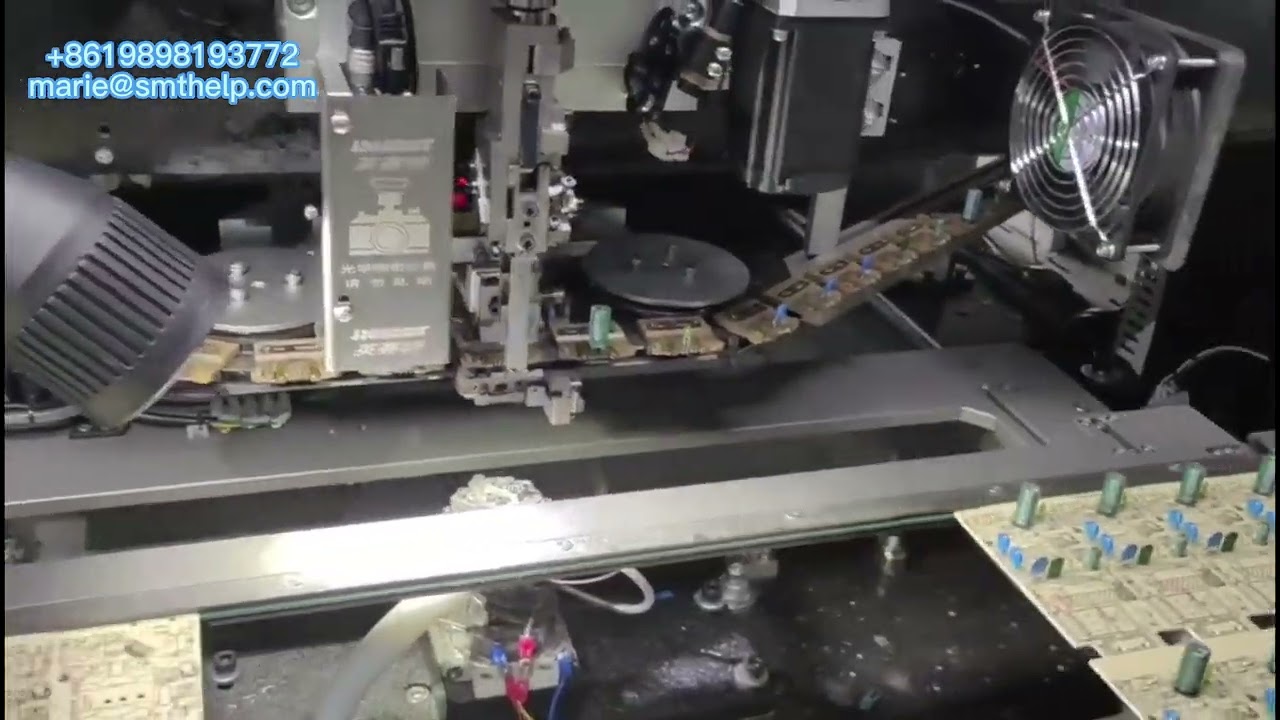
Radial Insertion Machine by Southern Machinery: Eliminating Manual Through-Hole Insertion Errors
What Is This Machine Used For?
Q: What does a radial insertion machine do?
A: A radial insertion machine automatically picks radial-lead components — parts whose two leads exit the body from the same side — from their tape packaging and inserts them into the correct holes in a PCB. It then forms and clinches the leads on the underside so each component stays locked in place until wave soldering.
Q: Which components does it handle?
A: Vertical tape-packed radial components, including electrolytic and film capacitors, transistors, LEDs, key switches, resistors, connectors and fuse blocks. These are exactly the parts that are most tedious — and most error-prone — to insert by hand.
Q: Why is radial insertion worth automating?
A: Radial parts are polarity-sensitive. An electrolytic capacitor or LED inserted backwards passes a quick visual check but fails electrically later. Automation takes operator judgment out of the equation: the machine inserts the same component, in the same orientation, every time.
Typical Application Scenarios
- Power supply & energy-saving electronics — vehicle power supplies, energy-saving supplies and ballasts carry banks of radial capacitors and transistors that must be placed with correct polarity at high volume.
- Electrical appliances — air conditioners, TVs, microwaves, electric kettles and induction cookers combine radial capacitors, LEDs and key switches on their control PCBs.
- LED lighting — LED lamps, displays and control systems use large numbers of radial LEDs per panel, where a single reversed LED is a visible field defect.
- Vehicle electronics — car audio, vehicle power supply and lighting modules demand zero-defect insertion for high-reliability THT assemblies.
How It Integrates Into a Complete PCB Assembly Line
A radial insertion machine occupies the through-hole segment of a full SMT-plus-THT line. In a typical flow, boards are loaded into the inserter — manually or from a magazine loader — the machine inserts the complete radial BOM, and the boards exit to a THT online AOI station (such as Southern's SVL501T) that verifies component presence and polarity before wave soldering. After soldering, boards proceed to cleaning, inspection and test.
Because the inserter accepts PCBs from 50×50 mm up to 400×400 mm and inserts at 0°–360° in 1° increments, it handles both small control boards and larger power boards on the same line. It is the natural upstream step for wave soldering, which requires each component to be mechanically held in place — precisely what a clinched lead provides.
Key Selection Parameters
When specifying a radial insertion machine, confirm these parameters with the vendor rather than assuming them:
- Lead span capability — which lead pitches (single, dual or triple span) the machine supports, and whether they match your component mix.
- Insertion head & clinch — servo-driven head travel, clinch length and clinch angle range, and whether the clinch base suits your board thickness.
- Vision & calibration — whether the machine provides coordinate correction and calibration to compensate for board or hole drift.
- Feeder capacity — the number of feeder stations and how quickly a station can be reloaded during changeover.
- Board compatibility — maximum and minimum PCB size, thickness range, and compatibility with your existing board-handling (SMEMA) equipment.
- Throughput — rated insertion speed in PCS/H and how it degrades across mixed component spans.
ROI, Quality & Throughput Considerations
The strongest case for radial auto insertion is not speed alone — it is the elimination of manual insertion defects. Every hand-inserted radial component carries a non-zero probability of reversed polarity, wrong value, or a bent lead. Each such error becomes a rework loop: detection, desoldering, re-insertion and re-inspection. A single reversed electrolytic capacitor that escapes to the field can become a warranty claim.
Automating the step converts that variable cost into a fixed, predictable one. Southern's radial inserter is rated at 18,000 PCS/H and inserts with a servo-driven head plus an "N"-type clinch base that forms leads to a 1.5–2.2 mm length at a 10°–35° angle, producing a repeatable joint on every board. Machine-vision coordinate correction further reduces mis-insertion caused by board or hole-position drift. For procurement and manufacturing engineering teams, the metric to track is first-pass yield before wave soldering — this is where the rework savings materialize.
FAQ
Q: What is the difference between radial and axial insertion?
A: Radial components have both leads on the same side of the body (capacitors, LEDs, transistors); axial components have leads on opposite ends (resistors, diodes). Radial machines insert the former, axial machines the latter — Southern offers both to cover a full THT BOM.
Q: Can one machine handle all my radial component types?
A: A radial inserter handles vertical tape-packed radial components across multiple lead spans. Confirm your exact span set (single, dual or triple) and component envelope with the vendor before committing.
Q: How does the machine prevent polarity errors?
A: The machine inserts in a program-controlled orientation and applies machine-vision coordinate correction, removing the manual judgment that causes reversed components.
Q: What board sizes does it support?
A: The S3000-class radial inserter accepts PCBs from 50×50 mm to 400×400 mm at 0.79–2.36 mm thickness, covering both compact control boards and larger power boards.
Q: Does it integrate with the rest of my SMT line?
A: Yes — it is a through-hole station that feeds downstream THT AOI and wave soldering, and should be specified for SMEMA compatibility with your existing board handling.
Contact Southern Machinery
Is manual insertion your biggest rework driver on through-hole boards? Are you measuring first-pass yield before wave soldering, or only catching defects at final test? Southern Machinery has helped more than 237 customers worldwide across EMS, power supply, LED and appliance manufacturing automate their THT assembly. Since 2011, our Shenzhen-based team has delivered full-line SMT and THT solutions backed by global support, spare parts and training.
- Email: jasonwu@smthelp.com
- Phone / WhatsApp: +86 13602562576
- Website: https://www.smthelp.com
- File Portal: https://file.autoinsertion.com
- Image Library: https://ph.smthelp.com
Watch in Action: S3010A radial insertion machine and S7000T pin terminal insertion machine · 16s to insert 33 components into a PCB
Comments