
S3000 Radial Inserter Wear Parts Cost by Southern Machinery
What S3000 radial inserter wear parts cost per month, plus spares lead time and a payback model for THT PCB assembly lines. Budget before you buy.
Oct 8, 2026 · Updated Oct 8, 2026 · Southern Machinery
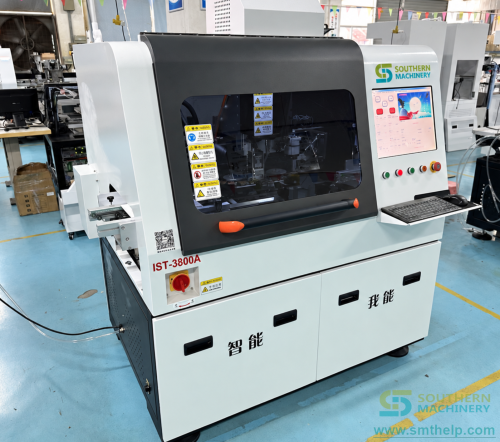
This page answers one narrow question: what does a radial inserter wear parts cost per month, and how should a THT buyer budget for it? According to the Southern Machinery S3000 product documentation, the S3000 radial inserter runs on 100% Universal-compatible wear-and-tear spare parts with a typical monthly usage cost of under US$100, backed by a 1-day spare-part lead time. Those three facts — compatible parts, a stated monthly spend and fast replenishment — turn an acquisition price into a predictable cost of ownership.
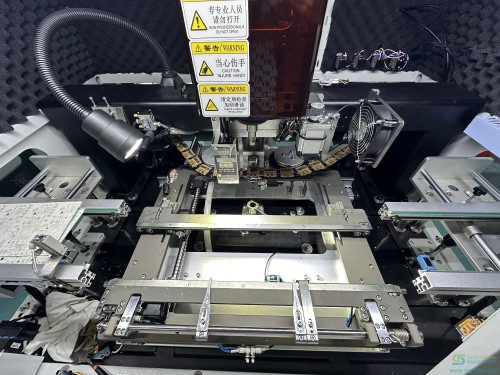
What does an S3000 radial inserter cost to own each month?
The consumable line: under US$100 per month, as stated in the datasheet
The S3000 documentation states that the machine uses "100% Universal-compatible wear-and-tear spare parts, with a typical monthly usage cost of under $100". The product page value strip repeats the same figure — "$100 / month … about half the competitor investment" — and the FAQ adds that Southern Machinery stocks spares with a 1-day lead time. Treat that as the manufacturer's stated figure for a typical configuration, not a quoted contract price: component mix, feeder count and shift pattern decide the real number, so confirm the parts list and pricing before the figure goes into a budget.
Spares lead time: one day instead of one week
A parts budget is only half the story; the other half is how long the machine stands still waiting for the part. The same document commits to a 1-day spare-part lead time and 24/7 after-sales guidance, and lists free installation and operator training with the machine. On a two-shift line, every day a worn part is unavailable is up to 16 hours of insertion capacity you cannot bill, so a one-day part turns a week-long hole in the schedule into a same-shift repair (arithmetic derived from the stated lead time).
The acquisition line: half of a comparable integrated inserter, as stated
The documentation states a 50% investment versus comparable inserters with an integrated design, and positions a payback of under one year for typical EMS cases. Both are the manufacturer's stated positioning for the configured machine. Neither is a guaranteed return, and neither replaces your own board-level calculation; the worked example below shows which inputs you supply yourself.
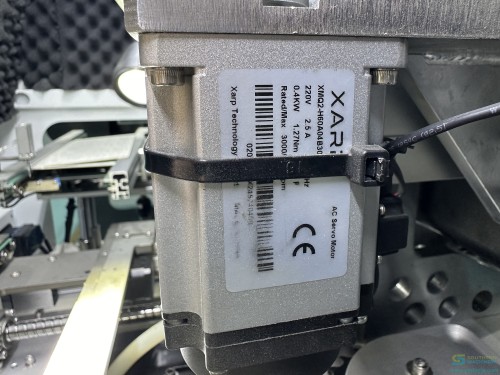
Which ownership costs are routinely underestimated before installation?
Manual insertion labour that disappears with the machine
The document is blunt about the manual baseline: "A skilled operator places only a few hundred radial parts per hour. Output rises with headcount, and headcount is getting harder to find." Against that, the S3000 is documented at 10,000 CPH actual production speed against a 20,000 CPH specification — and Southern Machinery states that it quotes the actual number so line planning stays realistic. The document summarises the change as "a machine replaces a team of hands".
Polarity errors that only surface at electrical test
Radial parts are polarised. In the document's own wording, "a reversed capacitor or transistor looks right to the eye and fails only at electrical test — rework and scrap you never see coming". Vision-assisted coordinate correction with servo positioning removes that failure mode at the source, which matters more than the parts budget in a high-mix EMS environment.
Turnover, 5S discipline and traceability
Three further manual-stage costs the document names directly: night shifts and seasonal workers re-introduce the mistakes the process was designed to prevent; reels, loose components and tape tails spread across workstations and fail customer audits; and manual insertion cannot document which part went where, when. None of those appear in a parts budget.
Which parameters drive the S3000 parts and tooling budget?
Use this checklist when you build the request for quotation; every value comes from the S3000 datasheet and product documentation.
- Insertable components: capacitors, transistors, triodes and standard radial (vertical) tape-packaged electronic components
- Component lead spans: 2.5 / 3.5 / 5.0 / 7.5 / 10.0 mm, with dual, triple and quad-span tooling
- Component envelope: maximum height 20 mm, maximum body diameter 13 mm, maximum lead diameter 0.7 mm
- Lead trimming: 1.5 ± 0.3 mm with the short blade, 2.0 ± 0.3 mm with the long blade
- Lead bend: 10-15 degrees, adjustable
- Speed: 20,000 CPH specification versus 10,000 CPH actual production speed
- PCB range: 50 x 50 mm up to 400 x 300 mm, thickness 0.79-2.36 mm
- Feeders: 10 stations in the recommended configuration
- Utilities: 220 V 50 Hz, compressed air 0.6-0.8 MPa, with a built-in air storage tank and a built-in 3 KVA regulator
- Footprint and weight: 1700 x 1500 x 1600 mm, 880 kg
- Control: colour touchscreen HMI with physical start/stop controls
- Stated service terms: under US$100 per month of Universal-compatible wear parts, 1-day spare-part lead time, 24/7 support, free installation and operator training
- Not specified in source - contact Southern Machinery to confirm: energy consumption per board, air consumption per cycle, the spare-part price list, and local labour rates
One numbering caveat belongs in the evaluation. The factory reference sheet for the same inline platform lists higher peak figures — up to 19,000 PCS/H and a 410 x 510 mm board class — while the datasheet quotes 20,000 CPH specification and 10,000 CPH actual on a 400 x 300 mm board. Question the source of every throughput number you are handed, including ours.
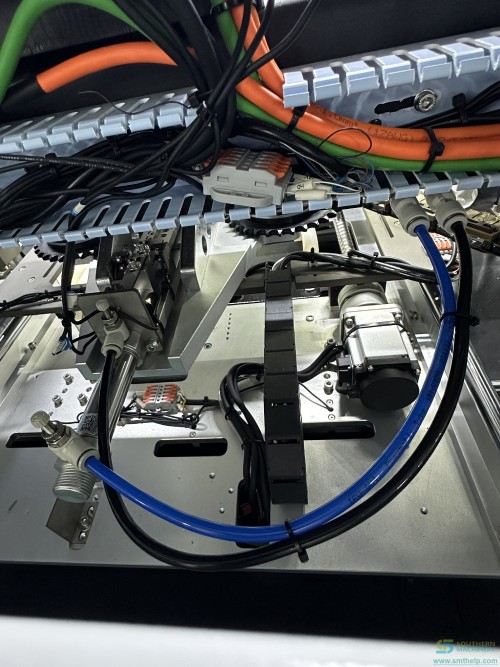
How does the S3000 connect to the rest of the line?
A radial inserter is one station, not a line. In a typical through-hole sequence the S3000 sits after the SMT stage — SMT line equipment covers stencil printing, placement and reflow — and before wave soldering, which solders the clinched leads. THT auto insertion equipment covers the insertion stage itself, and board handling systems move panels between the stations.
The documentation confirms the S3000 can be configured for online/inline production with an optional PCB loader/unloader and a T-type material station that keeps reels at the machine. If you are replanning the floor rather than adding one station, start from the complete PCB assembly line overview and the machine catalog at file.autoinsertion.com.
What does the ROI calculation actually look like?
Ownership cost and payback are separate formulas: one you can write down today, the other needs inputs only your factory has.
Monthly ownership cost = wear-part spend + spares holding + planned maintenance time + utilities + operator time
Payback (months) = machine investment / (monthly labour hours avoided x loaded hourly rate + monthly scrap avoided - monthly consumable spend)
Worked example - example only, depends on configuration, subject to final technical confirmation:
- Documented: 10,000 CPH actual production speed. A board carrying 200 radial components therefore needs 200 / 10,000 hours, about 1.2 minutes of machine insertion time (derived).
- Documented: manual placement runs at "a few hundred radial parts per hour". Assuming 300 parts per hour, the same board needs about 40 minutes of hand work (derived from an assumed operator rate).
- Derived saving: roughly 0.65 labour hours per board. At 500 boards per month that is about 325 labour hours a month, in the order of two full-time operators.
- Deduction: under US$100 per month of Universal-compatible wear parts, as stated in the documentation.
- Supplied by you: machine investment, loaded hourly labour rate, and scrap or rework avoided. The source document states none of these — contact Southern Machinery to confirm them for your configuration.
- Illustration only: at a loaded rate of US$10 per hour the labour line alone is about US$3,250 per month, before any scrap or rework saving.
FAQ
How much do S3000 radial inserter wear parts cost per month?
The S3000 documentation states a typical monthly usage cost of under US$100 on 100% Universal-compatible wear-and-tear spare parts — a stated figure for a typical configuration, so confirm the parts list and the pricing against your own component mix.
Are the spare parts original or compatible?
The S3000 is documented as using 100% Universal-compatible wear-and-tear spare parts. Beyond price, compatibility shortens the sourcing path for every element the machine consumes as it wears.
How quickly can spares be delivered?
The documentation states a 1-day spare-part lead time, alongside 24/7 after-sales guidance and free installation and training.
Should I plan the line around 20,000 CPH?
No. 20,000 CPH is the specification figure; the documented actual production speed is 10,000 CPH, and Southern Machinery states that it quotes the actual number so line planning is realistic.
Can the S3000 run inline?
Yes. The machine can be configured for online/inline production with an optional PCB loader/unloader and a T-type material station that saves floor space.
What utilities does the S3000 need?
220 V, 50 Hz power and compressed air at 0.6-0.8 MPa, with a built-in air storage tank and a built-in 3 KVA regulator to stabilise both. Energy and air consumption per board are not specified in the source.
Next step: price the consumables, then price the machine
Send your board sizes, component mix and monthly volume for a configuration, quotation and delivery schedule; both are documented as returned within 24 hours. Ask for the wear-parts list, the 1-day spares commitment in writing, and the optional inline configuration on your line. Request a quote, read the frequently asked questions, or contact Southern Machinery. Founded in 2011 in Shenzhen and serving 237+ global customers, Southern Machinery builds SMT, THT, wave soldering, board handling and inspection equipment as complete PCB assembly line solutions, with global spare-parts support and operator training.
Comments