
S120 Wave Unloader: Automating PCB Outfeed After Wave Soldering
The S120 wave unloader takes PCBA off the wave soldering exit and feeds the next machine automatically, so boards stop being moved by hand after soldering.
Sep 22, 2026 · Updated Sep 22, 2026 · Southern Machinery
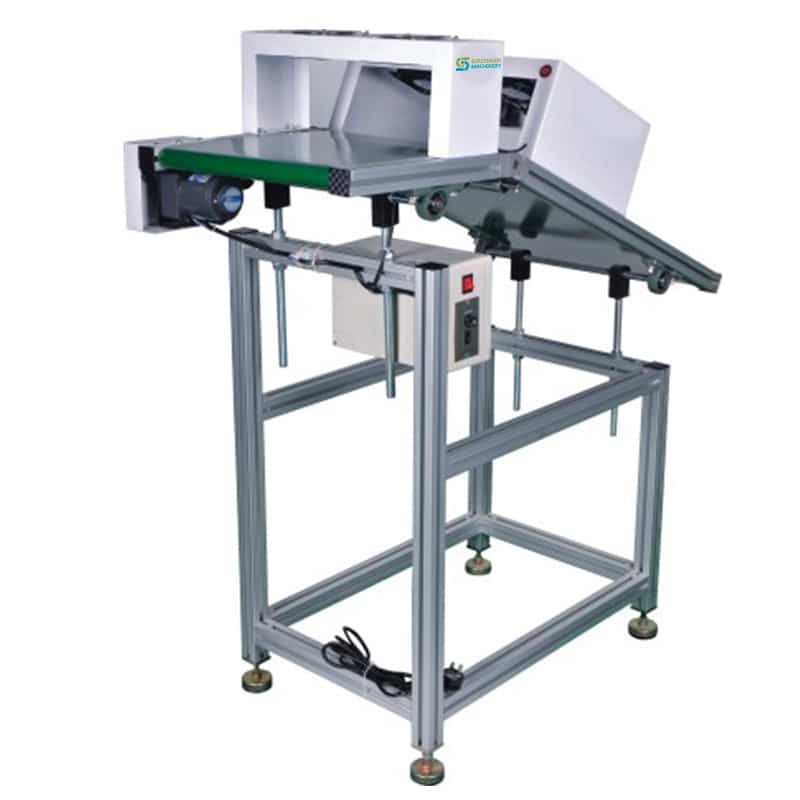
S120 Wave Unloader: Automating PCB Outfeed After Wave Soldering
By the time a board leaves a Wave Soldering machine, most of its value has already been added. Every component is placed, every joint is formed, and the assembly is at its most expensive point in the entire process. That is precisely the moment when most factories are still handling it by hand.
The S120 Wave Unloader is Southern Machinery's powered outfeed conveyor for the back end of a Wave Soldering line. Its published job description is one sentence long, and it is worth reading literally: "This equipment is used for connection between the wave soldering and guide PCBA delivery."
In plain engineering terms, the S120 is the bridge that carries a finished PCBA from the Wave Soldering exit to the next machine in the line — under controlled conveyor power, without an operator lifting it.
What is the S120 Wave Unloader used for?
Short answer: the S120 transports PCBA boards away from the Wave Soldering output and delivers them to the next process step on an adjustable-speed conveyor.
Longer answer. After Wave Soldering, a board still has to reach AOI, a depaneling machine, a magazine unloader, a cleaning station, or a review bench. On many THT lines that transfer is done by an operator who reaches into the machine exit, lifts a hot board, and sets it down on the next conveyor or into a stack. The S120 replaces that manual step with a motorised conveyor segment that:
- accepts the board at the Wave Soldering exit,
- moves it at an adjustable speed,
- and hands it off to the downstream machine at the correct transfer height.
Because the board never enters a manual handling path, the S120 removes one of the most common causes of post-soldering handling damage: uncontrolled human contact with a freshly soldered assembly.
Two configuration decisions that are locked in at order stage
The published specification contains two choices that are normally fixed when the machine is ordered, and that are expensive to change afterwards:
- Transport direction — L→R or R→L. The S120 is built for either direction, but the direction must be specified up front to match your line layout and the exit side of your existing Wave Soldering machine.
- Track fixed side — front side fixed. The fixed rail is on the front. If your line references boards to the rear rail, this must be confirmed with Southern Machinery before the machine is built, because it affects the rail position of every machine downstream.
Published specifications of the S120 Wave Unloader
The table below is reproduced from Southern Machinery's published product page. No value has been estimated, extrapolated, or filled in from a similar model.
| Parameter | Published value |
|---|---|
| Description | This equipment is used for connection between the wave soldering and guide PCBA delivery |
| Frame | 40×40 iron square (or aluminum profile) |
| Power source | 220VAC |
| Track fixed side | Front side fixed |
| Conveyor speed | One piece per 5–15 seconds |
| Surface treatment | Powder coating ivory white |
| Transmission type | 25W regulated speed motor |
| Transport direction | L→R or R→L |
Published features
- Solid and stable design.
- Iron square tube framework, powder coating on the surface — or all-aluminium framework.
- Transmission speed and height adjustable.
- 25W ZD speed motor.
Reading the conveyor speed figure. "One piece per 5–15 seconds" is a transfer rate, not a soldering rate. It describes how fast the S120 passes a board from one machine to the next. Dividing the published figure gives a transfer envelope of roughly 4 to 12 boards per minute of outfeed capacity — a number worth comparing against your Wave Soldering takt time before you assume the outfeed can keep up.
Reading the "height adjustable" feature. Adjustable conveyor height is what allows the S120 to sit between machines of different transfer heights without a mechanical adapter. On a THT line, transfer height mismatch between the Wave Soldering exit and the next machine is a frequent source of board jam and edge damage, so this adjustment is a practical requirement rather than a convenience.
Reading the frame and surface treatment. A 40×40 iron square tube frame with powder coating, or an all-aluminium frame, is a construction statement: it is a rigid, stable conveyor section intended to hold alignment under continuous production, and to be cleanable in a standard SMT/THT shop-floor environment.
What Southern Machinery does not publish on this page
Transparency is more useful to a buyer than a longer spec sheet. The published S120 page does not state:
- the supported PCB width or board size envelope,
- machine footprint and weight,
- SMEMA communication interface details,
- an anti-static / ESD construction specification,
- fixed-rail position options beyond front-side fixed.
These are legitimate engineering questions. Rather than invent plausible numbers, we flag them: if any of them is decision-critical for your line, request the values in writing from Southern Machinery before you order. Doing so is normal practice and it is how you avoid discovering a rail-position or board-width mismatch after the machine has been built.
Why outfeed handling is a quality decision, not a logistics detail
1. The assembly is thermally and mechanically at its most sensitive at the exit
Lead-free SAC alloys solidify in the region of 217 °C. A board leaving the Wave Soldering exit is therefore still shedding heat, and its joints have only recently transitioned from liquid to solid. Any outfeed design that holds, drops, or stacks boards abruptly during that window risks stressing joints and warping thin laminates. A powered conveyor that carries the board on rails, at a controlled speed and a matched transfer height, is the mechanically gentle option.
The S120's published function is transport, not active cooling. If your process requires controlled cooling before the board is touched or stacked, treat that as a separate line requirement and raise it during configuration discussions.
2. Manual removal is an uncontrolled force event
An operator lifting a board out of a machine exit applies force at an angle, at a speed, and at a point that varies from board to board and shift to shift. Multiply that by every board on every shift and it becomes a variable you cannot characterise. Rail-based transfer removes the variable: the board position, transfer height and conveyor speed are the same for board 1 and board 100,000.
3. Transfer consistency sets the ceiling for downstream inspection
If boards arrive at an AOI station at inconsistent positions, the inspection system has to work harder to locate them, and false calls rise. A conveyor segment that delivers boards at a repeatable position and height makes the downstream machine's job easier. This is one of the least discussed and most reliable quality gains from automating the line ends.
Typical applications
The S120 fits any line where Wave Soldering output currently ends in a manual tray or an operator's hands. Southern Machinery's served industries that most often need this outfeed arrangement include:
- Power supply and ballast manufacturing — vehicle power supplies, energy-saving power supplies, ballasts.
- LED lighting — LED drivers, lighting boards, luminous-character and control boards.
- Electrical appliances — air conditioner, television, microwave, electric kettle and induction cooker control PCBA.
- Automotive electronics — car audio and in-vehicle power electronics.
- Energy-saving lighting — industrial, outdoor, street lamp and floodlight assemblies.
- General electronics — instruments, watches and spare-part boards.
In each of these, the Wave Soldering line is followed by inspection, depaneling or magazine unloading, and the S120 is the segment that connects those two ends together.
How the S120 integrates into a complete PCB assembly line
A THT / Wave Soldering line that uses an S120 typically follows this sequence:
| Line section | Representative equipment |
|---|---|
| Line entry | S-V500 bare board vacuum loader, SLC460 / SBU460 bare board destacker line loader, SLD460 line loader |
| SMT section | Stencil printer → SPI → Pick and Place → Reflow Oven → AOI |
| THT section | Radial / axial / odd-form insertion machines → S100B selective soldering, or S-WS450 / S-WS350B Wave Soldering |
| Outfeed | S120 Wave Unloader → QC unloader (SBH390 / SBH460) → depaneling → SUL-390 magazine unloader |
| Custom routing | SUB610 / SUB650 output custom conveyors, S-350C buffer conveyor, SPD330 shuttle conveyor, S-460 90° turning conveyor |
Southern Machinery supplies equipment on both sides of the S120, which matters more than it sounds: when the Wave Soldering machine and the outfeed conveyor come from the same supplier, transfer height, rail reference and handshake behaviour can be resolved during configuration instead of on your shop floor.
The S120 can also be used to feed a review station where operators inspect joints, or to bridge a Wave Soldering section to a PCBA cleaning machine. Where the downstream machine needs boards every few seconds rather than continuously, the adjustable conveyor speed is what you tune.
Key selection parameters to confirm before ordering
Use this checklist when you request a quotation. Exact values must come from Southern Machinery — the categories below are what you need to have answers for.
Board handling envelope - PCB width range, and minimum / maximum board length - PCB thickness range - Board weight - Whether pallets, carriers or bare boards pass through this section, and their dimensions
Interface and mechanics - Fixed rail side versus your line's board reference edge - Transport direction (L→R or R→L) and the exit side of your Wave Soldering machine - Conveyor height, and the transfer heights of the machines immediately upstream and downstream - SMEMA or other handshake protocol required by your line controller - Conveyor speed range needed to match your takt time — check it against the published one-piece-per-5–15-seconds figure
Electrical and environment - Supply voltage and phase (published: 220VAC — confirm against your facility) - Compressed air requirement, if any - ESD / anti-static requirement for your product class - Cleanroom or controlled-environment requirement
Documentation and after-sales - Spare parts list and wear items (belts, drive motor) - Warranty terms - Commissioning, training and remote diagnostic support
ROI, quality and throughput angle
Labour. A powered outfeed replaces a standing handling task at the end of the line. Southern Machinery publishes that its automation equipment typically pays back within 6–12 months; that figure is the company's own published guidance, and it will vary with your shift pattern, labour rate and board mix. What makes the S120 an easy case in that calculation is that it does not require a new process — it simply takes over a transfer that already happens.
Quality. The quality case rests on repeatability. Conveyor speed and transfer height are machine settings, so they are identical for every board. A manual lift is not. On THT assemblies where joint integrity and board flatness are customer-visible requirements, that difference shows up in returns and rework rather than in a line-side metric.
Throughput. The published transfer envelope of one board every 5–15 seconds gives you a clear upper bound for comparing the outfeed against Wave Soldering output and against the takt time of the downstream machine. If the downstream machine is the constraint, the outfeed should not be.
Capital efficiency. The S120 is a single conveyor segment, not a new line. It upgrades the weakest link at the exit without touching the soldering process, which keeps the project small enough to fit a normal capital budget and the validation effort proportionate.
FAQ
What does the S120 Wave Unloader do?
The S120 is a powered outfeed conveyor that connects a Wave Soldering machine to the next downstream process. Its published purpose is "connection between the wave soldering and guide PCBA delivery" — it accepts boards at the soldering exit and transports them, at adjustable speed and height, to the next machine in the line.
What are the S120's published technical specifications?
Frame: 40×40 iron square or aluminum profile. Power source: 220VAC. Track fixed side: front side fixed. Conveyor speed: one piece per 5–15 seconds. Surface treatment: powder coating, ivory white. Transmission type: 25W regulated speed motor. Transport direction: L→R or R→L. Published features include a solid, stable design, an iron square tube framework with either powder-coated or all-aluminium construction, and adjustable transmission speed and height.
Do I need a Wave Unloader if my line is short?
If the machine immediately after your Wave Soldering exit is physically adjacent and boards can be transferred with a matching conveyor segment, a short line may only need a transfer conveyor rather than a dedicated unloader. The decision point is whether boards are currently being moved by hand, dropped into a tray, or stacked between the two machines. If any of those is true, automating the transfer removes a handling risk that is difficult to control in any other way.
Can the S120 run right-to-left?
Yes. The published specification lists transport direction as L→R or R→L. Direction must be specified when the machine is ordered so that it matches the exit side of your Wave Soldering machine and your line layout.
Is the S120 SMEMA compatible?
SMEMA interface details are not published on the S120 product page. Rather than assume compliance, confirm the required handshake protocol with Southern Machinery against your line controller's specification. This is one of the parameters to have settled in writing before the order is released.
What information do I need to send to get an S120 configuration recommendation?
Send: your PCB width range and thickness, board weight, whether you run pallets or carriers, the transport direction and rail reference side of your line, the transfer heights of the machines immediately upstream and downstream, your required takt time, your supply voltage, and any ESD, SMEMA or cleanroom requirement. With those details Southern Machinery can confirm the S120 configuration — or tell you if a different outfeed or transfer conveyor is the better fit.
Get a configuration recommendation from Southern Machinery
Southern Machinery (Shenzhen Southern Machinery Sales And Service Co., Ltd) was established in March 2011 in Shenzhen, Guangdong, China. The company designs and manufactures SMT and auto-insertion machines, and supplies full service support and spare parts for electronics manufacturing and PCB assembly. Its technical team has more than 20 years of industry experience, and its equipment is exported across North America, Europe, Latin America and Southeast Asia, serving 237+ global customers.
Beyond a single conveyor, Southern Machinery can configure SMT, THT, Wave Soldering, board handling and inspection into one complete PCB assembly line — which is the practical reason to talk to the same supplier about both the soldering machine and what happens immediately after it.
To get a configuration recommendation for your line:
- Email: jasonwu@smthelp.com
- Phone / WhatsApp: +86 13602562576
- Equipment catalog and PDFs: file.autoinsertion.com
- Machine photos: ph.smthelp.com
- Website: www.smthelp.com
Published service commitments include a response to enquiries within 2 hours, a quotation the same day, and warranty on all spare parts and equipment. Send your board dimensions, line layout and takt time, and we will come back with the outfeed configuration that matches — or tell you honestly that you need something else.
Comments