
S-V500 Bare Board Vacuum Loader by Southern Machinery: Automated SMT Board Feeding
S-V500 bare board vacuum loader by Southern Machinery: vacuum board transfer, 100-board buffer, selectable pitch. Verified line-fit specs for SMT loading.
Sep 13, 2026 · Updated Sep 13, 2026 · Southern Machinery

S-V500 Bare Board Vacuum Loader: Automated Bare Board Feeding for SMT and THT Lines
Every SMT line starts the same way: bare PCBs have to reach the conveyor, in the correct orientation, at the correct pitch, without being scratched, dropped, or hand-stacked. The S-V500 Bare Board Vacuum Loader from Southern Machinery is the board-handling module that does exactly that — it keeps a working store of bare boards on the machine and feeds them into the line automatically instead of asking an operator to stack and unstack boards all shift.
Southern Machinery (Shenzhen, China, est. 2011) designs and manufactures SMT and THT PCB assembly automation equipment and has served 237+ customers worldwide. The S-V500 sits inside its board handling family alongside magazine loaders and unloaders, buffers, turnover machines, and conveyors — so a line can be sourced as one integrated solution rather than a collection of unrelated machines.
What Is the S-V500 Bare Board Vacuum Loader Used For?
Q: What does a bare board vacuum loader actually do?
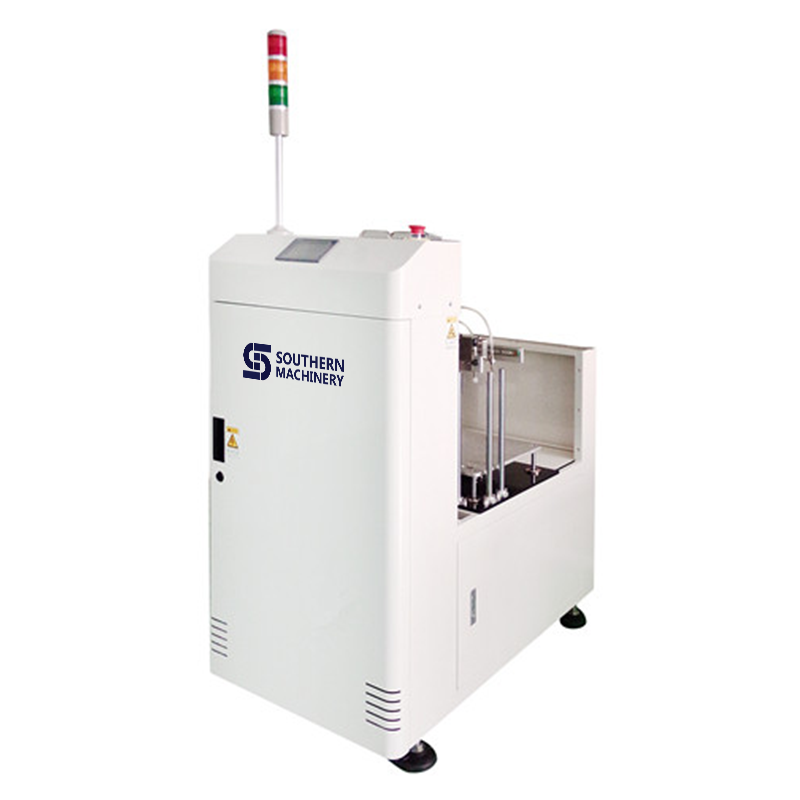
A bare board vacuum loader is an inline loading module for bare (unpopulated) PCBs. Instead of an operator pulling boards out of a magazine or sliding a stack onto the conveyor, the S-V500 holds the boards in its own onboard store and uses vacuum transfer to move them onto the line one at a time, at a selectable pitch, so the downstream machine receives product at a steady rhythm.
The S-V500 is a loader — not a printer, placer, or soldering machine. Its job is to remove the first manual touch point of the line, protect bare boards from handling damage, and keep a small buffer of boards available so the stencil printer or Pick and Place machine never starves while an operator is performing another task.
Typical duty: load bare boards at a controlled rate, hold a buffer of up to 100 boards, and repeat for the whole production run without a dedicated operator standing at the line head.
Verified S-V500 Specification Snapshot
The values below are taken from the official S-V500 product page on smthelp.com. They are the machine's published configuration — confirm your own board envelope and line height against them before ordering.
| Parameter | S-V500 specification |
|---|---|
| Model | S-V500 |
| Machine dimensions | L 810 x W 810 x H 1460 mm |
| PCB size | L 500 x W 390 mm |
| Maximum boards stored | 100 PCS |
| Transfer height | 900 ± 20 mm |
| Transfer direction | Left to right or right to left |
| Conveyor speed | 9 m/min |
| Pitch selection | 10, 20, 30, 40, 50 |
| Control system | PLC programmable controller |
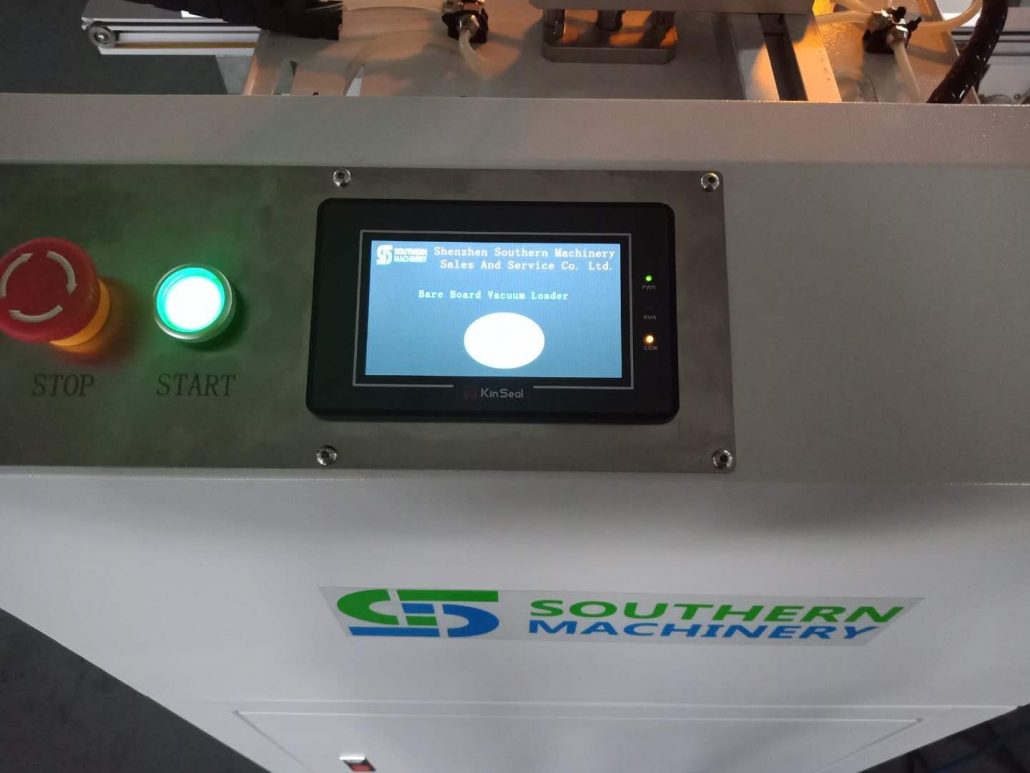
| Operator interface | Touch screen display control panel |
| Power supply | Single phase 220 V, 50 Hz |
| Air supply | 0.4 – 0.6 MPa |
| Machine weight | Approx. 150 kg |
Typical Application Scenarios
SMT line front end
The most common placement is immediately before the solder paste printer or stencil printer. Bare boards are loaded at line speed so the printer is fed continuously instead of in operator-sized batches, which smooths the print cycle and reduces idle time.
Mixed-technology SMT + THT lines
On lines that combine SMT placement with a THT (through-hole) insertion stage and Wave Soldering, bare boards often arrive at the line head in unpopulated form. Loading them automatically keeps the manual handling risk at the very start of the process, where boards are still unprotected.
EMS and ODM high-mix production
Contract manufacturers change board types frequently. A loader with its own buffering capacity lets planners stage the next product's bare boards while the current build finishes, cutting the dead time between changeovers.
LED lighting, power supply, and appliance electronics
These product families typically run large, rectangular boards — the S-V500's 500 x 390 mm board envelope and 9 m/min transport suit panel sizes common in LED lighting, power supply, ballast, and appliance control boards.
Long panels and conveyor-linked cells
Where bare boards must travel between two joined machines or an L-shaped line layout, a loader with selectable transfer direction (left-to-right or right-to-left) removes the need for an operator to bridge the gap.
How the S-V500 Connects into a Complete PCB Assembly Line
In a typical automated flow, the S-V500 is the first module:
- The S-V500 loads bare boards from its onboard store onto the line conveyor at the selected pitch.
- Boards move into the solder paste printer / stencil printer for printing.
- The Pick and Place machine places SMD components, followed by the Reflow Oven and AOI or SPI inspection.
- For mixed-technology products, boards continue to the THT side for radial, axial, or odd-form auto insertion.
- Boards pass through fluxing and Wave Soldering, then to post-solder cleaning, lead cutting, depaneling, and final inspection.
- A magazine unloader, NG/OK unloader, or buffer collects finished PCBs.
Because Southern Machinery builds the whole chain — loaders and unloaders, conveyors, buffers, turnover machines, printers, Pick and Place, Reflow Ovens, Wave Soldering machines, auto insertion machines, cleaning, and inspection — the S-V500 can be specified as part of one line design instead of being retrofitted into equipment from several vendors.
Key Selection Parameters for Buyers
Machine dimensions and storage numbers are only half of a loading decision. Before requesting a quotation, confirm these points with the supplier and with your own process engineers:
- Board envelope: your largest and smallest panel. The published S-V500 PCB size is L 500 x W 390 mm — verify against your current and planned products.
- Buffering requirement: how many bare boards must the machine hold to bridge a changeover or an operator break? The S-V500 stores up to 100 PCS.
- Line transfer height: must match adjacent machines. S-V500 standard is 900 ± 20 mm.
- Transfer direction: left-to-right or right-to-left, to match your layout.
- Feed pitch and cadence: the S-V500 offers 10, 20, 30, 40, 50 pitch selection at 9 m/min transport — confirm this matches the cycle time of the machine it feeds.
- Conveyor interface: confirm the handshake and connector type used by the equipment immediately downstream (SMEMA is the usual standard in SMT lines — ask specifically, because signalling conventions differ between machine generations).
- Board thickness and material: thin FR4, FPC, and metal-core boards behave differently in any transport system; state your stack-up.
- House power and air: single phase 220 V / 50 Hz and a 0.4 – 0.6 MPa air supply must be available at the line head.
- Cleanliness and ESD policy: for automotive, medical, and industrial control customers, confirm ESD-safe transport and the cleanliness class your auditors expect.
- Footprint and access: the S-V500 is roughly 810 x 810 mm on the floor, 1460 mm tall — check aisle space, operator access, and maintenance clearance.
ROI, Quality, and Throughput Perspective
Labor
A bare board loader removes one of the most repetitive jobs at the line head. Instead of one person loading boards continuously, that operator can run inspection, material kitting, or a second machine. The saving is not the machine's price divided by a salary — it is the number of shifts you currently staff at the loading position, multiplied by the years you intend to run the line.
Quality
Handling damage on bare boards — chipped edges, scratches, contamination from hands and gloves, and mis-oriented loading — shows up later as solder defects, poor paste release, or placement errors that are expensive to trace back. Vacuum transfer with a defined board envelope removes fingers and manual stacking from the equation at the point where the board has no protective components on it yet.
Throughput
Equipment is only as productive as its input. A loader with onboard buffering means the printer, SPI, and Pick and Place machine downstream see a continuous supply of boards, so they stop waiting for product between batches. On high-mix lines, the biggest gain is usually changeover: staged bare boards let the next job start as soon as the previous one clears.
How to build the business case honestly
Southern Machinery does not publish a generic payback figure, because loading economics depend on your shift pattern, board size, operator wages, and existing downtime. Ask for a configuration review that maps your current manual loading headcount, your bare-board scrap and rework rate, and the idle time at the first machine in the line. Those three numbers, not a brochure claim, tell you whether a loader pays for itself — and Southern Machinery will help you calculate them.
FAQ
Q: What is the S-V500 bare board vacuum loader used for?
A: It automatically loads bare (unpopulated) PCBs into an SMT or THT assembly line. It holds boards in an onboard store and transfers them onto the conveyor using vacuum at a selectable pitch, replacing manual stacking at the line head.
Q: How many boards does the S-V500 hold?
A: The published specification states a maximum store of 100 PCS, with a board envelope of L 500 x W 390 mm.
Q: Does the S-V500 work with existing SMT lines?
A: Yes. It is an inline board handling module with a standard 900 ± 20 mm transfer height, left-to-right or right-to-left direction, single phase 220 V / 50 Hz power, and a 0.4 – 0.6 MPa air requirement. Confirm the downstream handshake convention (commonly SMEMA) with the equipment supplier before specifying.
Q: What is the difference between a bare board vacuum loader and a magazine loader?
A: A magazine loader takes PCBs out of a standard magazine rack. A bare board vacuum loader such as the S-V500 stores bare boards on the machine itself and transfers them with vacuum, which suits lines where boards arrive loose or where the operator should not touch unpopulated product.
Q: Which industries use bare board loaders?
A: EMS and ODM factories, automotive and medical electronics, industrial control, LED lighting, power supply, and appliance electronics — anywhere boards are fed into an automated line in volume.
Q: Can Southern Machinery supply the rest of the line as well?
A: Yes. Southern Machinery (Shenzhen, est. 2011) supplies SMT placement, THT auto insertion, Wave Soldering, Reflow Ovens, board handling, cleaning, and inspection equipment, and has served 237+ customers worldwide as a single-line solution provider.
Contact Southern Machinery for a Line-Fit Review
Send your board size range, required buffer quantity, transfer height, direction, and the machine you intend to feed, and Southern Machinery will confirm whether the S-V500 fits — or recommend a different loader from the board handling range.
- Email: jasonwu@smthelp.com (Jason Wu, Co-Founder / Sales & Service Engineer)
- Website: https://www.smthelp.com
- Product catalogs and PDFs: https://file.autoinsertion.com
- Machine pictures and photo albums: https://ph.smthelp.com
- Working videos: Southern Machinery channel on YouTube
Technical figures in this article are taken from the official Southern Machinery S-V500 product page on smthelp.com. No certifications, customer names, prices, or lead times are claimed beyond what Southern Machinery publishes. SMT, THT, PCB, PCBA, CPH, Feeder, Nozzle, Reflow Oven, Wave Soldering, Pick and Place, SPI, AOI, and MES are used in their standard industry meaning.
Comments