
S-TC100 Full Automatic Tin Slag Cleaning Machine: Automating Dross Removal on Wave Solder Pots
The S-TC100 is an automatic tin slag cleaning machine that removes solder dross from wave soldering pots, protecting wave stability and cutting solder waste.
Sep 26, 2026 · Updated Sep 26, 2026 · Southern Machinery
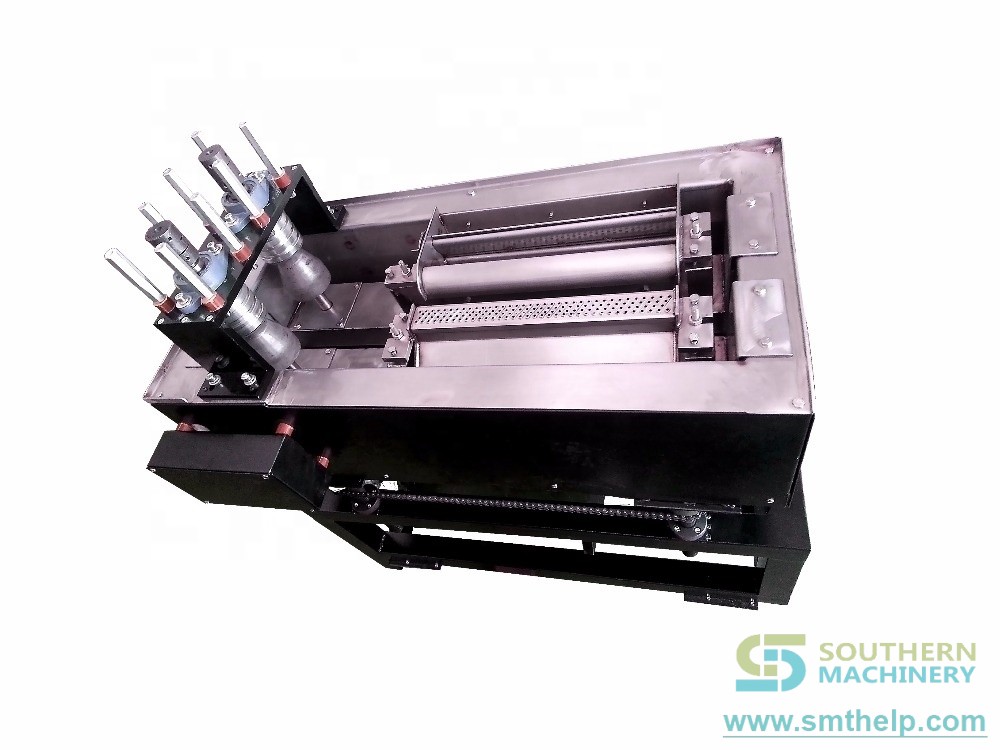
S-TC100 Full Automatic Tin Slag Cleaning Machine: Automating Dross Removal on Wave Solder Pots
Every THT line has a pot of molten solder at its centre, and every one of those pots produces tin slag. Operators skim it by hand, shift after shift, with a steel ladle and a heat-resistant glove. The S-TC100 full automatic tin slag cleaning machine from Southern Machinery is built to take that job off the operator's hands.
The wave soldering solder pot assembly: the surface and the wave are where oxide scale and tin slag build up during production.
What is the S-TC100 tin slag cleaning machine used for?
The S-TC100 is used to clean tin slag — the oxide-rich dross that forms on the surface of a wave soldering solder pot — automatically, instead of by manual skimming.
Southern Machinery describes it as a full automatic tin slag cleaning machine. In practice, that means the machine handles the slag that accumulates on top of molten solder during wave soldering, so the pot stays in a condition where the wave can do its job: a clean, stable wave that wets the pads and does not carry oxide onto the board.
It is a wave soldering support machine, not a soldering machine. It does not replace your wave, selective or dip soldering equipment — it protects the process those machines depend on.
Why tin slag forms in a solder pot
Tin slag — called dross in most Western plants — is what happens when molten solder meets oxygen.
Liquid solder oxidises continuously. Every wave pump cycle, every board entering the wave and every turbulence event at the nozzle exposes fresh molten alloy to air and grows more oxide. Southern Machinery's own published wave soldering process notes describe the mechanism directly: the solder wave surface carries a layer of oxide scale along its length, and a board entering the wave has to break through that skin before good wetting can begin.
The same notes flag what happens when the pot is not maintained:
- Oxide carried through the pump produces rough, sandy-looking solder surfaces.
- A low pot level lets oxide and contamination flow into the pump instead of resting on the surface.
- Oxide accumulation contributes to shorts and bridging — faults that eventually force a pot clean-out and a line stop.
- Solder chemistry drifts. Southern Machinery's published guidance is to test the metal composition inside the pot periodically, at a published interval of every three months, because alloy drift and impurity crystallisation change joint appearance and wetting behaviour.
Air is not the only variable. Wave soldering machines designed with nitrogen capability — such as Southern Machinery's own nitrogen wave soldering platforms — reduce slag formation by holding oxygen away from the pot and the wave. Atmosphere control reduces how much slag forms. Slag removal is what deals with the slag that forms anyway.
What manual slag removal actually costs
Skim the pot by hand and you are accepting four costs, three of which rarely appear on a cost sheet:
| Cost | What it looks like on the floor |
|---|---|
| Molten metal loss | Every ladle of slag is solder alloy you already paid for, leaving the pot as waste |
| Labour | A recurring, non-productive operator task, every shift, on every pot |
| Safety exposure | Operators working directly over molten solder with hand tools |
| Process variation | Skim quality depends on who is on shift and how carefully they work |
There is a fifth, quieter cost: skimming tends to be done when it becomes obvious — usually after the wave has already started to behave badly. Condition-based, mechanised removal keeps the surface in a consistent state rather than reacting to a problem.
What "full automatic" changes
The difference between manual skimming and an automatic tin slag cleaning machine is the difference between a task and a process. A manually skimmed pot is cleaned when an operator decides it needs cleaning. An automatically cleaned pot is treated on a repeatable cycle, with the slag handled the same way every time.
That matters for three reasons:
- Repeatability. The pot surface condition is no longer an operator judgement call.
- Operator protection. Manual slag work over a solder pot is one of the least comfortable jobs on a THT line, and removing it helps retention as well as safety.
- Process stability. A pot kept consistently clear produces a more stable wave, which shows up downstream as fewer bridging and skip-solder defects and less unplanned pot maintenance.
Typical application scenarios
The S-TC100 sits where tin slag is a recurring production issue rather than an occasional annoyance:
- EMS and contract manufacturers running THT or mixed-technology boards through wave soldering across two or three shifts, where skimming labour accumulates quickly.
- Automotive electronics — ECUs, sensors, power and connector boards, where an unstable wave is a field-reliability risk, not just a yield number.
- Medical electronics — long-life assemblies where solder joint consistency supports documented process control.
- Industrial control and power electronics — transformers, relays, large capacitors and connectors that keep wave soldering busy all day.
- LED lighting, power supply and appliance electronics — high-volume, cost-sensitive production where solder consumption and labour both sit directly on the margin.
- Factories running SAC lead-free alloys — lead-free solders run hotter and wet less readily than the old SnPb alloys, so pot condition matters more, not less.
How the S-TC100 fits a complete SMT/THT PCB assembly line
Tin slag cleaning belongs to the soldering stage, so the machine supports the section of the line that runs after SMT placement:
- Solder paste printing — stencil printing, with SPI if the quality gate requires it.
- Pick and place — SMD components placed, then reflow soldering.
- THT insertion — radial, axial, odd-form auto insertion machines plus manual stations for the remaining through-hole parts.
- Fluxing and wave soldering — the solder pot stage, supported by the S-TC100.
- Cleaning and inspection — post-solder cleaning, AOI or AVI, lead cutting and depaneling.
- Board handling — loaders, conveyors, buffers and unloaders keep boards moving between every step.
Because Southern Machinery supplies each of those stages — SMT equipment, THT insertion machines, wave and selective soldering, board handling, cleaning and inspection — the slag-handling question can be planned at line-design stage, alongside the wave soldering machine it supports, rather than treated as a standalone purchase.
Key selection parameters to confirm before quotation
Southern Machinery does not publish a full technical specification table for the S-TC100 on its product page, so treat the points below as the checklist to settle in writing during quotation:
- Solder pot compatibility — the pot size, alloy and wave machine model the cleaner will serve, and whether it operates with the pot in or out of production service.
- Slag handling method — how slag is collected, cooled and discharged, and whether the recovered material is sent for solder recovery or disposal as regulated waste.
- Cleaning cycle and throughput — how often the machine runs, and whether the cycle is scheduled or triggered.
- Footprint and installation — the floor space next to the wave soldering machine, and how the unit is positioned relative to the pot and the operator.
- Utilities — power supply, air and any extraction or fume handling required in your facility.
- Operator interface and safety — controls, guarding and thermal protection for staff working near molten solder.
- Consumables, spares and service — what wears, what is stocked, and what response time you are contracting for.
- Integration with your ESG and waste reporting — how slag volumes and disposal are recorded for environmental reporting.
ROI, quality and throughput perspective
The business case for mechanised slag handling rests on four levers, and all four can be measured on your own line before you buy:
- Metal recovery. Slag leaving the pot as waste is alloy you purchased. Reducing how much solder leaves with the slag, and recovering what is economically recoverable, is a direct material saving.
- Labour. Skimming is recurring, non-productive time on every pot, every shift. Removing it frees operator hours for work that adds value.
- Yield protection. A stable, slag-free wave reduces bridging and skip-solder defects, and cuts rework on boards where the added value is already high.
- Uptime. Less oxide entering the pump means less unplanned pot cleaning, less nozzle attention and fewer wave instability stops.
Rather than quote a headline payback figure, the honest approach is to model it with your numbers: solder consumption per shift, slag volume, disposal cost, operator time on skimming, and the defect and rework rate your line currently carries. Southern Machinery builds ROI cases from the customer's own data during the quotation process.
What Southern Machinery does not publish about the S-TC100
Southern Machinery does not publish capacity figures, pot sizes, power ratings, dimensions, weight, certification lists, pricing or delivery lead times for the S-TC100, and this article does not invent them. Those values depend on your pot, your alloy, your wave soldering machine and your final configuration. Ask for them in writing in your quotation, and treat any specification you find elsewhere without a source as unverified.
About Southern Machinery
Founded in 2011 in Shenzhen, China, Southern Machinery (Shenzhen Southern Machinery Sales And Service Co., Ltd) designs and manufactures SMT and THT PCB assembly automation equipment and supports 237+ customers worldwide. The company supplies complete line solutions across SMT, THT insertion, wave and selective soldering, board handling, cleaning and inspection — backed by spare parts, retrofit and upgrade kits, repair services, overhaul and operator training with global support.
FAQ
What is tin slag, and is it the same as dross?
Yes. Tin slag is the term used in many Asian manufacturing environments for solder dross — the oxide-rich paste that forms on the surface of molten solder in a solder pot. Both refer to the same material: oxidised solder and entrained metal that must be removed from the pot.
What does the S-TC100 actually do?
It automatically cleans tin slag from a wave soldering solder pot. Southern Machinery describes it as a full automatic tin slag cleaning machine — a wave soldering support machine that keeps the pot surface clear so the wave stays stable.
Why not just skim the pot by hand?
Manual skimming works, but it costs molten alloy, operator time, and safety exposure over molten solder, and its quality varies by shift and operator. It is also reactive: skimming usually happens after the wave has already started misbehaving.
Does automatic slag cleaning replace nitrogen in a wave soldering machine?
No — they solve different halves of the same problem. Nitrogen capability reduces how much slag forms by limiting oxygen at the pot and wave. Automatic slag cleaning deals with the slag that forms regardless. Many plants use both.
Which production environments benefit most?
High-volume, multi-shift THT and mixed-technology lines where wave soldering runs continuously: EMS and contract manufacturers, automotive and medical electronics, industrial control, power electronics, appliances, power supply and LED lighting assembly.
How do I know whether the S-TC100 suits my pot and my line?
Send Southern Machinery your wave soldering machine model, solder pot details, alloy type, shift pattern and current slag/skimming practice. Southern Machinery will confirm compatibility and configuration options for your line in the quotation.
Next steps
If tin slag is consuming solder, operator time and wave stability on your THT line, talk to Southern Machinery about how the S-TC100 fits your pot and your process:
- Email: jasonwu@smthelp.com
- WhatsApp / phone: +86 13602562576
- Product page: https://www.smthelp.com/s-tc100-full-automatic-tin-slag-cleaning-machine.html
- Catalog and technical documents: https://file.autoinsertion.com
- Machine photos and product albums: https://ph.smthelp.com
Published by Southern Machinery — SMT/THT PCB Assembly Automation Lines, Shenzhen. Established 2011, serving 237+ global EMS, ODM, automotive, medical and industrial electronics manufacturers.
Comments